

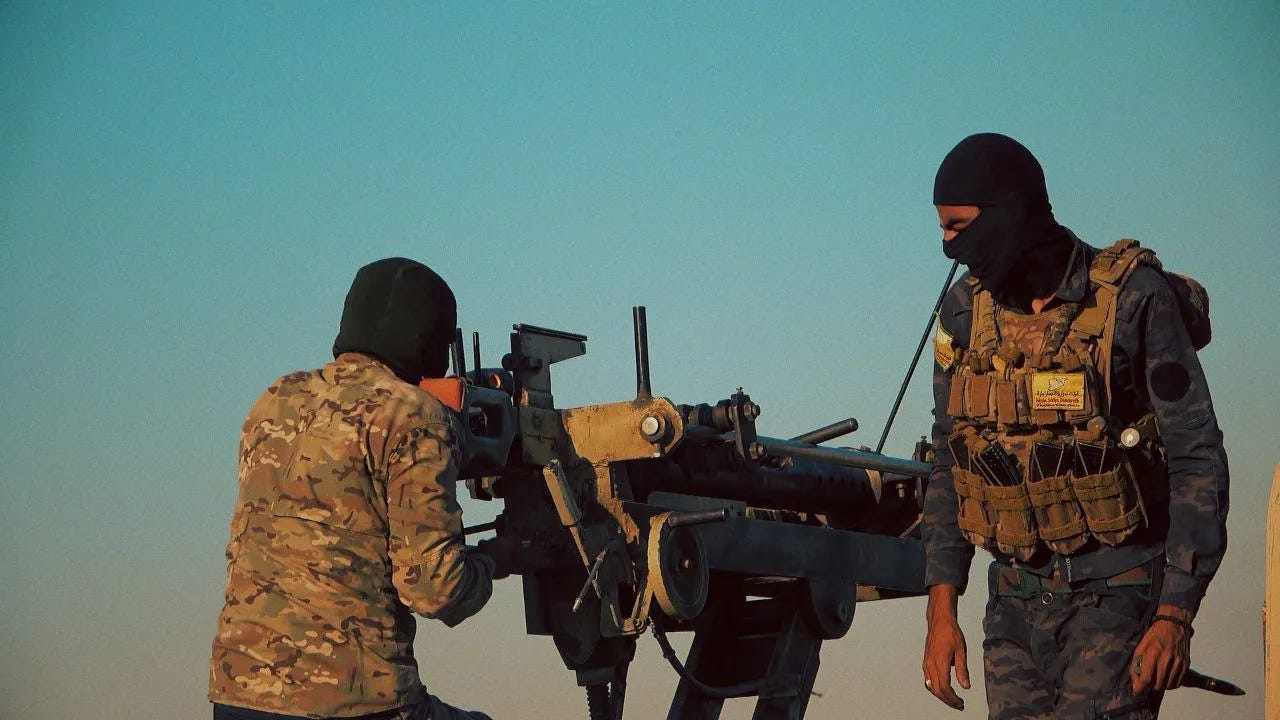
The clashes between the Syrian Arab Army and the Syrian Democratic Forces (SDF) have exposed the fragility of the SDF’s military structure and its organizational weakness despite it being an entity that has existed for nearly a decade, a partner to the international coalition against ISIS, receiving military and logistical support, and controlling regions considered Syria’s breadbasket and important oil resources.
The erosion of SDF influence in its areas of control began in early January when its fighters withdrew from Ashrafiyah and Sheikh Maqsood neighborhoods in Aleppo after three days of clashes with the Syrian Army. It then lost control of the cities of Deir Hafer and Maskanah in eastern Aleppo in less than 24 hours.
Subsequently, the collapse accelerated, and the SDF lost the eastern parts of Deir ez‑Zor and Raqqa in under 48 hours, in clashes with local tribal fighters, residents, and the Syrian Army.
The Army then advanced and seized towns in al‑Hasakah province before the battles halted under a new four‑day ceasefire that went into effect on the evening of January 20. The ceasefire has since been shaky amid mutual accusations of violations, and the Ministry of Defense announced 11 soldiers killed and 25 wounded by SDF attacks.
These losses and ruptures brought back descriptions of the SDF as an “empire on chicken legs,” in the words of Syrian Information Minister Hamzah al‑Mustafa, and a “paper tiger,” according to researchers and experts just before U.S. envoy to Syria Thomas Barak said the SDF’s original purpose as the main force against ISIS on the ground has ended.
The Birth of the SDF and the End of Its Role
The SDF emerged in northeastern Syria in 2015 as a military alliance formed with direct U.S. support, which relied on it as the main ground force in the war against ISIS within the international coalition. Since its founding, Kurdish elements have dominated its leadership and military hierarchy.
The People’s Protection Units (YPG) and the Women’s Protection Units (YPJ) form the backbone of the SDF, comprising the majority of fighters and commanders. The YPG was founded in 2012 as the armed wing of the Democratic Union Party (PYD), considered the Syrian branch of the Kurdistan Workers’ Party (PKK).
The SDF also includes Arab, Kurdish, and Syriac factions, with estimates of its fighters ranging from 40,000 to 60,000 including armed tribal members though the SDF claims up to 100,000, a figure many researchers regard as exaggerated.
The SDF encompasses internal security forces (Asayish), counter‑terrorism units, and regional military councils responsible for protecting areas like Deir ez‑Zor, Manbij, and Raqqa. The Autonomous Administration serves as its civilian face.
In terms of armaments and funding, the SDF received direct military support from the international coalition, including light, medium, and heavy weapons troop carriers, mortars, heavy machine guns plus ammunition and equipment. It also receives annual financial support, most recently $130 million allocated by the U.S. Senate in the 2026 Department of Defense budget for the SDF and the Free Syrian Army.
The SDF’s primary resources come from oil sales, alongside taxes and fees on income, goods, and imports, with a heavy dependence on oil revenue.
The last major battle between ISIS and the SDF, backed by the international coalition, was fought between February 9 and March 23, 2019, in the village of al‑Baghouz in eastern Deir ez‑Zor, ending the group’s geographic control but not eliminating its activity in Syria.
The SDF regularly reports on operations against ISIS cells in its areas, citing, for example, 163 security and military operations in 2025, while claiming ISIS carried out 220 attacks against its forces.
A Record of Combat and Strategic Withdrawals
While the SDF has a history of fighting ISIS -the reason for its formation- its military record shows repeated setbacks, especially against the Turkish‑backed Syrian National Army in operations such as Euphrates Shield (2016), Olive Branch (2018), and Peace Spring (2019).
Turkey repeatedly targets individuals and leaders it deems “terrorists” in SDF‑held areas, viewing the SDF as affiliated with the PKK an organization it and some other states designate as terrorist.
The SDF has not engaged directly with Bashar al‑Assad’s forces or Iranian militias; its ties with the Syrian regime were characterized by shared political and economic interests, and even discussions of integrating the SDF into Syrian forces under specified mechanisms.
After years of praise as the most effective ground partner in defeating ISIS, U.S. envoy Thomas Barak said on January 20 that the SDF’s original purpose has ended, and that Damascus is now prepared and qualified to assume security responsibilities.
Rapid Collapse: A Military Analysis
The fall of Bashar al‑Assad’s regime on December 8, 2024, did not change the military situation in eastern Syria. The SDF remained autonomous, despite the March 10, 2025 agreement to integrate its civil and military institutions into the state an agreement that went unimplemented amid mutual accusations between the government and the SDF.
The Syrian Network for Human Rights documented 65 civilians shot dead by SDF snipers in Aleppo between November 30, 2024, and January 30, 2025, after the city was liberated and regime forces withdrew. Recently, President Ahmad al‑Sharrah noted that the SDF hindered Aggression Deterrence forces entering Aleppo by its presence in Sheikh Maqsood, impeding advancement that spread into Ashrafiyah and Bani Zayd.
Before the latest clashes, there were several skirmishes, security tensions, and mutual accusations, especially in Sheikh Maqsood and Ashrafiyah, halted by coordinated ceasefires negotiated between Defense Minister Marhaf Abu Qasra and SDF Commander Mazloum Abdi seen by researchers as attempts to draw the government into battle and undermine political agreements.
Once fighting began, the SDF’s strength quickly crumbled both in populated neighborhoods and across larger areas like eastern Aleppo, Raqqa, and eastern Deir ez‑Zor. It failed to sustain its positions, contradicting its narrative of enduring capacity.
The SDF’s media director, Farhad Shami, described it as a “military, social, political, and administrative organization,” claiming the new Syrian Army was unprepared to absorb a structured force like it.
A Syrian Army commander involved in operations, speaking on condition of anonymity, told Noon Post that the SDF’s collapse was tied to several military causes, pointing out that true strength is measured by a military structure’s ability to withstand changing conditions a test the SDF failed within days, also citing the lack of cohesion among its units.
He emphasized that Syrian military and security forces took measures to protect civilians, manage evacuations, prevent abuses, identify objectives and sensitive sites, coordinate defections, prioritize peace over combat, and open humanitarian corridors.
Turkish foreign policy and military affairs analyst Ömer Özkizilcik told Noon Post that the rapid SDF collapse means there are no longer forces under that name. He said non‑YPG elements fragmented, leaving the YPG as the sole remaining force, significantly weakened and limited in influence.
According to him, the YPG has not been completely defeated yet its future depends on its stance toward the recent agreement with the Syrian government, whether through implementation and playing a local policing role in Kurdish areas like al‑Hasakah, or repudiation leading to a new military campaign that ends its existence.
Anas Shawakh, political analyst at the Bridges Center for Studies, attributed the dramatic collapse to external and internal factors. Externally, he cited the absence of international coalition air support -the most critical factor- which revealed the true size and strength of the SDF and adversely affected fighters’ morale.
Internally, Shawakh pointed to two main factors: the SDF’s control over predominantly Arab areas like Deir ez‑Zor and Raqqa, where it was seen as an occupying force lacking intrinsic motivation to defend, and the composition of its ranks, heavily Arab recruits who were conscripted or joined for income, limiting genuine military commitment and contributing to its rapid disintegration amid popular and tribal uprisings that dismantled SDF control before the Syrian Army’s arrival.
“Gang‑style” Tactics and Weapon Shortfalls
During the fighting, the SDF used snipers targeting civilians after losing control, deployed Iranian‑made drones, and was accused of striking Aleppo’s municipal palace a claim the SDF denied.
On January 10, the Syrian Army’s Operations Authority said the SDF entered a new escalation phase with more than ten Iranian‑made drones targeting Aleppo, its civil institutions, and mosques. Subsequent reporting revealed drone‑manufacturing sites under its control.
The SDF left many mines in Ashrafiyah and Sheikh Maqsood. Its extensive tunnel networks, dug over years and stretching thousands of kilometers, had limited impact on the battle, and its tank and rocket launcher presence was minimal.
The Syrian commander told Noon Post that the SDF relied primarily on coalition air cover, intelligence, logistical and technical support, and organizational flexibility that made it a hybrid force rather than a trained, organized army. This resulted in heavy weapons being limited in effectiveness and its strength tied to the political‑military environment rather than its own capacities.
Brigadier General Ahmad al‑Aboud, commander of the Second Brigade of the 66th Division in the Syrian Army, told Noon Post that the tunnel networks failed to serve the SDF during battles despite their high cost and advanced engineering, describing the collapse as due to internal factors linked to the absence of real attachment to the land.
Military strategist Brigadier General Abdullah al‑As’ad told Noon Post that the SDF’s roots in the PKK equipped it with guerrilla and sabotage tactics ambushes and assassinations rather than the structured organization and doctrine of conventional armies.
Shawakh reiterated that the strategic weapon of the SDF was the air cover provided by the international coalition the main reason for its endurance in previous years, as shown by its rapid collapse without it.
Regarding armaments, he said that while the SDF had large quantities of weapons due to substantial funding, high‑grade arms were limited to specific groups operating with the coalition in anti‑terror missions roughly two thousand fighters under strict oversight and that more advanced weapons were restricted by Turkish‑U.S. coordination to prevent threats to Turkish national security.
Finally, Shawakh noted that light weapons were less visible in confrontations because the SDF leadership decided -under pressure- that withdrawing from Arab-majority regions was preferable to attempting to defend more effectively in Kurdish areas, particularly in al‑Hasakah, considered its primary base and the origin of most of its activities in Syria.
