
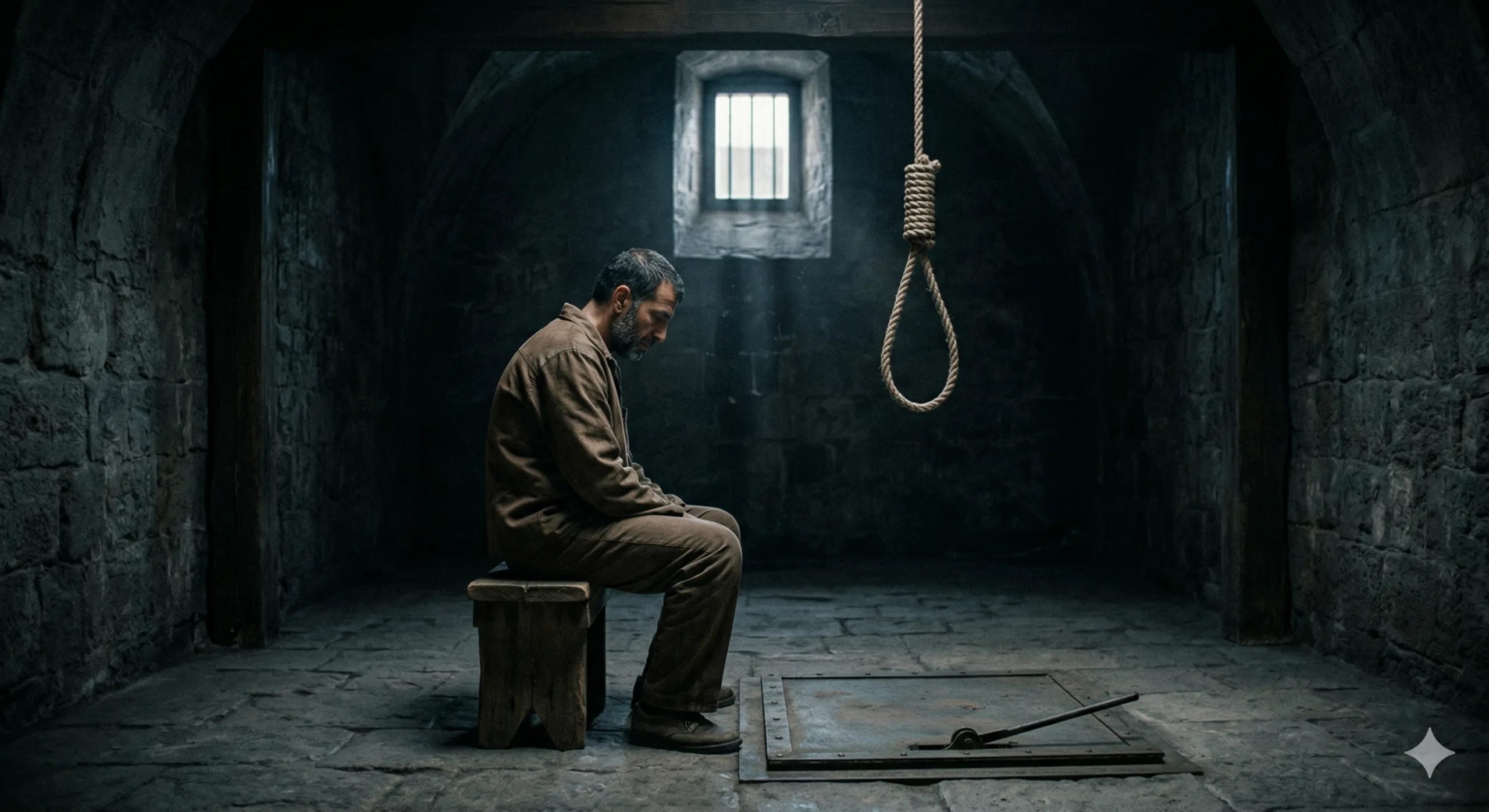
Heavy days weigh on the families of thousands of Palestinian prisoners held in Israeli prisons. Until midweek, their fears centered on torture especially amid mounting reports of dire detention conditions and the harrowing testimonies of released detainees, accounts so severe they are almost beyond belief.
But following the passage of the “death penalty for prisoners” law, their fear has escalated to an even darker level as if what remained was to imagine their loved ones’ necks in the noose.
Under the law passed by the Knesset last Monday, the “crime” punishable by death appears narrowly defined and limited to prisoners meeting specific criteria. Yet families place little faith in either the law or those who enacted it. They fear it may serve as a prelude to mass executions that could ultimately include their sons.
Tears from the Next Room
Outwardly, Aya Mahdi carried on as if nothing had changed scrolling through Facebook, reacting to posts, and watching videos. But inside, she was burning. She is not only the wife of a prisoner; she is also a mother striving to remain composed before her children after they caught wind of the news.
Speaking to Noon Post, she said: “When I read the news, I felt my limbs freeze with fear, and my heart pound as if it would stop. But I didn’t have the luxury of fully processing my anxiety.”
“I tried to hide the news from my four children (aged 3 to 12), but soon I heard my two eldest daughters crying from the next room,” she added.
Their questions came in different forms but carried the same meaning: “Does the execution apply to Dad?” She explained, “I had to act like a mother—so I suppressed my fear and showed indifference. The girls believed me and went to sleep.”
Aya’s husband, Basel, was arrested in November 2023 at a checkpoint separating northern and southern Gaza while the family was fleeing south.
She believes her husband has done nothing that would warrant execution under the new law. Yet she is equally convinced that the Israeli occupation is brutal it needs no justification, and nothing prevents it from executing all prisoners if it chooses, she said.
“Since talk of the law began, I never believed it would actually pass. I thought some party would intervene to stop it. So the news struck me like a lightning bolt and devastated me psychologically.”
Despite the fear and grim reality, hope persists. “Al-Aqsa Mosque has been closed and Islamic countries have not acted. I doubt anyone will move for prisoners who sacrificed their freedom. But even if I lose hope in worldly causes, I do not lose hope in God. I draw strength from my faith and continue to pray. My husband also sent word through his lawyer, praying that God grant me strength in his absence.”
No Charges—Yet I Still Fear
“My son is a nurse. He treated people. Is that a crime that warrants arrest? Why should I fear for his life? Shouldn’t he be released immediately?” asks Jamal Al-Jaish, reflecting on the law and its toll on prisoners’ families.
His son, Majed, was arrested in March 2023 from Al-Shifa Hospital in Gaza while performing his humanitarian duty as a nurse.
In his interview with Noon Post, Jamal said: “The Israeli occupation renews Majed’s administrative detention every six months. He still faces no charges, which should mean there’s no reason to fear for him but we are deeply worried. He is in the hands of an occupying power that acts as it pleases.”
“I worry about all prisoners and pray the death penalty is not applied to any of them. My son is no more precious than anyone else’s,” he added.
Describing his wife’s condition after the law’s approval, he said: “This law has only deepened a sorrow that has not ceased since his arrest. She cries constantly at every moment, with every memory. As for me, I have nothing but prayer. In every prayer, I ask God to return him to me.”
Majed, 26, suffers from health issues and harsh prison conditions, according to his father, who refuses to appeal to any authority. He is convinced that the world has left Palestine and its prisoners alone to face the brutality of the Israeli occupation.
Adding Insult to Injury
A year passed after the arrest of Walid Musbah before he could complete treatment for leukemia. Naturally, he has not received treatment in prison, leaving his health in a fragile state, according to his family via his lawyer.
His wife, Tasneem, said: “We live an extremely difficult life. Our thoughts are consumed by him, and anxiety eats away at us whenever we hear of abuses against prisoners. We wonder what he is enduring and constantly mourn his absence. This was our reality even before the death penalty law so what now?”
“The law has only made things worse, pouring salt into a deep wound that will not heal except with my husband’s freedom,” she added.
“When we heard the news, all we could do was cry and pray. There is nothing we can do to bring our loved ones back.”
Tasneem, a mother of two boys aged 10 and 12, does everything she can to shield them from such news especially the death penalty law. “Their sadness over their father’s arrest is already enough,” she said.
“I don’t know how to process this. My mind is torn between thinking about my husband and his fate, and managing life without him and the heavy responsibilities I carry. I cannot bear to imagine harm coming to him. I want him beside me, sharing life’s burdens.”
She added: “His illness only heightens our anxiety, especially since we know nothing about his condition. But I trust his spirit is strong he has a resilient character and always accepts God’s will.”
Tasneem believes international silence has emboldened the Israeli occupation to pass the law, leaving little hope for global intervention. “There is nothing to rely on except divine justice,” she said.
Holding on to Prayer
When Louay Hassouneh was arrested in November 2024, he was just 18. His young age only deepens his family’s anxiety. They wonder how he endures the horrors described by other prisoners and how he has received news of the law.
His father, Imad Hassouneh, told Noon Post: “Even if my son weren’t imprisoned, this law would have shaken me with grief for the prisoners. So how can I describe my feelings when my own son is one of them?”
“We live in constant anticipation, clinging to scraps of news from released prisoners. When the law was first proposed, our anxiety grew. The decision is devastating and what makes it worse is that we can do nothing.”
Nothing has changed for this father he continues to pray as he did before the law. In every prostration, he repeats: “O God, return him to me safe and victorious.”
He hides his fear behind hope and the absence of charges against his son. “Our hope in God’s mercy is great. So far, no charges have been filed against him, and I am certain the law does not apply to him. Yet I suffer because I feel all prisoners are my sons.”
No Words Suffice
Suzan Abu Matr struggles to speak about the law. Overwhelmed by its weight, she finds no words to express her psychological pain beyond: “God is sufficient for us, and He is the best disposer of affairs. God willing, all prisoners will be freed.”
Her husband, Ahmad Abu Matr, was arrested two months after the outbreak of the war. Since then, she and her daughters have longed for any news of him never imagining that the next news would be this terrifying.
She describes the law as “catastrophic,” yet insists: “For me, hope is greater than fear first because of my faith in God, and also because I know the Israeli occupation has not accused my husband of anything that would warrant execution.”