

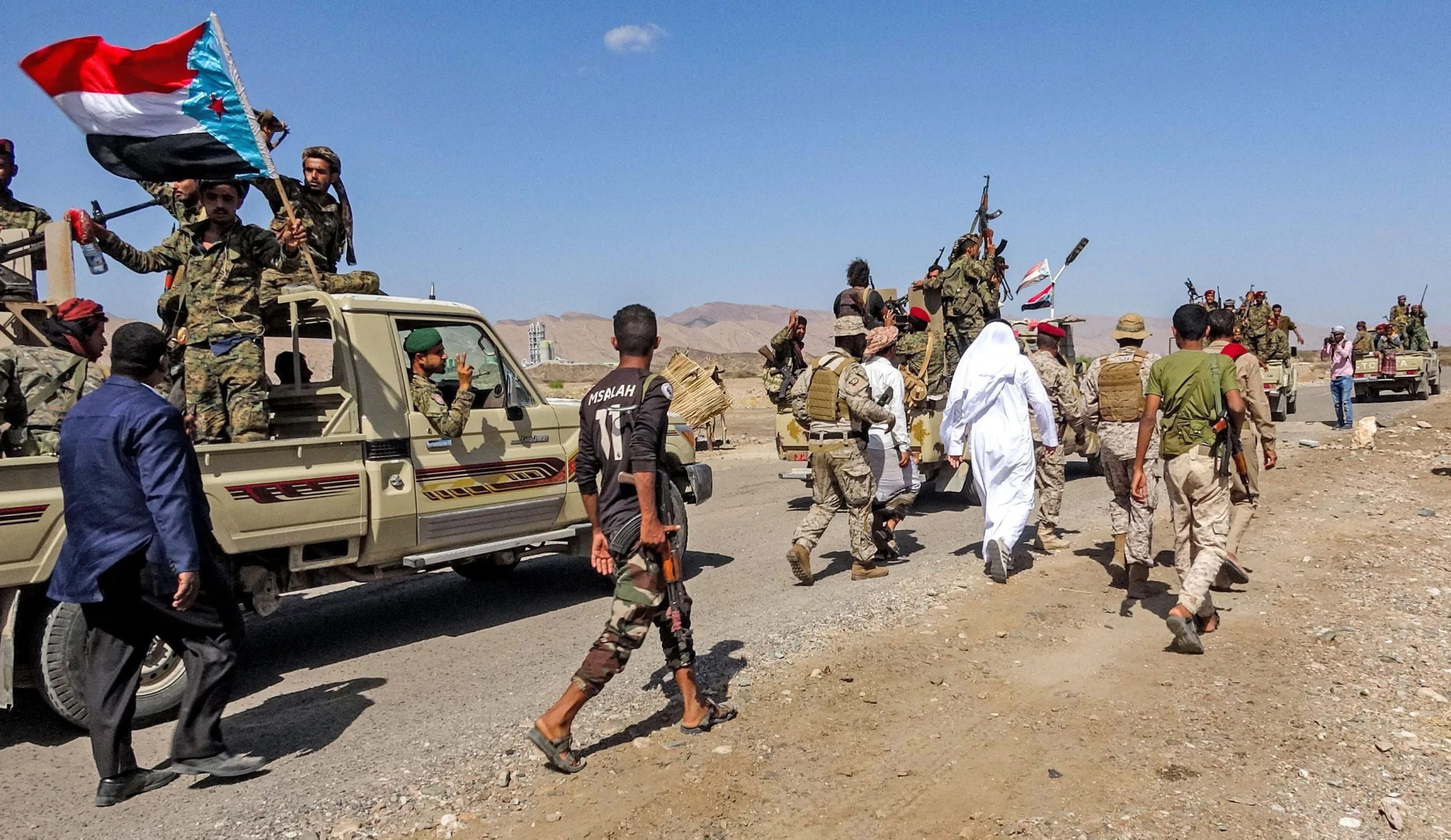
Yemen is entering a pivotal phase marked by an unprecedented convergence of domestic and regional crises. The country stands at the edge of a fundamental shift in the nature of its internal conflict—one that now directly reflects a broader regional rivalry, particularly between Saudi Arabia and the United Arab Emirates. At stake is control over critical areas of influence, strategic ports, and natural resources in southern and eastern Yemen, especially in Hadramawt and Al-Mahrah, along with the vital port city of Aden.
What is unfolding in eastern Yemen signals a departure from being a theater of internal conflict alone it has become a testing ground for regional and international dynamics. Strategic considerations now intertwine with political calculations, and each military, economic, or political move may reorder the priorities of major powers in the region.
This report offers a deep analysis of the future of the Southern Transitional Council (STC), the fragile military balance in Hadramawt, Al-Mahrah, and Aden, the limits of Saudi tolerance, and the potential scenarios if unilateral actions reshape the balance of power in Yemen and beyond.
Contest for Influence and Military Realignment
The disagreement between Saudi Arabia and the UAE over Yemen’s future is no longer a passing tactical divergence; it reveals a deeper strategic rift in visions and interests. While Riyadh is focused on protecting its national security, securing its eastern border, and preventing the rise of armed factions outside the authority of the Yemeni state, Abu Dhabi appears intent on cementing long-term influence through local proxies, chief among them the STC.
In light of recent rapid developments, Brigadier General Abdelghani Al-Zubaidi told Noon Post that talk of the STC repositioning or redeploying its forces is unlikely at this stage. The nature of the current conflict has expanded beyond a bilateral dispute between the STC and Saudi Arabia to encompass a broader Saudi-Emirati competition.
He stressed that both parties are seeking to preserve their influence and field positions as much as possible amid growing regional and international pressure, without any significant changes expected in the near term.
Al-Zubaidi noted that any upcoming military movement might be limited to a partial withdrawal of STC forces toward urban centers, while border areas particularly those adjacent to Saudi Arabia are likely to remain under the control of other groups such as the “Shield of the Nation” forces.
Should a significant redeployment become inevitable, STC units could move toward Abyan, Shabwah, or the southern fringes of Hadramawt, especially near key ports effectively establishing new facts on the ground.
On Aden, Al-Zubaidi emphasized its historic and strategic importance as a central international port. He argued that any genuine development of Aden’s port serves Yemen’s national interests, but suggested there are active regional efforts to obstruct such development, viewing it as direct competition with other ports in the Gulf.
Aden’s geographic position near the Bab al-Mandeb Strait now more strategically vital following recent regional shifts has elevated the city as a coveted and sensitive strategic objective.
He further explained that Shabwah’s real significance lies in its tribal and geographic makeup, rather than in partisan or political weight. The STC’s presence there remains relatively limited, despite UAE influence over the Balhaf port and ongoing efforts to secure local loyalties. Compared to Hadramawt and Al-Mahrah, Shabwah does not carry the same strategic weight in regional calculations.
Al-Zubaidi emphasized that Hadramawt and Al-Mahrah represent vital strategic depth for Saudi Arabia, with deeply rooted historical and social ties. Any incursion by other actors into these provinces is perceived in Riyadh as a red line. While unity discourse is often used in media narratives, strategic and security calculations ultimately drive policy on the ground.
Hadramawt and Al-Mahrah: Yemen’s Eastern Gate
Hadramawt is Yemen’s largest province by area and boasts vast natural resources. It produces about 80% of the country’s oil and includes strategic ports along the Arabian Sea, making it a major revenue source and a powerful bargaining chip in any future political settlement. Its border with Saudi Arabia only magnifies its security importance, placing it squarely at the heart of Saudi-UAE competition for influence.
Researcher Ramah Al-Jabri told Noon Post that Hadramawt and Al-Mahrah, which together comprise Yemen’s eastern gateway, are of strategic significance not just for Yemen, but also for Saudi Arabia’s national security. Their role in border protection, energy supply routes, and maritime security adds to their strategic weight. Al-Jabri described stability in these provinces as a joint Saudi-Yemeni interest and a red line not open to unilateral redefinition.
He said that current tensions in Hadramawt reflect the STC’s attempt to impose a new status quo by force, despite widespread Hadrami opposition and formal rejection by the Presidential Leadership Council. Saudi Arabia, as the head of the pro-legitimacy coalition, has taken a firm stance. Al-Jabri noted that regional and international actors are similarly wary of unilateral actions. These dynamics suggest that the STC is on a collision course with all major stakeholders without legal or political cover.
Al-Jabri added that developments in Hadramawt cannot be isolated from the broader Yemeni context. Any internal tension or armed conflict inevitably reverberates across the country. In his view, intra-Yemeni rivalries only serve the Houthi movement by fracturing the national front, weakening state institutions, and prolonging the war at the expense of the Yemeni people.
Al-Jabri also suggested that the UAE’s withdrawal from Yemen following a directive by Presidential Council head Rashad Al-Alimi could fundamentally alter the rules of engagement. He emphasized that the land naturally gravitates toward its native inhabitants. Hadrami tribes, he noted, possess both the will and capacity to protect their territory, and categorically reject any imposition of external authority—whether from the STC or otherwise.
Alliance Cracking
International media reports suggest the situation in Yemen reflects a broader crisis within the Arab Coalition itself. Regional alignments are shifting, and indications of a reshaped Gulf dynamic are emerging. Saudi-Emirati tensions in Yemen are now seen as a potentially decisive factor in altering the regional balance of power particularly in a way that could undermine efforts to confront the Houthis, who stand to benefit from any rift among their adversaries.
International relations expert Adel Al-Musni told Noon Post that the decision by Al-Alimi to expel the UAE from Yemen sent shockwaves through the coalition, exposing an unprecedented level of tension. The harsh Saudi statement that followed directly blamed Abu Dhabi for supporting the STC signaling a dramatic shift in Riyadh’s political tone toward its erstwhile ally.
Al-Musni said that the trajectory now points toward open confrontation, marking the beginning of a new phase that moves beyond the coalition’s traditional framework. He argued that control of Hadramawt and Al-Mahrah has upset the military and political equation and signals a rise in tensions not only within Yemen but also across regional relationships.
He described this shift as an “Emirati rebellion,” reflecting a profound change in relations with Saudi Arabia. He warned that the consequences of this breakdown will not remain confined to Yemen but could reverberate across the region.
According to Al-Musni, regional alignments are already being redrawn, with the specter of a new Gulf crisis looming. The Saudi statement, he argued, clearly indicates that all diplomatic pathways have been exhausted, particularly given its timing alongside a tangible military escalation on the ground. The crisis, he warned, is now entering a more complex and dangerous phase.
Saudi National Security: Red Lines That Cannot Be Crossed
Western policy institutes have raised alarms over Yemen’s evolving dynamics, especially in the east and south. The fallout, they argue, goes well beyond Yemen’s internal landscape and threatens the security of the Gulf and international shipping in the Arabian Sea and Bab al-Mandeb. Any further erosion of Yemen’s state institutions or power struggles between former allies could create security vacuums ripe for exploitation by rival regional and global actors.
Saudi military and strategic expert Abdullah Ghanem Al-Qahtani told Noon Post that the entire region—especially areas adjacent to Saudi Arabia is of vital military and strategic importance. It affects not only Saudi national security, but also the broader interests of the Arab region.
He explained that the principal threats to Saudi Arabia stem from security risks, particularly the possibility of conflict erupting among rival Yemeni factions. Yemen, he stressed, is already home to an armed insurgency in Sana’a that hijacked the state and is hostile to all Yemenis. The last thing Yemen and the region need, he said, is another militia or armed group clashing with others along the Saudi border.
Al-Qahtani emphasized that Saudi policy has been clear from the start: it intervened in Yemen to support the Yemeni people, not to stoke conflict or deepen divisions. He acknowledged that while the STC is a component of the Yemeni landscape, it does not represent all factions or speak for all southerners.
He suggested that any redeployment or withdrawal of STC forces from key provinces could be a positive step, provided it helps de-escalate tensions and protects local interests. However, he cautioned that any advance toward Saudi borders or threats to its interests constitutes a red line reminding observers of Riyadh’s decisive past responses in defense of its national security.
The STC and the Future of Southern Representation
The STC’s recent seizure of Hadramawt and Al-Mahrah was more than a military maneuver—it marked a turning point for Yemen’s internationally recognized government and the future of the unified state. This move triggered sharp tensions within the government, particularly within the Presidential Leadership Council, which comprises Yemen’s key political factions.
Some Yemeni voices view the STC’s military expansion as a blow to the symbolic unity of the state and a dismantling of centralized security and military authority. It is seen as a direct threat to Yemen’s territorial integrity, raising the risk of further internal fragmentation. The STC’s advances also signaled a weakening of the central government and an emboldening of local forces backed by regional powers reviving fears of a disintegrated Yemeni state along new political and geographic lines.
Academic and political analyst Aedh Al-Manna’ told Noon Post that the STC’s potential withdrawal from the Presidential Council would be damaging, as it would eliminate formal southern representation in Yemen’s top executive authority. However, he noted that this gap could be filled by other southern figures not aligned with the STC.
Al-Manna’ warned that the STC’s move to revive the former South Yemen possibly under a new label such as “Arab South” has serious implications, particularly if it enjoys foreign backing, notably from the UAE. Such a trajectory could plunge Yemen into a fresh spiral of conflict.
He argued that replacing the STC in the council could be feasible through credible southern leaders who still believe in unity or, at the very least, reject unilateral action on the southern question before the Houthi insurgency is defeated and the state is restored.
Al-Manna’ also noted that relations between the STC and Saudi Arabia are clearly strained, opening the door for a political reshuffle within the southern camp. This could lead to a new understanding with Riyadh on handling STC deployments in Hadramawt and Al-Mahrah, and on curbing emotionally driven calls for secession especially those invoking the 1990 unification.
He concluded by stressing that Saudi Arabia, by virtue of its regional and global clout, possesses the political, economic, and military tools to ensure that any unilateral declaration of southern independence faces formidable obstacles.
