

In recent years, it has become commonplace to describe Palestinians as among the most educated peoples in the region. The numbers and statistics supported that claim, and Palestinians took pride in it. Then came Israel’s war of annihilation.
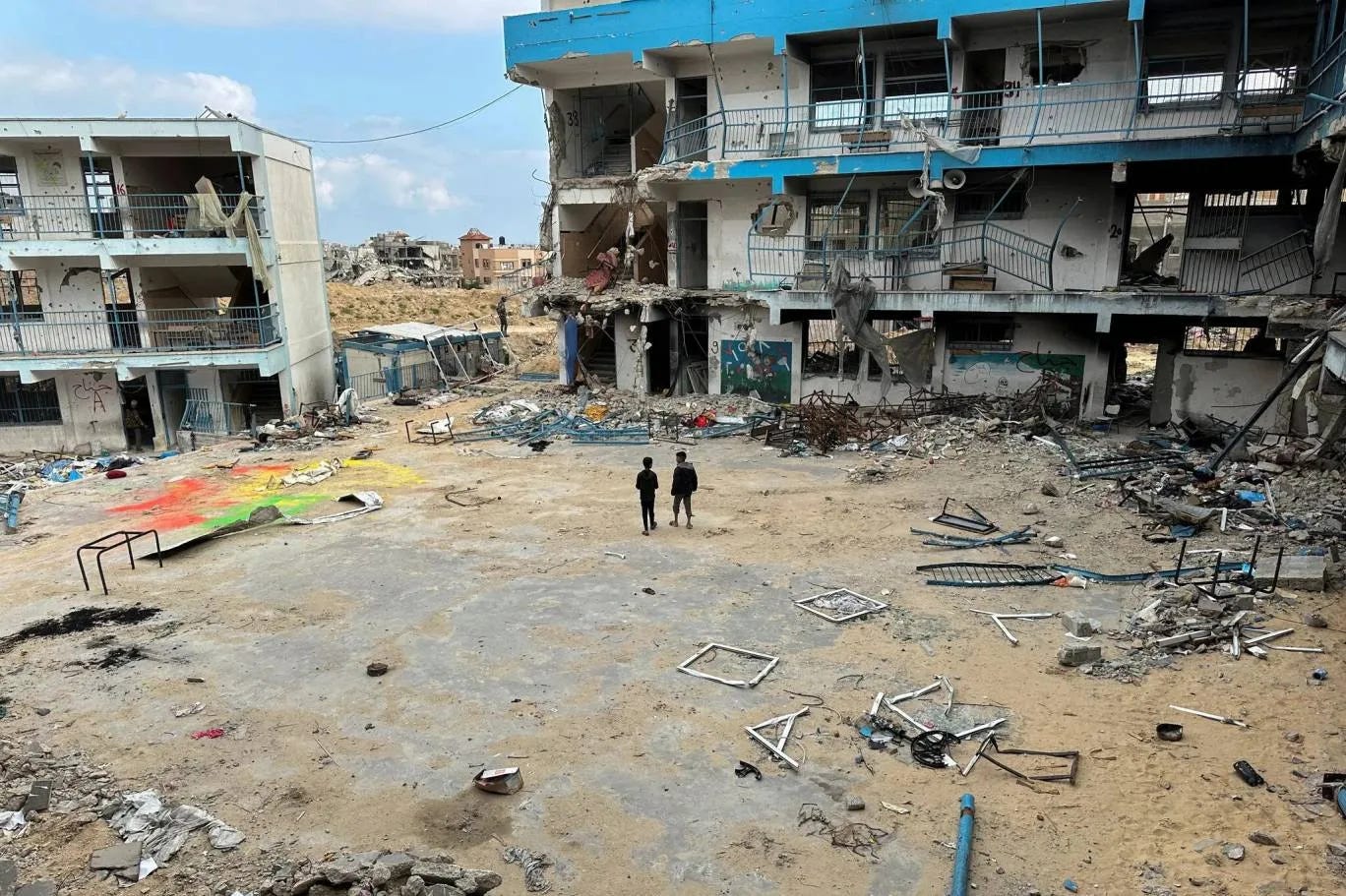
Education itself became a target, caught in the crosshairs of occupation forces. Schools and universities were destroyed, and large numbers of academics were killed. Today, Gaza’s once highly educated society has been without functioning schools for nearly two and a half years.
According to the Palestinian Central Bureau of Statistics, in 2023 the year the war began the illiteracy rate among individuals aged 15 and above in the Gaza Strip stood at just 1.9 percent. Literacy among those aged 15 to 19 reached 99.2 percent. Today, however, half of students in basic education cannot find a school able to accommodate them. Daily survival conditions make continuing one’s education a formidable challenge.
The education sector is attempting a gradual recovery, though progress remains slow and limited. The first efforts relied on online learning. Gradually, makeshift “learning points” emerged even if they consisted of little more than tattered tents where students sat on the ground. With the start of the current academic year, limited in-person instruction resumed, constrained by the dire circumstances created and compounded by the genocidal war.
Between School and the Market
Tenth-grade student Nael Subeih was forced to work after his father was killed last May.
“I’m the eldest of my siblings,” he says. “I decided to take responsibility and help my mother provide for the family. Selling candy, juice, and similar items seemed like the most suitable job.”
“My time is divided between school and work,” he explains. “Three days a week I attend classes, and three days I work. Friday I dedicate to studying.”
“I used to love studying,” he continues. “But everything has changed. After everything we’ve endured, I don’t have the energy, and there’s nothing to motivate me to put in the effort. I’m exhausted from the long distance between home and school I spend an hour walking there and another hour back. There’s no transportation.”
One of his greatest obstacles, he says, is the inability to obtain printed copies of the “educational packets” or even a digital version, since he does not own a phone. This limits his ability to participate in class and, paradoxically, makes him prefer online learning over in-person classes.
Two school days a week, without textbooks that is the extent of Subeih’s educational opportunity. He feels he is absorbing nothing and gaining little from the curriculum. He offers an example: “Today, the math teacher explained one and a half lessons in a single class. I didn’t understand anything. I’m waiting for Thursday so I can borrow my mother’s phone and maybe find a clearer explanation.”
The challenges extend beyond curriculum and instruction. The absence of a school canteen, the lack of pocket money, and soaring prices all weigh heavily on students, Subeih says. With a note of sorrow, he recalls: “Before the war, my average never fell below 95 percent. Now I’ve lost about 10 percent.”
Work consumes most of his time and forcibly distracts him from his studies. He heads to the market early each day, surveys the goods to identify the most profitable items, purchases them, and begins selling. He does not return home before five or six in the evening.
Yet Subeih insists that this exhaustion has not shaken his belief in the value of education. He pays extra for private tutoring in addition to school fees and remains enrolled in a school for high achievers, despite its distance from his home, because it helps graduates secure university scholarships. All his fatigue dissolves, he says, when he sees his mother’s joy and his younger siblings’ laughter as he brings home items bought with his earnings.
After Loss
A young boy who lost his father months ago appeared, at first, to be coping—at least in his mother’s eyes. But the psychological toll soon became evident in his monthly exam results.
“After my husband was killed, my son’s teachers alerted me to his constant distraction,” she says. “I thought it was simply a natural expression of his grief.”
The mother, who asked not to be named to protect her child’s privacy, continues: “I realized how serious the problem was when his test results came back. He scored only one or two marks on most of them.”
She sought help from a psychologist. “After speaking with him, she told me he was suffering from trauma due to his father’s death. We began therapy sessions, and improvement is now gradually appearing.”
Her son is not the only one affected. His younger sister, who once maintained a 100 percent average, has also seen her performance decline sharply. “I am absolutely convinced that education is what will benefit my children in the future,” the mother says. “I spare no money or effort for their studies. I work to meet their needs. But psychologically, I don’t know how I will manage. I never imagined their academic achievement would deteriorate like this for emotional reasons.”
Mariam Ajour, meanwhile, has grown weary of searching for a suitable school for her three daughters—one that is nearby, affordable, and offers quality instruction. The best option she found costs $30 a month but is far from home, requiring her to accompany her daughters to and from school.
Because she is employed, she walks with them to school each morning before heading to work. At midday, she leaves her job to bring them home.
“All I want is to salvage what can be salvaged after the sharp decline in my daughters’ academic performance, despite their intelligence,” she says.
“I found a closer school with lower fees, but teaching there was rushed and limited to the basics. I want a place that truly resembles a school. So I kept searching and transferred them to a new one.”
For Ajour, the problem extends beyond textbooks. “School is more than just academic subjects,” she explains. “It provides basic religious education, Qur’an memorization, character building, relationship formation so many things happen there.”
“No matter how hard I try, I can’t compensate for what’s missing,” she adds. “I’m employed, I have an infant, and life has become exhausting and time-consuming in every respect.”
Education Still Holds Its Place
Dr. Mahmoud Matar, Assistant Undersecretary for Educational Affairs at Gaza’s Ministry of Education, told Noon Post that education has always held a special place among Palestinians.
“Before the war, this was evident in the high education rates and low illiteracy levels,” he said. “Today, it is evident in the intense desire to enroll in schools. Whenever the ministry opens a new school, tens of thousands rush to register, but its capacity allows for only one or two thousand students. This happens despite the fact that many are unable to continue their education due to the harsh reality.”
The education sector has suffered catastrophic blows. “We have lost more than 21,000 school-age students among the martyrs, along with 1,200 education staff teachers, supervisors, administrators, and principals. Thousands more have been injured, many left with permanent disabilities, in addition to profound psychological trauma that makes psychosocial support programs urgently necessary.”
Infrastructure damage has been immense. Ninety-eight percent of schools have been damaged, and approximately 82 percent are effectively out of service, requiring major rehabilitation or reconstruction. The remaining 18 percent are currently sheltering displaced families, making their use for educational purposes nearly impossible until the displacement crisis is resolved.
In response, the ministry has worked to reintroduce the educational process in modified form, opening schools and learning points operating on rotating schedules, reducing school days, and shortening curricula.
There are currently 730 schools and accredited learning points serving roughly 300,000 students. Registration is conducted through a computerized system under ministry supervision, which coordinates and monitors operations.
“The shape of the school has changed,” Matar explains. “Very few classrooms have been cleared of displaced families and made operational. We have built schools out of wood, sheet metal, tarpaulins, and ready-made tents. In many, students sit on the ground, and teachers lack even a board to write on.
There is no space for laboratories or other facilities. These schools lack basic components such as furniture, electricity lines, and internet connectivity. This poses enormous challenges.”
Despite these obstacles, the ministry’s immediate priority is to raise enrollment rates and restore in-person education to its previous levels.
Curricular interventions have been introduced through condensed “educational packets,” designed to allow students to progress to higher levels without facing undue academic burdens in future years. The extent of reduction varies by subject, preserving the core of the curriculum while adapting to available time.
Instructional hours have also been curtailed. Schools now operate on a rotation system, with a single classroom serving six groups of students compared to one or two before the war.
“Before the war, the dropout rate was below 2 percent,” Matar says. “Today it exceeds 50 percent. Student numbers have fallen to less than half. Around 300,000 students are currently registered in accredited schools and learning points, compared to 625,000 before the war. Even those attending in person often miss periods of school. Schools follow up with parents, and educational counselors and teachers investigate absences to understand the causes.”
The decline is attributed to displacement, personal hardships, and the shortage of school capacity. The ministry is working to create new spaces and aims to raise enrollment to 80 percent before the next academic year.
Financial hardship, the loss of parents, limited electricity and internet access, elderly grandparents caring for orphaned children who cannot navigate digital tools, transportation crises forcing long walks, and the growing need for child labor all contribute to absenteeism.
“Child labor is one of the byproducts of this war,” Matar notes. “Reducing school hours helps mitigate the problem. Students attend three hours a day, three days a week, allowing them to work alongside their studies.”
Given these extraordinary conditions, the ministry avoids labeling current interruptions as “dropout.” Instead, it seeks to identify students who are out of school and direct them to the nearest educational points.
For those unable to join either in-person or online instruction, remedial programs have been established, including one via the Microsoft Teams platform and another in person. These target students who have missed one or two academic years and aim to help them catch up. Additional plans are being prepared for other groups at the start of the coming school year.
Teachers themselves face immense hardship, including injury and displacement. Yet many continue their mission with dedication. Some launched individual initiatives during the war, transforming their tents into unpaid learning centers an act that reflects their commitment to students and community alike.
Higher education, too, faces formidable challenges. Universities have turned to online instruction to enable many students to continue their studies. Still, significant difficulties remain, particularly in scientific faculties such as medicine and the sciences, where the absence of laboratories hampers practical training and undermines educational quality.