

The global Zionist movement and its influential lobbying networks across the world could hardly have imagined that just 140 minutes would be enough to undermine a narrative meticulously constructed over decades.
That narrative initiated by the Israeli occupying state and amplified by pro-Israel pressure groups in the West met an unexpected moment of deconstruction from within its own camp.
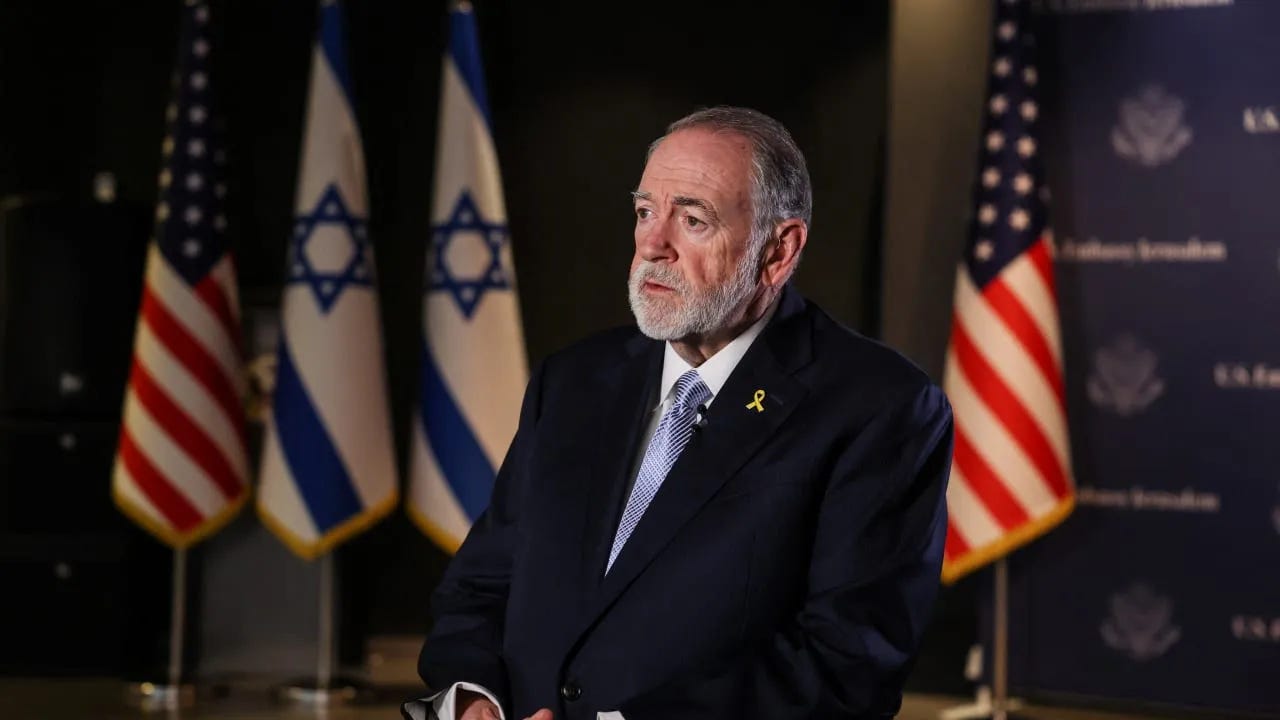
The dismantling came at the hands of one of the most prominent figures of the evangelical pro-Israel current in the United States: the US ambassador to Tel Aviv, Mike Huckabee.
The reverberations of the interview conducted by the well-known American media personality Tucker Carlson with Huckabee broadcast on Friday, February 20 continue to cast a shadow over both Arab and international arenas. The conversation featured blunt and direct remarks concerning the alleged “historical right,” the boundaries of the Israeli project, and the rhetoric of “peace” and respect for state sovereignty.
Observers have described the encounter as one of the most consequential media and political moments of the past two decades. At its core, it marked a pivotal round in the battle over narrative and public consciousness surrounding Israel and its broader project. In a matter of minutes, the dialogue succeeded in unraveling the foundations of Israel’s “state project” and indeed the Zionist idea in its broader ideological structure.
Attempts by some quarters to contain the fallout portraying the remarks as merely “personal views” expressed by Huckabee as a Christian Zionist figure known for his unwavering support for Israel are difficult to separate from his official position as US ambassador to Israel.
Huckabee was not speaking in a purely doctrinal or pastoral capacity, but from his political office as Washington’s direct diplomatic representative in Tel Aviv. That fact imbued the interview and its implicit messages with heightened weight and exceptional resonance. It invites interpretation not as isolated opinion, but as a possible indicator of currents within influential American circles.
An Important Context: Why Was the Interview Conducted?
Before interviewing Huckabee, Carlson had held a series of conversations with two Christian figures from the Middle East as part of an effort to assess the condition of Christian communities in the region. This trajectory was consistent with his media profile and his identity as a devout Christian who has publicly expressed concern for Christians worldwide.
The first meeting took place in Amman with Saad Al-Mu’asher, chairman of the board of the Jordan National Bank, focusing on the stability and prosperity of Christian life in Jordan as a Muslim-majority country. The second interview was with Archbishop Hosam Naoum of Jerusalem, centering on Israel’s treatment of Christians in the occupied territories, including references to Israeli violations affecting Christians and their holy sites, particularly in Jerusalem.
According to accounts circulating behind the scenes, this path reportedly irritated Huckabee, who requested a direct interview to “present the counter-narrative” regarding Christians in the occupied territories.
Carlson seized the opportunity and began preparations for what appears, in hindsight, to have turned against its initiator transforming from a corrective platform into a controversial stage that the US ambassador may long regret.
Why It Matters
The significance of the interview stems from three main dimensions.
The first concerns the two figures themselves. Carlson stands as one of the most prominent faces of the Christian right in the United States, commanding a substantial following, particularly among conservative youth. Within that milieu, he is viewed as an influential voice capable of shaping opinion and reframing sensitive debates within the conservative Christian base.
Opposite him stands Huckabee, one of the most vocal representatives of Christian Zionism in America—a current rooted in theological interpretations that regard Israel as the “Promised Land” and draw upon religious notions of divine election and a “chosen people.” Given his political and diplomatic role, he is not merely a sympathetic advocate of this current but one of its most visible public representatives, reflecting its priorities and wagers within the American political scene.
The second dimension relates to the target audience. The interview was not directed at a casual viewership but at the Christian base in the United States and beyond that has long constituted a cornerstone of political and financial support for Israel and a key pillar of domestic lobbying influence. Any tremor within this constituency, or renewed questioning from within, carries amplified political weight.
The third dimension concerns the subject matter itself: the condition of Christians in the occupied territories and Israel’s conduct toward them, alongside broader questions about America’s near-unconditional support for Israel. The sensitivity here lies in the complex intersection of religious belief, political commitment, and strategic calculations in US foreign policy.
Early Circumstances: The Police-State Atmosphere
The circumstances surrounding the interview, in Carlson’s telling, were revealing perhaps even more so than the interview itself. He described the environment as akin to that of a “police state,” governed by a rigid security mindset devoid, in his words, of the customary standards of hospitality toward guests and journalists.
According to Carlson, Israeli authorities and the US embassy declined to provide security protection for him and his team, forcing them to assume responsibility for their own safety. The interview, initially scheduled at the US embassy, was moved to the diplomatic lounge at Ben Gurion Airport a facility Carlson sharply criticized for its poor condition.
He further remarked that Huckabee was surrounded by individuals who appeared more like informal security enforcers than conventional staff.
More controversially, Carlson claimed that the embassy not only failed to provide security cover but that he and his team were subjected to what he described as humiliating inspections after the interview. Three staff members were reportedly detained briefly before being released.
He expressed astonishment that such measures occurred while the US ambassador remained at the airport without intervening.
These events prompted Carlson to raise public questions about diplomatic representation: Does the ambassador act on behalf of American interests or Israel’s? He extended the question further: Does the US government serve its own citizens, or does it serve Tel Aviv?
Carlson also observed that Huckabee appeared cautious and, at moments, unsettled as though constrained by considerations that discouraged any deviation from the Israeli official line. In Carlson’s reading, this caution stemmed not from fear of criticizing American institutions he himself criticized the US military during the interview but from concern about provoking Israeli displeasure. This reinforced the impression of a deep overlap between Huckabee’s diplomatic position and the Israeli government’s agenda.
Breaking the Taboo
The sensitivity of the interview derived from the simplicity of its questions questions that nonetheless touched on existential issues: Israel’s origins, the foundations of its historical and political legitimacy, its vision for the region’s future, and claims of historical and religious ties between contemporary Jews and Palestinian land.
For years, such questions remained taboo in much of Western discourse, often met with sharp criticism or accusations foremost among them anti-Semitism.
Here, the article argues, credit belongs to Gaza. Palestinian resilience in the face of Israel’s devastating war machine has reintroduced Palestinian rights into global consciousness and repositioned the issue at the center of international attention after years of marginalization. Without this shift in global mood, Carlson might not have ventured to pose such questions to Huckabee.
Deconstructing the Zionist Narrative
At its core, the Zionist narrative rests on several ideological and historical pillars: the concept of the “Promised Land” grounded in biblical interpretations extending “from the Nile to the Euphrates,” notions of divine election and a chosen people, and the assertion of an unbroken historical bond between modern Jews and Palestine.
The interview suggested that these pillars are not immune from questioning even within traditionally pro-Israel Western Christian circles. Carlson raised doubts about applying ancient religious texts to contemporary political realities and alluded to historical and theological debates over identity and lineage.
He also highlighted the region’s layered history from Canaanites and Samaritans to Christians and Muslims underscoring the complexity of reducing Palestine’s history to a single narrative conferring exclusive rights.
In a particularly pointed exchange, Carlson referenced the Eastern European origins of Israeli Prime Minister Benjamin Netanyahu, questioning how claims of ancestral residence on the land could be substantiated. Huckabee reportedly struggled to respond.
Carlson further challenged the credibility of American rhetoric about peace, especially under the administration of Donald Trump, asking how a state that proclaims peace can entertain talk of annexing territories belonging to other nations some of them US allies.
The legal basis of Israel’s establishment was also scrutinized. Carlson expressed reservations about treating the Balfour Declaration as a binding legal foundation, describing it instead as a political expression issued by a colonial power in a specific historical context—reflecting ongoing academic and political debate over sources of legitimacy.
Finally, the discussion turned to the reality of occupation. Huckabee reportedly acknowledged the existence of an occupation a characterization loaded with political and legal implications. A heated exchange followed regarding the justification of force against children in Gaza.
Huckabee affirmed Israel’s right to such force under certain premises; Carlson categorically rejected it, lending the dialogue a stark moral dimension in which, according to the article, the ambassador faltered.
The Zionist Lobby and the Fallout
Few anticipated that the interview would produce such shockwaves. For the first time, a segment of conservative right-wing discourse long seen as a hospitable environment for pro-Israel narratives posed questions that unsettled Zionist assumptions from within.
The tremor was felt within pro-Israel lobbying structures in the United States. The debate had shifted from external criticism to internal review arguably the most disquieting development of all.
Signs of backlash emerged swiftly. Pro-Israel activist Laura Loomer launched a sharp attack, urging Trump to sever political ties with Carlson and exclude him from the White House orbit. She hinted at movements within Republican circles to frame the episode as evidence of party division ahead of midterm elections.
In sum, the interview stripped away layers of long-packaged narratives and exposed vulnerabilities in elements of Zionist discourse when subjected to direct, logical questioning.
At the same time, it placed Washington in an awkward position before the international community and its Arab and Muslim allies, revealing a gap between its declared rhetoric of peace and sovereignty and statements emerging from its diplomatic representation on the ground.
