

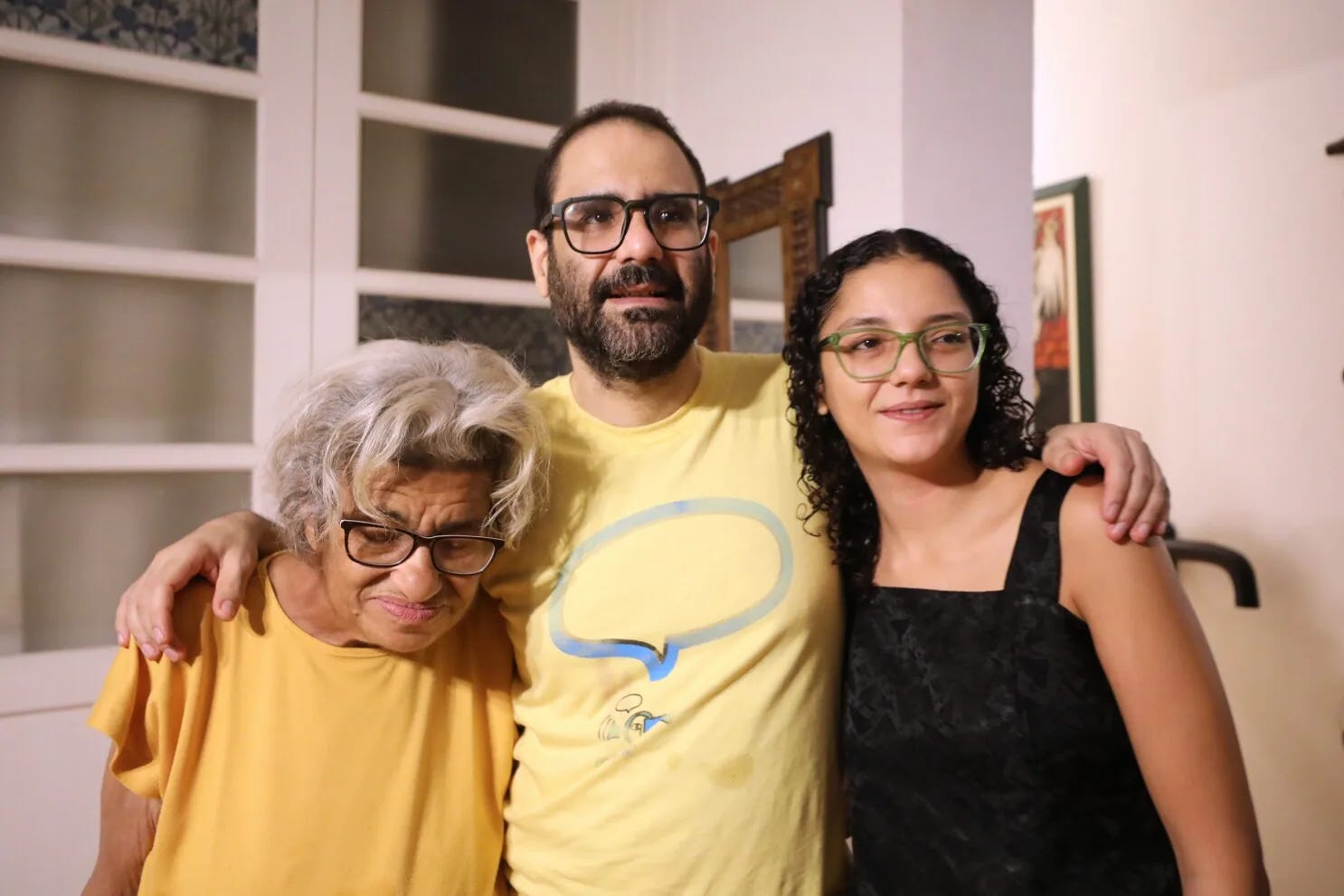
On December 26, 2025, a plane carrying British-Egyptian activist Alaa Abd El-Fattah landed at London’s Heathrow Airport an arrival hailed by many as a human rights and diplomatic victory after a decade of imprisonment and abuse in Egypt. But the long-awaited family reunion quickly turned into a political storm that redefined the terrain of rights-based and political discourse in the UK.
While Prime Minister Keir Starmer welcomed the return of a wrongfully detained British citizen, a coordinated digital and political campaign began almost immediately. It sought to strip Abd El-Fattah’s case of its human rights framing and recast him as a “security threat” and an enemy of “British/Western values,” based on a decade-old digital archive.
This campaign driven by key figures in the British right such as Nigel Farage and Robert Jenrick and amplified by digital accounts linked to pro-Israel lobbying groups was not only an attack on Abd El-Fattah personally. It was part of a broader effort to enforce “conditional citizenship” and punish voices expressing solidarity with the Palestinian cause.
The crisis reached its peak when Foreign Secretary Yvette Cooper announced an urgent security review into what she called “serious informational failures” in Abd El-Fattah’s case, amid growing political and media pressure to strip him of his citizenship and deport him.
This article offers a brief investigative analysis of this campaign tracing the digital architecture behind it, the instrumentalization of anti-Semitism accusations as a political tool, and the fusion of Egyptian security discourse with British political debate in a striking case of the globalization of repression.
Converging Narratives: The Digital-Political Alliance Against Abd El-Fattah
The assault on Alaa Abd El-Fattah was far from spontaneous. It emerged from a strategic convergence between the rising British far-right particularly the hardline factions of the Conservative Party and Reform UK and digital platforms aligned with the Zionist lobby in the UK.
This alliance did not merely target Abd El-Fattah as an individual. It sought to undermine the Labour government’s foreign policy and punish any voice linking the Arab Spring struggles with the Palestinian cause. Central to the campaign was an ideological excavation strategy: posts from 2010 to 2012 an era marked by revolutionary fervor and brutal regional conflicts (in Egypt, Libya, and Syria) were dredged up and presented as present-day evidence against a man who either matured politically or, even if not, had spent years in Egyptian prisons for peaceful opposition to Sisi’s authoritarianism.
Investigations by independent fact-checking platforms like Sahih Masr revealed that the campaign’s initial spark didn’t originate entirely in the UK. It began with anonymous accounts known for defending Israeli occupation policies. The campaign was triggered by a comment from Abd El-Fattah’s sister, Mona Seif, on a post by Prime Minister Keir Starmer welcoming Alaa’s return.
In her comment, Mona called for the release of activists jailed in Britain for their pro-Palestinian advocacy an act deemed “provocative” by the British right, prompting a broad backlash against her and her brother.
The account that spearheaded the attack, operating under the alias “prudent rose fire finch,” had previously posted a series of comments targeting Labour politicians critical of Israeli bombing campaigns in Gaza. This confirmed that the assault on Alaa was part of a broader campaign to suppress the Palestinian narrative in the UK.
Momentum quickly spilled from the digital realm into formal political arenas. Right-wing leaders in Britain seized the narrative from anonymous accounts: Robert Jenrick, Justice Minister in the shadow cabinet, and Nigel Farage, leader of Reform UK, led the political charge, calling for Abd El-Fattah’s citizenship to be revoked and for his immediate deportation.
They labeled him an “extremist,” while right-wing media outlets like The Telegraph and Daily Mail amplified these demands, branding Alaa’s return a “security failure” and ignoring the legal and human rights context that had compelled successive UK governments to call for his release as a prisoner of conscience.
Anti-Semitism and Britain’s Double Standards
The case of Alaa Abd El-Fattah starkly illustrates how accusations of anti-Semitism are being weaponized as a means of political discipline crippling the government’s ability to take consistent human rights positions. The official British reaction to Abd El-Fattah’s return exposed a pattern of “selective outrage.”
While the government swiftly mobilized its apparatus to scrutinize decade-old tweets by Alaa criticizing Zionism, it remained silent on recent and documented misconduct by foreign officials visiting the UK during the same period.
This double standard is especially clear when comparing Abd El-Fattah’s treatment to that of Israeli officials. While Alaa faced a security review and calls for deportation over old tweets, Prime Minister Starmer warmly welcomed Israeli President Isaac Herzog despite Herzog’s statements being used as evidence in a genocide case before the International Court of Justice.
In July 2025, Israeli Air Force Chief Tomer Bar was granted legal immunity to visit the UK, shielding him from war crimes allegations. This contradiction highlights how British “moral outrage” is often reserved for powerless individuals, while powerful allies are shielded.
The media pressure eventually pushed Foreign Secretary Yvette Cooper to launch a review into what she called “serious informational failures” in Abd El-Fattah’s case. She deemed the due diligence process inadequate. The review marked a dangerous precedent: the introduction of “ideological vetting” into consular and human rights work.
Scrutinizing an activist’s political views before defending their rights signals a shift away from the universality of human rights and toward a selective model granting protection only to those whose views align with powerful interest groups in London.
Thus, the campaign successfully recast anti-Semitism not as a legitimate human rights issue, but as a political weapon used to intimidate Gaza supporters and associate their advocacy with violence. This happened despite Abd El-Fattah’s explicit apology for his old posts, which he described as the product of youthful rage in a time of regional upheaval.
Globalized Repression and the Constitutional Debate Over Citizenship
One of the most striking features of this episode is the covert alignment between Egypt’s security apparatus and the British far-right, including journalists and media outlets. The smear campaign in London offered the Sisi regime a golden opportunity to repackage its security narrative one that had long been used to justify imprisoning Abd El-Fattah but now repurposed in a British voice.
Investigations revealed that Egyptian journalists working for outlets owned by United Media Services (a conglomerate controlled by Egypt’s General Intelligence Directorate) helped promote the campaign in the UK by amplifying hashtags calling for Alaa’s deportation, aiming to create international consensus on labeling him an extremist.
This collaboration created a new reality of “globalized repression.” Old Egyptian charges such as “spreading false news” were reinterpreted for a Western audience as accusations of “anti-Semitism” and “incitement to kill police.”
The campaign reached a fever pitch when pro-regime media figures like Ahmed Moussa proclaimed that “Britain has finally discovered the truth about Alaa,” even calling for his Egyptian citizenship to be revoked to complete the UK’s campaign.
At the same time, leaks from inside the UK government’s Whitehall offices revealed how some civil servants treated Alaa’s case as an ongoing “joke,” according to Paul Offinden, a former adviser to Keir Starmer. Offinden criticized what he described as the “stakeholder state,” where bureaucracy obsesses over marginal issues like activist rights.
Legally and constitutionally, calls to revoke Abd El-Fattah’s citizenship ran up against firm barriers. Alaa obtained British citizenship by birthright through his mother, which is not subject to the “good character” test applied to new applicants.
Revoking it would require proving imminent threat or direct involvement in terrorism conditions that do not apply to decade-old tweets written during a revolutionary context outside Britain.
Although UK courts technically have the authority to revoke citizenship from dual nationals, the government ultimately concluded that such a move would be “too authoritarian” and legally indefensible. This confirmed that the campaign against Alaa was political at its core not legal.
A Turning Point in Western Rights Discourse
The December 2025 smear campaign against Alaa Abd El-Fattah was not an isolated event. It marked a pivotal moment in the reconfiguration of public discourse even in Western democracies. What became starkly visible was the fragility of rights frameworks when confronted with power-driven narratives.
Authoritarian regimes, led by Sisi’s Egypt, have learned how to export their security logic abroad exploiting the rise of the far-right and deep polarization in the West.
In this context, exile whether voluntary or forced has ceased to be a refuge. It has become a new front line where false narratives against dissidents are rebranded and legitimized under political and media cover.
Though Abd El-Fattah remains in Britain thanks to the robustness of legal citizenship protections, the campaign has left a deep scar on the credibility of Western commitments to unconditional human rights.
The fight no longer ends with release from prison. It continues in the realm of public meaning—where victims are stripped of their humanity and turned into archival fodder for defamation and character assassination.
This raises a pressing question for the future: Has human rights protection become contingent on ideological alignment? And if repression has succeeded in globalizing its tools can justice do the same?
