

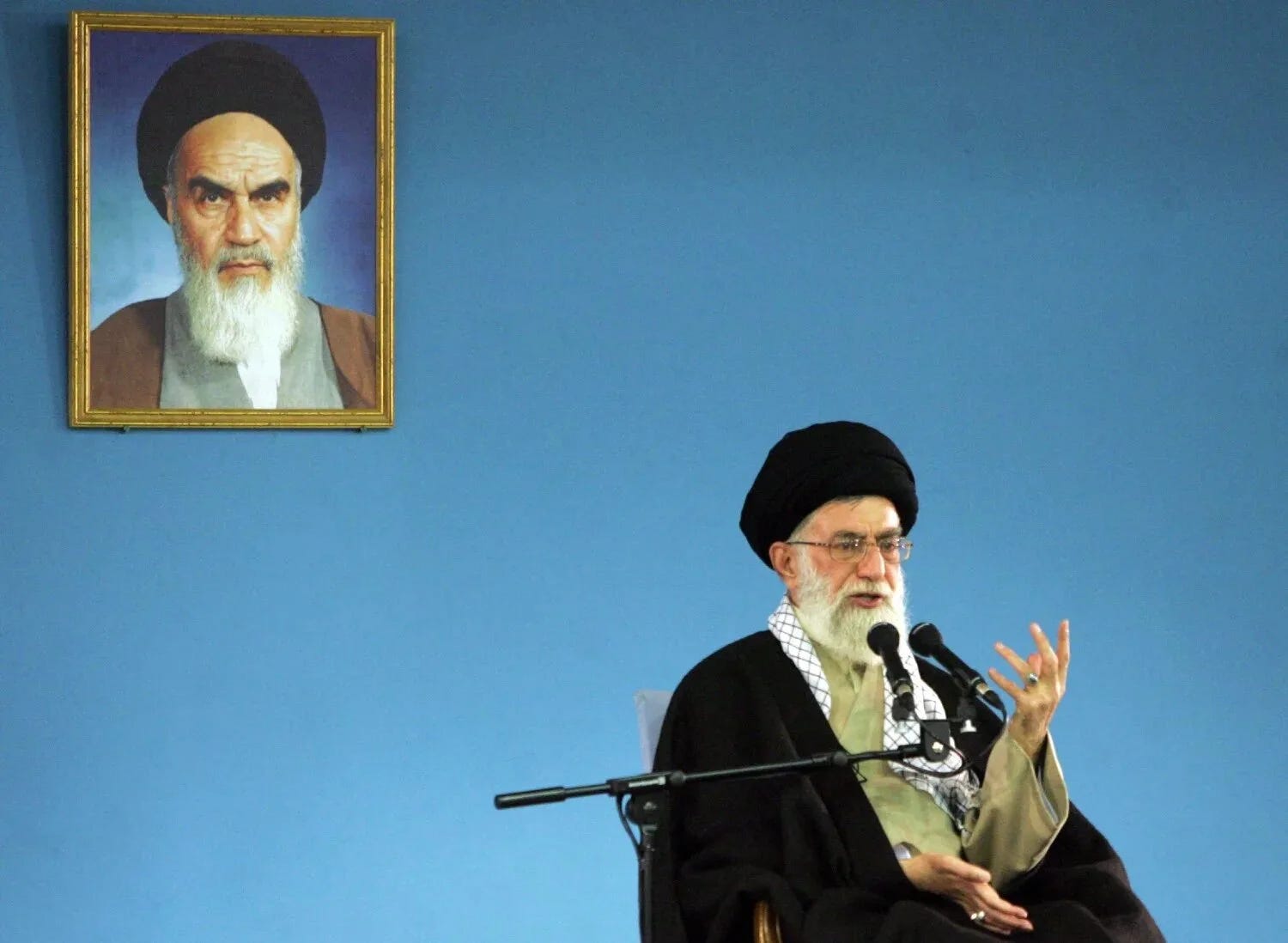
“It was no ordinary day in the Islamic Republic. The news broadcast by state television and carried by global wire services was anything but marginal: the Supreme Leader of the Islamic Republic, Ayatollah Ali Khamenei, had been killed in an Israeli airstrike targeting his headquarters.”
As with everything in Iran, the announcement was sparse in detail but unmistakable in substance. The faces of the anchors delivering the news on state television appeared paler than Tehran’s darkened night. This was no routine assassination, nor a quiet passing in a bed that had borne the weight of decades. It was an earthquake at the core of the Islamic Republic.
The magnitude of the news reflects the singular place Khamenei occupied in the history of the Islamic Republic. He was the man who consolidated the republic’s pillars after the death of its founding Supreme Leader, Ayatollah Ruhollah Khomeini, and who for 37 years stood at the forefront of confrontation with the United States and Israel.
He worked tirelessly to construct a regional project through which Iran exerted influence over four Arab capitals until the moment he was killed defending his unsettled republic from within his private compound in central Tehran. He leaves behind a state mired in a war with no clear end and a future bereft of certainty.
Khamenei’s absence from Iran’s political stage ushers in an extraordinarily difficult future. His death comes amid a war waged jointly by the United States and Israel one expected to continue for several days. Compounding the peril, U.S. President Donald Trump, followed by Israeli Prime Minister Benjamin Netanyahu, has declared that the ultimate objective of the war should be the overthrow of the regime.
Yet Khamenei’s departure does not necessarily mean the collapse or immediate fall of the system. The Islamic Republic was designed to absorb shocks of this magnitude. Indeed, Khamenei had already addressed such a scenario prior to his assassination.
Still, his absence will leave a profound mark on the regime’s vitality whether in confronting internal challenges that may intensify in the wake of his death, or in sustaining the momentum of military confrontation with Washington and Tel Aviv.
After His Absence, Nothing Is the Same
Article 111 of Iran’s 1979 Constitution outlines a clear mechanism for filling a leadership vacuum. It provides for the formation of a temporary leadership council composed of the president, the head of the judiciary, and a member of the Guardian Council nominated by the Expediency Council. This body administers the country’s affairs until the Assembly of Experts selects a new Supreme Leader.
Yet despite these explicit constitutional procedures, the greatest challenge lies in the fact that Khamenei’s absence comes under highly abnormal circumstances.
The transition following Khomeini’s death unfolded under far less volatile conditions. Today, Iran faces an expanded war with the United States and Israel, coupled with intense domestic strain. The coming phase is therefore expected to witness violent tremors inside Iran at least until the Islamic Revolutionary Guard Corps (IRGC) can restore a measure of stability.
In practical terms, the IRGC now confronts a historic reckoning authorized by the constitution itself: it is the institution charged with safeguarding the regime and the Islamic Republic. As such, it will likely serve as the most influential channel in selecting the next Supreme Leader.
Before his death, Khamenei had tasked the secretary of Iran’s Supreme National Security Council, Ali Larijani, with overseeing the country’s affairs. On Sunday morning, March 1, 2026, Larijani announced the formation of a temporary leadership council.
Even so, his mission is unlikely to be straightforward especially amid the turmoil engulfing Iran’s military and political establishments after a wave of assassinations that claimed several senior commanders who were with Khamenei at the time of the strike.
The IRGC understands that the central dilemma lies in producing a successor who approximates Khamenei politically and ideologically, thereby prolonging the life of the Islamic Republic in the face of mounting challenges. At the same time, neither the United States nor Israel is expected to allow the succession process to unfold easily.
The atmosphere in Iran suggests that open-ended war will define the coming stage. As long as wartime conditions dominate the domestic arena, every major decision including succession will be inseparable from the war effort. This is the reality the IRGC will navigate in the immediate term.
Even before Israel assassinated Khamenei, who was 86, the question of succession had resurfaced over the past year following the Twelve-Day War albeit more discreetly. Names were floated in line with Khamenei’s own preferences and with the trust of the IRGC. Now that his assassination has been confirmed, several paths lie ahead.
Beyond the specific candidates, three broad scenarios emerge: adherence to the names previously endorsed by Khamenei; adjustment of that list in light of current developments; or the possibility of an internal coup undertaken by the IRGC should events spiral beyond control.
Beyond succession, the current war reveals a fundamental paradox. Iran does not possess sufficient conventional military power to defeat either Israel or the United States in direct confrontation. Yet military force alone may not suffice to dismantle a political system designed explicitly to survive crises.
By escalating the war while simultaneously preserving diplomatic channels that might facilitate an exit from dangerous escalatory spirals, Iran may seek to achieve its longstanding objective: surviving long enough to compel its adversaries to revise their policies.
This prospect may be heightened under a U.S. president presumed to loathe costly regional entanglements. In this sense, the ultimate battle may not be about military supremacy so much as endurance, cohesion, and control of the narrative.
Despite the stature of the figures previously floated as potential successors during last year’s Twelve-Day War, none is necessarily capable of rescuing the Islamic Republic from the threats Iran faces today.
Accordingly, the immediate priority for both the IRGC and Ali Larijani is to conclude the present war in a manner that secures the republic’s survival with the fewest possible losses. Once relative stability is restored, conditions can be prepared for the selection of a new Supreme Leader.
Difficult Choices, an Uncertain Future
Khamenei was a complex figure, and it is difficult to imagine any successor filling his vacuum with ease. He was not merely a cleric but a strategic architect who cultivated the image of a statesman more than a jurist issuing religious decrees.
He functioned as the central axis of the political system the final arbiter of foreign policy, commander-in-chief of the armed forces, and a decisive actor in economic, social, media, and religious affairs.
Crucially, he developed a sophisticated foreign policy and intricate frameworks for engaging the external environment. He generated political concepts that governed Iran’s interactions with both regional and international arenas most notably with the United States, with which he waged a political and strategic struggle so intense that the slogan “Death to America” became a driving force of Iran’s regional strategy in the Middle East.
While Khamenei’s absence could free Iranian domestic and foreign policy from some of the ideological constraints that bound it in previous years, this does not necessarily guarantee the republic’s long-term survival particularly if the ongoing war with the United States and Israel ultimately leads to regime collapse.
The current Iranian system operates as an integrated organic whole; the notion of a “rescue deal” with a Trump administration to halt the war, as Trump has suggested, appears implausible. The system was designed to endure in its entirety or to fall in its entirety. That is how it was built, and that may well define its end.
A complex future thus awaits the Islamic Republic. Ultimately, the conduct of the IRGC and the trajectory of the present war may shape its fate more decisively than the mere selection of a new Supreme Leader. Yes, a successor is essential for the continuity of the doctrine of Wilayat al-Faqih.
But without a stable and dominant IRGC within Iran, no new Supreme Leader will be able to consolidate political and religious legitimacy at home or sustain authority over Iran’s network of regional proxies abroad.