

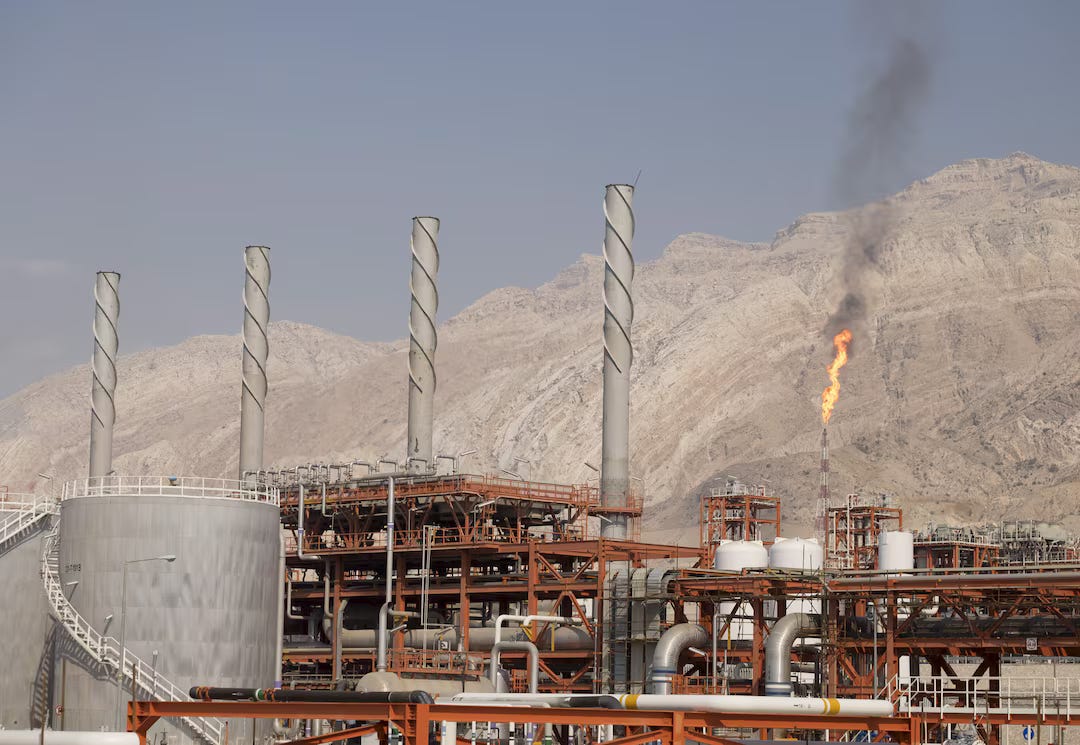
The U.S.–Israeli war on Iran has entered an unprecedented phase, as strikes have for the first time targeted Iran’s petrochemical industry (chemical and industrial materials derived from oil and gas), a key pillar of the domestic economy.
Iran is among the largest petrochemical producers in the Middle East. Which major hubs in this sector have been struck or placed on target lists? What does each encompass, and why are they industrially significant?
Mahshahr: A Dense Cluster of Petrochemical Complexes
Location:
Mahshahr lies in Khuzestan Province in southwestern Iran, forming together with Bandar Imam a coastal hub along the Gulf shoreline.
What does it include?
The city hosts the Petrochemical Special Economic Zone (Petzone), spanning roughly 3,000 hectares. The zone has attracted nearly $1 billion in investment and aims to raise production capacity to 19 million tons annually while creating 4,800 jobs.
Mahshahr’s port is connected to railway networks and waterways, serving as a key export gateway. The zone accommodates more than 30 complexes and companies, including Shahid Tondguyan, Bu Ali Sina, Fanavaran, Amir Kabir, Khuzestan, Marun, Arvand, Karun, Razi, Bandar Imam, and Farabi.
It also includes service complexes such as Fajr, the region’s first and largest centralized provider of water, steam, electricity, and waste treatment.
Many of these facilities depend on the Fajr 1 and Fajr 2 plants for energy and water supply, meaning that any strike on these utilities affects dozens of companies simultaneously.
Why is it important?
Mahshahr represents a vital artery for exports of polymers (raw materials used in plastics manufacturing) and chemical products. It is also linked to pipelines carrying natural gas and crude oil.
Damage to central power stations such as Fajr can cut electricity and water to dozens of factories, halting production and reducing exports.
Its proximity to Khuzestan’s oil fields further elevates its strategic importance beyond petrochemicals, as disruptions could pressure both domestic and global energy markets.
Field developments:
On April 4, 2026, Iranian reports indicated that U.S.–Israeli strikes targeted the Petrochemical Special Economic Zone in Mahshahr.
The Islamic Republic News Agency (IRNA) reported that at least five people were killed and around 170 injured, with several facilities inside the zone hit.
Fars News Agency reported five injuries and damage to three companies, including Amir Kabir, though the full extent of losses remains unclear.
In a statement on April 6, Israeli Defense Minister Israel Katz said Israeli forces had struck the Mahshahr complex, claiming that targeting it alongside Asaluyeh could disrupt roughly 85% of Iran’s petrochemical exports.
Asaluyeh: The Heart of South Pars
Location:
Asaluyeh sits on the coast of Bushehr Province in southern Iran. It serves as a port and onshore processing center for gas from the South Pars field.
This offshore field—shared with Qatar—is the largest gas field in the world, with estimated reserves of around 1,800 trillion cubic feet. It supplies between 70% and 75% of Iran’s gas production.
Gas is transported via subsea pipelines to Asaluyeh, where it is processed into energy products and petrochemical feedstock.
What does it include?
The Asaluyeh complex comprises processing plants and separation units tied to various development phases of South Pars, alongside dozens of petrochemical facilities.
Service providers such as Damavand Energy Asaluyeh and Persian Gulf Mobin Energy supply electricity, steam, water, compressed air, and oxygen to the entire zone.
Mobin alone provides approximately 31% of Iran’s petrochemical utility services, supplying facilities such as Nouri, Arya Sasol, Zagros, and Jam. This centralized system functions as the “heart and lungs” of the region any disruption to utility plants can trigger widespread paralysis.
Why is it important?
Asaluyeh’s link to South Pars makes it central to energy production and gas supply. More than 85% of Iran’s electricity is generated by gas-fired power plants, much of it sourced from this field.
The petrochemical sector also depends on gas as feedstock. Any disruption to processing operations or service plants such as Damavand or Mobin could halt production across dozens of facilities and impact national electricity and industrial water supplies.
Targeting Asaluyeh therefore threatens the stability of Iran’s energy grid and significantly undermines its export capacity.
Field developments:
On March 18, 2026, Israel launched strikes on the South Pars field and processing facilities in Asaluyeh, marking a major escalation in the conflict.
Reuters reported that the field supplies most of Iran’s gas, and the strike halted gas flows to Iraq while driving up global gas prices.
On April 6, Iranian media confirmed explosions in the Asaluyeh complex. Fars reported blasts within South Pars facilities, while Tasnim said companies supplying electricity, water, and oxygen were targeted, causing a complete power outage across all units.
The deputy governor of Bushehr confirmed damage to several units. Israel’s defense minister stated that the complex accounts for roughly 50% of Iran’s petrochemical production, adding that strikes on Asaluyeh and Mahshahr could cut 85% of sector exports.
Tabriz: A Northern Hub for Downstream Industries
Location:
Tabriz is located in East Azerbaijan Province in northwestern Iran, near the Turkish border. The Tabriz Petrochemical Company lies about 8 kilometers from the city center along the Azarshahr road and is part of the National Petrochemical Company.
Due to its inland location, facilities here rely on light oil and gas transported via pipelines from other regions, primarily serving the domestic market and plastics manufacturers.
What does it include?
The Tabriz complex produces a wide range of derivatives, including ethylene, propylene, 1-butene, high- and medium-density polyethylene, as well as benzene and ethylbenzene.
It also produces styrene, toluene, polystyrene, and butadiene intermediate materials used in plastics and chemical industries as well as ABS compounds (engineering plastics used in automobiles and household appliances).
The company’s annual capacity ranges between 450,000 and 870,000 tons. Its products are exported to around 36 countries, though a large share is sold domestically.
According to IRNA, the plant is a near-monopoly producer of polyethylene, polystyrene, and ABS in Iran, with one of the broadest product portfolios after the Arak complex.
Why is it important?
While smaller than Mahshahr or Asaluyeh, Tabriz supplies essential plastics to the domestic market and exports to Europe, Russia, Turkey, and Iraq.
Any prolonged shutdown would create shortages of polymers used in automotive manufacturing, household appliances, and packaging likely driving up domestic prices.
The facility also represents a key industrial base near Iran’s northern borders, making it a symbolic target that signals the potential geographic expansion of the conflict.
Field developments:
During the ongoing war, Tabriz has been mentioned in the context of airstrikes. Iran International reported that an airstrike hit part of the Tabriz petrochemical facility on March 30, 2026, though emergency teams quickly contained the fire and no major damage was reported.
Some foreign reports referred to an attack on a “northern petrochemical plant” without further detail. No fatalities or major disruption have been confirmed, suggesting the site avoided large-scale destruction during the wave of attacks.
Mahshahr, Asaluyeh, and Tabriz together map the backbone of Iran’s petrochemical infrastructure a combination of coastal export hubs and inland industrial centers supplying gas, feedstock, and plastic derivatives.
Targeting them delivers a dual blow: it weakens Iran’s ability to generate electricity and produce fertilizers, plastics, and liquefied gas, while also draining its foreign currency reserves.