

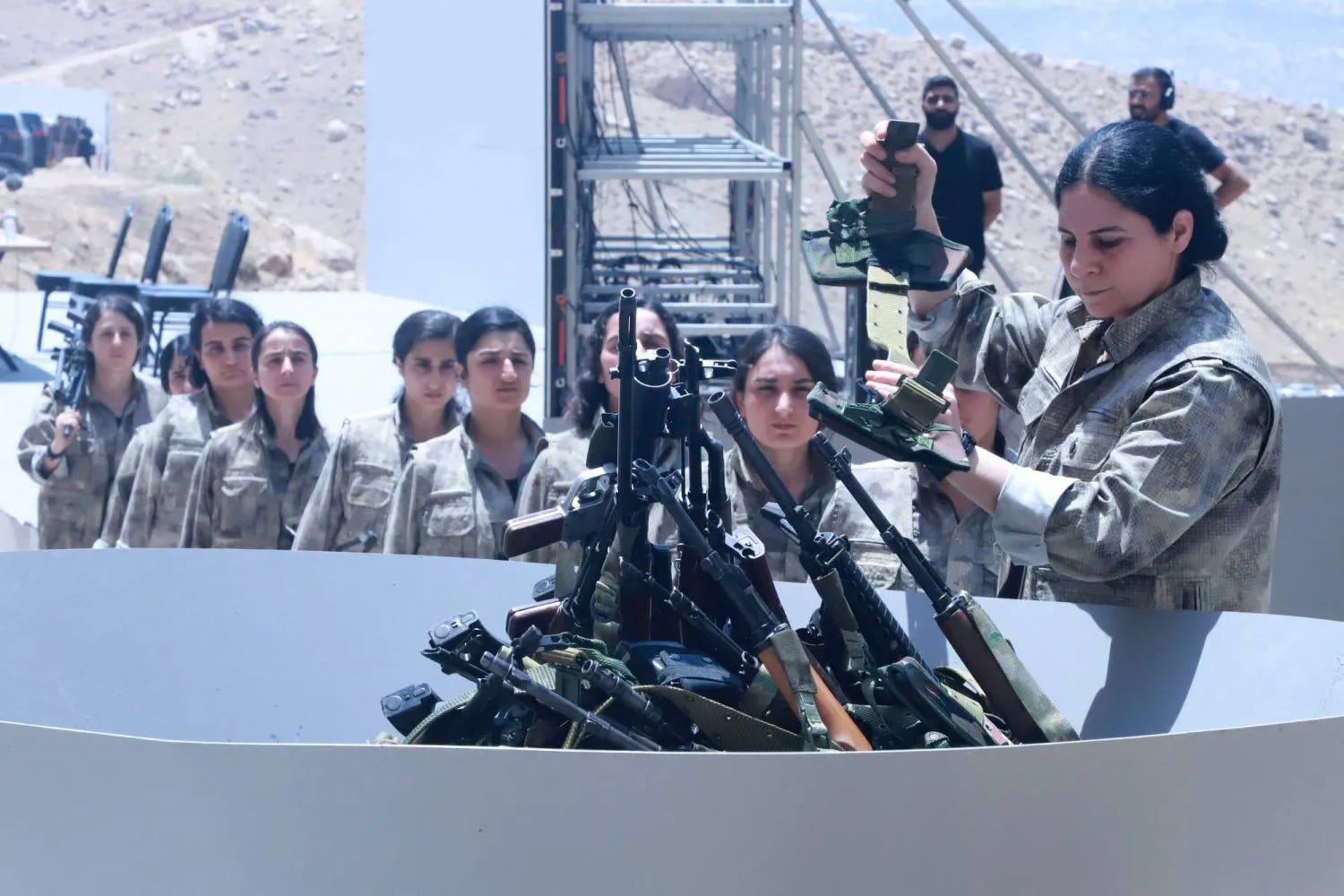
After four decades of bloody conflict between the Kurdistan Workers’ Party (PKK) and the Turkish state, the regional landscape appears to be entering a pivotal phase, with the PKK announcing a halt to its armed struggle and initiating the dismantling of its military wing.
Responding to a call from its imprisoned leader Abdullah Öcalan, the group has declared an end to the use of arms and the beginning of a new political course a step that could bring closure to a conflict that has claimed over 40,000 lives since 1984.
Already, the first wave of fighters has begun withdrawing from Turkish territory toward the Qandil Mountains in northern Iraq, as part of a phased disarmament process coordinated with Ankara.
Despite widespread optimism that this move may usher in a long-awaited peace, caution and apprehension continue to dominate both sides of the conflict. Is this truly the start of a sustainable solution? Or are we witnessing the prelude to a new iteration of the same struggle?
Cautious Optimism in Turkey
The PKK’s announcement was met with cautious optimism across various segments in Turkey. Many see it as a rare opportunity to turn the page on a war that has exhausted the region and to open a new horizon for political engagement.
The Turkish government welcomed the move in principle, framing it as a positive development that aligns with its stated goal of achieving a “terrorism-free Turkey.” Officials in Ankara have revealed plans to introduce special legislation that would allow thousands of Kurdish fighters and civilians living in exile in northern Iraq to return home under a gradual reconciliation framework.
These laws are aimed at facilitating the reintegration of returnees into society while providing them with legal protections though this does not include a blanket amnesty.
Authorities have clarified that certain fighters will face judicial proceedings, while senior PKK commanders are expected to be relocated to third countries as part of discreet arrangements.
Members of the parliamentary reconciliation committee stress that progress remains contingent on the full dismantling of the group’s armed wing.
At the same time, key Kurdish demands such as improving the detention conditions of Abdullah Öcalan and other political prisoners, and advancing constitutional and cultural reforms remain suspended amid Ankara’s reluctance to fully engage with these issues.
This hesitation revives memories of the failed reconciliation process of 2015 and the subsequent crackdown that saw the arrest of lawmakers and mayors, including prominent Kurdish politician Selahattin Demirtaş. This history continues to erode mutual trust. MP Gulistan Kılıç Koçyiğit voiced concern over the government’s ambiguous stance, noting that the official rhetoric remains vague and lacks a clear roadmap to revitalize the peace process.
President Recep Tayyip Erdoğan, for his part, insisted that disarmament must be unconditional and that the state would maintain its firm stance. He warned that any disruption of the peace process would be met with decisive military force.
This contrast between the government’s reassuring tone and Kurdish skepticism underscores the fragile and unpredictable nature of the current moment. While there have been encouraging developments such as the first visit in years by Kurdish MPs to Öcalan in prison, and unexpected support from Erdoğan’s nationalist ally Devlet Bahçeli many Kurds still question whether this is the beginning of a genuine political reconciliation.
Guarded Relief in Iraqi Kurdistan
Authorities in Iraq’s Kurdistan Region have welcomed the developments with cautious relief. The Kurdistan Regional Government (KRG) has long found itself caught between the presence of PKK fighters in its mountainous border areas and the repeated Turkish airstrikes that have severely impacted security, the economy, and the social fabric of local communities.
With the PKK now beginning to dismantle its bases and withdraw its fighters, Erbil sees a potential end to this state of attrition and an opportunity to restore some stability along the border.
KRG Prime Minister Masrour Barzani described the initiative as a first step toward lasting peace, calling for a new era of understanding and stability. Major Kurdish political parties the Kurdistan Democratic Party (KDP) and the Patriotic Union of Kurdistan (PUK) also expressed clear support for the process, conveying in meetings with Turkish Kurdish delegations their hope that this marks a true beginning to end the entrenched conflict.
In reality, the region has borne a heavy cost from the PKK’s continued presence, particularly after the collapse of peace efforts in 2015. Northern Iraq has effectively become an open battleground between the PKK and the Turkish military, which has advanced more than 15 kilometers into Iraqi territory and established dozens of military bases in the Duhok province.
This presence has significantly undermined the KRG’s ability to exercise full sovereignty over these areas.
The fighting has displaced thousands from mountain villages, and civilian casualties have recurred most notably during the shelling of the Zakho resort in the summer of 2022, which killed several tourists. The incident reinforced Erbil’s belief that dismantling the PKK is essential for restoring stability and halting Turkish military operations.
Nonetheless, the KRG remains concerned about who will fill the power vacuum along the border once the PKK withdraws. While Baghdad has also welcomed the peace trajectory, it has publicly demanded that Turkey end its military presence and withdraw its forces from Iraqi territory, asserting that Turkey’s security justifications are no longer valid.
This dual anticipation of peace and of potential replacement by a permanent Turkish force puts the KRG in a delicate position. Observers agree that long-term stability in northern Iraq requires balanced security arrangements, including a stronger presence of Peshmerga and border guards to prevent any power vacuum that might be exploited by extremist groups or external actors.
The Complex Puzzle of Northern Syria
Northern Syria today presents the most entangled front in the Turkish-Kurdish reconciliation process, where regional agendas intersect with intricate local dynamics. Although the Syrian Democratic Forces (SDF) a Kurdish-led coalition is not structurally linked to the PKK, Ankara views it as the party’s Syrian extension and considers its disarmament a parallel condition to ending the PKK’s armed presence.
For years, Turkey has tied any prospect of rapprochement with Syrian Kurds to the dismantling of the People’s Protection Units (YPG), the core component of the SDF. Ankara sees the continued existence of this armed entity as a threat equivalent to the PKK insurgency in southeastern Turkey.
As the peace process with the PKK gained traction, Turkey began pressing for the inclusion of the SDF in new regional security arrangements, even urging Öcalan to issue a clear call for these fighters to disarm, citing his symbolic authority over them.
Turkish officials have explicitly stated their expectation that Kurdish forces in Syria should follow the PKK’s lead, especially given the existence of an autonomous Kurdish administration in northern Syria, which Ankara views as part of the PKK’s broader regional project.
In response, SDF leaders have denied any organizational ties to the PKK and reject the idea that they should bear the burden of its negotiations with Turkey. Nevertheless, SDF commander Mazloum Abdi welcomed Öcalan’s peace call as a gesture that could ease tensions in the region, but emphasized that Öcalan’s statements “do not apply to the situation in northern Syria.”
He insisted that his forces would not disarm, given their responsibility to protect their regions amid persistent Turkish threats, remnants of ISIS, and uncertainty regarding the Syrian regime’s stance toward Kurdish autonomy.
The Kurdish self-administration in Syria argues that surrendering arms without clear political and security guarantees would leave their areas vulnerable. Turkey, on the other hand, maintains that the continued existence of a large armed force on its southern border presents an equally grave risk.
In short, northern Syria remains an extension of the Turkish-Kurdish conflict, but with its own unique complexities. Any misstep in this theater could unravel progress made in Turkey. Syrian Kurds are therefore watching Turkish-PKK talks with intense caution, demanding concrete international assurances before considering any path toward demilitarization or repositioning their forces.
Lasting Peace or Looming Void?
As the Kurdish question in Turkey and the region reaches a critical juncture, one central question looms: Is silencing the guns enough to build lasting peace? Or will the absence of a comprehensive political settlement simply reproduce the conflict in new forms?
While the dismantling of the PKK’s military structure is an unprecedented move since its founding, true peace cannot be reduced to disarmament alone. It requires addressing the root causes that sparked the conflict four decades ago.
For Turkey, experts outline a clear set of prerequisites for peace and stability: recognition of Kurdish cultural and linguistic rights, an end to legal discrimination, expanded political participation, genuine development in Kurdish-majority provinces, and resolution of political prisoner cases all while dismantling exclusionary policies that have fueled resentment.
PKK leaders argue that the organization may dissolve, but the grievances that gave rise to it will persist unless the core issues are addressed. Remzi Kartal emphasized that armed struggle was a response to Kurdish identity denial, while Murat Karayılan stated that giving up arms is contingent on a fair settlement that includes a mutual ceasefire and political guarantees above all, the release of Abdullah Öcalan.
The post-PKK phase also raises other concerns. Thousands of fighters await a defined future, and without safe paths to civilian life or political integration, analysts warn that some could gravitate toward more radical factions, or their precarious status might reignite cycles of violence.
For both Iraqi Kurdistan and Syria, a successful Turkish-Kurdish reconciliation could mean tangible regional stability. But this outcome hinges on the complete dismantling of the war apparatus, the cessation of Turkish military operations beyond its borders, and the incorporation of local Kurdish forces into clear political frameworks that ease security concerns and preserve hard-won gains under recognized constitutional arrangements.
In the end, burning weapons may symbolize the end of war, but peace demands mutual commitment, political and security guarantees, and a shared vision for the future one that acknowledges the fears of both sides.
Without these conditions, caution will continue to prevail, and the risk of renewed conflict under different names will remain. But if this moment is seized politically, militarily, and economically, it could pave the way, for the first time, toward a historic peace that closes the chapter on the longest conflict in modern Turkish history.
