

Leaked U.S. intelligence has revealed that China is preparing to supply Iran with new air defense systems in the coming weeks, according to three individuals familiar with recent intelligence assessments who spoke to CNN. The development raises significant questions about the trajectory of the U.S.-Israeli war against Iran.
According to these leaks, U.S. assessments suggest that Tehran may seek to exploit the current ceasefire to rebuild parts of its military infrastructure, drawing on support from key external partners. Some of these evaluations indicate that Beijing could route any potential shipments through intermediary countries in an effort to obscure their true origin and avoid political embarrassment or direct diplomatic costs.
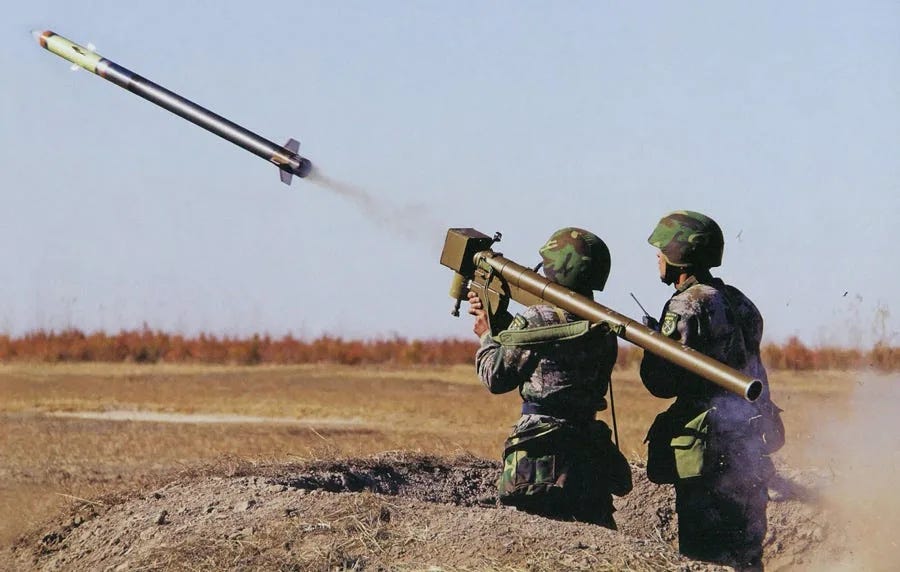
The circulating information points specifically to shoulder-fired air defense missiles, known as MANPADS. These systems are notable not only for their timing but also for their implications. If confirmed, their introduction into Iran’s arsenal would not merely represent an incremental addition of weaponry, but rather a calculated effort to enhance deterrence capabilities.
The sensitivity of these developments is heightened by their political timing. They come ahead of a potential visit by U.S. President Donald Trump to China early next month for talks with Chinese President Xi Jinping, making the issue—if substantiated—a potentially pressing item on the agenda between the two powers.
Although a spokesperson for the Chinese embassy in Washington swiftly denied the reports, calling them inaccurate and asserting that China has not supplied weapons to any party in the conflict, the denial has not tempered the American response.
Trump issued a direct warning to Beijing, suggesting it would face consequences if the intelligence proves accurate an indication that Washington views the matter as more than a routine leak, but rather as a potential strategic threat.
This narrative does not appear in isolation. U.S. media outlets have increasingly highlighted what they describe as forms of military or logistical support provided to Iran by its allies, particularly China and Russia. This raises fundamental questions: What might drive Beijing to take such a step at this critical juncture?
And what would be the scope of a possible U.S. response? More importantly, how might such a development, if confirmed, reshape the rules of engagement and push the conflict into a more complex and dangerous phase?
An Exceptional Escalation
As of this writing, these claims remain within the realm of intelligence leaks, with no official confirmation or conclusive public evidence that China is indeed moving to arm Iran directly. However, if these assessments are later verified, they would signal that the regional and international landscape is on the brink of an exceptional escalation in the arms race one that could disrupt existing balances and reshape the conflict beyond conventional boundaries.
The transfer of air defense systems in such a manner via intermediaries and at a moment of heightened sensitivity marked by U.S. military mobilization and fragile negotiations already strained by mistrust renders these leaks too consequential to dismiss as routine information.
Their deeper political significance lies in the possibility that they place Beijing, even from behind the scenes, at the heart of the war’s equation as an active participant in its trajectory, even if it seeks to obscure its direct involvement or deny responsibility for exporting such weapons, which could ultimately be traced through intelligence channels.
The narrative gains further weight in light of remarks made days ago by the U.S. president, who stated during a press conference that an F-15 fighter jet shot down over Iran last week was hit by a “shoulder-fired, heat-seeking missile.” Tehran, for its part, claimed it used a “new” air defense system but offered no further details.
Amid this ambiguity, speculation is mounting over whether that system may have been of Chinese origin a possibility that, if confirmed, would not only add a new dimension to Iran’s military capabilities but also significantly amplify the political and military weight of these leaks.
What Are MANPADS?
MANPADS are shoulder-fired air defense systems that are relatively lightweight, allowing a single individual to carry and operate them. They are used to target aircraft and helicopters, particularly those flying at low altitudes, during takeoff or landing, or in close-range engagement environments where maneuverability is limited.
Their danger stems from two parallel factors. First, their portability and ease of concealment make them difficult to detect, track, or neutralize. Second, their effectiveness in threatening or downing aircraft especially at low altitudes creates a more complex operational reality for airspace management and complicates any potential airborne operations, including amphibious or aerial landings in sensitive areas or near strategic islands.
In response to such threats, U.S. aviation would likely need to adjust its operational patterns flying at higher altitudes, altering routes, and revising rules of engagement to reduce risk. However, such measures inevitably increase operational costs, complicate battlefield dynamics, and heighten the risk of both human and material losses. This helps explain why limiting the proliferation of these systems has long been a consistent U.S. objective.
The Third-Party Tactic
According to CNN, the proposed scenario does not involve China delivering these missiles directly to Iran, but rather through intermediary countries a method commonly referred to as the “third-party” approach. This tactic allows states to transfer sensitive shipments without overtly revealing their involvement, whether due to sanctions imposed on the recipient or a desire to avoid political and diplomatic repercussions.
This pattern is not without precedent. Western media outlets, including Reuters, have previously reported on Chinese-linked networks indirectly connected to Iranian procurement of military components and drones. Similar accusations have surfaced regarding the use of third-party mechanisms in dealings with sanctioned or internationally isolated states.
Yemen has emerged as one such arena of scrutiny. While no conclusive public evidence has confirmed direct Chinese involvement, Washington has repeatedly accused Beijing of facilitating the transfer of components later used in armed drones operated by regional proxies, including the Houthis and Hamas.
Similar dynamics have been observed in Myanmar, where China and Russia have faced accusations of providing material and military support to the ruling military council, as well as in North Korea, which frequently appears in discussions about sanctions evasion networks and indirect supply chains.
In this context, the essence of the leaks suggests that Beijing, if the reports are accurate, is not operating through overt engagement. The “third party” thus becomes not merely a logistical pathway, but a political tool one that grants China plausible deniability while enabling it to support allies or partners without bearing the full cost of direct exposure.
Not Free Support… What Does Beijing Want?
Any Chinese support for Iran particularly if conducted covertly cannot be viewed as gratuitous or detached from strategic calculations. Rather, it appears, if confirmed, to be part of a deliberate approach guided by clear objectives in a highly fluid regional moment.
Foremost among these is the erosion of U.S. influence in the Middle East by raising the cost of military, political, and economic engagement. The longer and more complex the conflict becomes, the greater the burden on Washington—whether in terms of military deployment, alliance management, or mitigating economic and security fallout.
At the same time, China appears intent on preserving Iran as a regional deterrent force, one that should not be allowed to collapse or undergo strategic dismantlement. A severely weakened Iran would likely open the door to greater American dominance in the region an outcome that does not align with Beijing’s broader strategic interests.
This consideration is further amplified by Iran’s significance within China’s economic and geopolitical calculations whether in terms of energy, regional connectivity, or its role as a key partner in safeguarding Chinese strategic interests.
Ultimately, these factors converge toward a broader objective: strengthening China’s regional and global presence. Weakening U.S. unilateral dominance while preventing the marginalization of Iran would grant Beijing greater room to expand its influence and establish itself as a decisive actor in shaping global balances.
What About the U.S. Response?
The United States is unlikely to remain passive in the face of such a development if confirmed. Washington would likely view it as an exceptional escalation requiring a multi-layered response.
The first track would likely be economic and diplomatic intensifying pressure on China and raising the cost of any involvement in supporting Iran. In this context, Trump’s threat to impose additional tariffs of up to 50% on countries supplying Tehran with weapons carries particular weight, even if it remains, for now, a political warning rather than an implemented policy.
Such pressure could extend beyond general threats to targeted sanctions on specific Chinese sectors, including banking, ports, shipping companies, and major commercial entities—a strategy Washington has employed repeatedly in similar contexts.
The second track would be operational and security-focused, involving efforts to intercept or even target suspected shipments if intelligence confirms their movement. This possibility is reinforced by recent U.S. actions against vessels linked to sanctions evasion networks, particularly the so-called “shadow fleet.”
However, this path carries significant risks. Moving from sanctions and political pressure to direct interception raises the prospect of early and potentially dangerous friction between the United States and China a scenario Washington may seek to avoid unless faced with clear and consequential evidence.
Preemptive Deterrence… What If the Leaks Are False?
Perhaps the most sensitive question is this: What if these leaks are not accurate? Why would Washington allow or even promote their circulation at such a critical moment?
In that case, the leaks cease to be mere intelligence disclosures and instead function as a political tool a form of preemptive deterrence aimed at sending a clear message to Beijing: any consideration of military support for Iran will come at a cost, and Washington is watching, exposing, and threatening consequences even before actions are taken.
From another angle, the leaks may serve to diplomatically pressure China, placing it under early international scrutiny and narrowing its room for maneuver within the gray zone between indirect support and official denial.
They may also help prepare domestic and international public opinion for a more hardline phase whether through intensified sanctions on both Iran and China, or by laying the political and media groundwork for a potential return to military operations if the ceasefire collapses.
In sum, the manner in which these leaks have surfaced, their timing, and their broader context suggest they are far from politically neutral. Even if not entirely accurate, they carry a clear strategic function advancing U.S. objectives ranging from deterrence and diplomatic pressure to shaping the conditions for possible escalation.
