

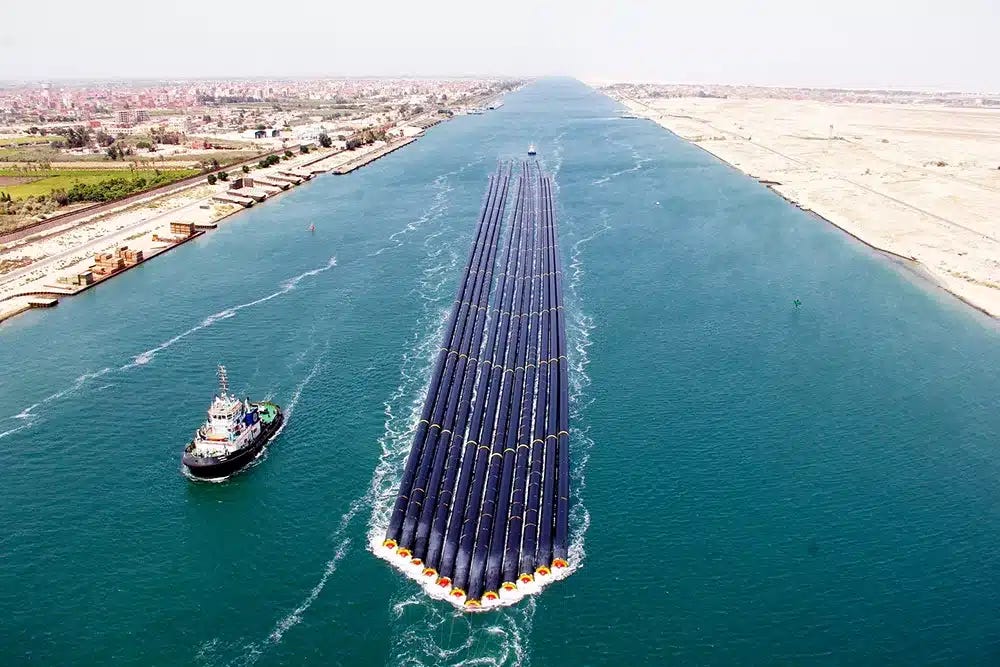
Two years after most container ships and tankers rerouted via the Cape of Good Hope to avoid Houthi attacks in the Red Sea, signs of relative calm in late 2025 have prompted some companies to tentatively consider returning to Egypt’s Suez Canal.
The Suez Canal and the Red Sea remain vital arteries of global trade. Yet, the path to normalization remains fraught with risks and costs, with potential bottlenecks and market disruption if all operators return at once. The real question is not whether traffic will resume, but when, how, and under what conditions?
Crisis by the Numbers
Scale of the withdrawal: The Suez Canal and Red Sea account for roughly 12–15% of global trade. As Houthi attacks surged from November 2023 to mid-2025, with more than 190 incidents container traffic through the canal dropped by 90% by early 2025 compared to early 2023.
Longer voyages and soaring fuel costs: Shipping lines were forced to detour around the Cape of Good Hope, southwest of South Africa, adding 10–15 days to Asia-Europe routes and increasing fuel consumption by around 40%. By 2024, the extended journey caused shipping costs to surge fivefold.
Insurance premiums and evolving threats: Marine insurance in London jumped from less than 0.1% of a ship’s value to 0.7–1% by mid-2025 translating to an extra $360,000 per voyage for a large crude oil tanker.
Economic toll on Egypt: Revenue from the Suez Canal plummeted by over 50% in 2024. Oil and refined product flows fell to around 3.9 million barrels per day down from 7.9 million in 2023. Egyptian President Abdel Fattah el-Sisi stated that canal revenues dropped by more than $7 billion due to the ongoing threats.
Signs of a Return — and What’s Driving It
Relative calm: Following a ceasefire agreement in Gaza and a halt in Houthi attacks on shipping, the International Maritime Organization recorded 28 daily ship transits through the Bab el-Mandeb strait compared to over 70 before the crisis.
By October 2025, Suez Canal revenues had risen 14.2% year-on-year, with 229 ships transiting in the same month the highest monthly figure since the onset of the crisis.
Pioneering returnees: France-based global shipping firm CMA CGM announced the relaunch of its INDAMEX service through the Suez Canal. Its vessel CMA CGM Verdi is scheduled to sail from Karachi to New York on January 15, 2026 marking the first ultra-large container ship (17,000 TEUs) to transit the canal in two years.
Cautious responses from others: Despite cautious optimism, major global players like Maersk and Hapag-Lloyd have yet to set firm return dates. Israeli shipping firm Zim said it would wait for insurance green lights before resuming canal transits. Maersk emphasized crew safety as its top priority and ruled out a rapid return.
Why a Swift Return Remains Unlikely
Persisting risks: Future decisions hinge on the perceived capability and intent of the Houthis to resume attacks. Data firm Xeneta, which monitors shipping rates and contracts, said operators won’t return on the basis of ceasefire statements alone they want “tangible proof” and insurance-backed guarantees. A lack of trust continues to delay a full-scale return.
Insurance hesitation: Insurers are reluctant to assume liability, especially with the marine insurance market now more adept at identifying high-risk targets. Vessels linked to Israel, the UK, or the US face steeper premiums.
Global firm Howden Insurance warned that risk pricing could remain elevated for years and that resuming direct oil shipments through the Red Sea could take “seasons, not weeks.”
Market pressures: Zim’s CEO noted that a return to the Suez would flood the market with container vessels at a time when new orders are already straining demand ships on order represent around 31% of the global fleet, potentially driving prices downward.
Realigned alliances: Dutch financial group ING reported that the Gemini Alliance a partnership between Maersk and Hapag-Lloyd—aims for 90% schedule reliability. The alliance is unlikely to disrupt its new network structure unless long-term stability is assured.
Market Impact and Freight Rate Dynamics
Rising overcapacity: According to Xeneta analysts, a rapid return to the Suez route could inject 20–30% additional capacity on Asia–Europe corridors, erasing the impact of the longer Cape route.
Meanwhile, the global fleet expanded by 10% in 2024 and is projected to grow another 6% in 2025 setting the stage for a supply glut that could push spot freight rates from $1,744 per forty-foot container back to pre-crisis levels.
Temporary spike, followed by a drop: A report by US-based logistics platform AJOT forecast that a surge in shipping capacity could initially cause fresh congestion at European ports briefly lifting rates but once schedules stabilize, oversupply will likely cause sharp rate declines.
2026 Scenarios
Gradual return: Experts anticipate some lines may resume Suez transits by December 2025 or early 2026 if calm persists. However, a full recovery may stretch into late 2026. The situation, they say, is like a partially repaired bridge drivers tend to wait before crossing to ensure it’s structurally sound.
Continued caution and insurance hikes: Trade intelligence firm Kpler argued that halting attacks isn’t enough escalations could quickly resume without a broader political resolution. Insurance caution will persist. If attacks resume, premiums could surge again and the region could be reclassified as high-risk.
Climate commitments at stake: Logistics experts warn that a hasty return could undermine emissions-reduction goals. The longer Cape route raised emissions by 40%. A phased return allows time to adopt cleaner fuels and develop greener infrastructure helping the industry stay aligned with International Maritime Organization climate targets.