

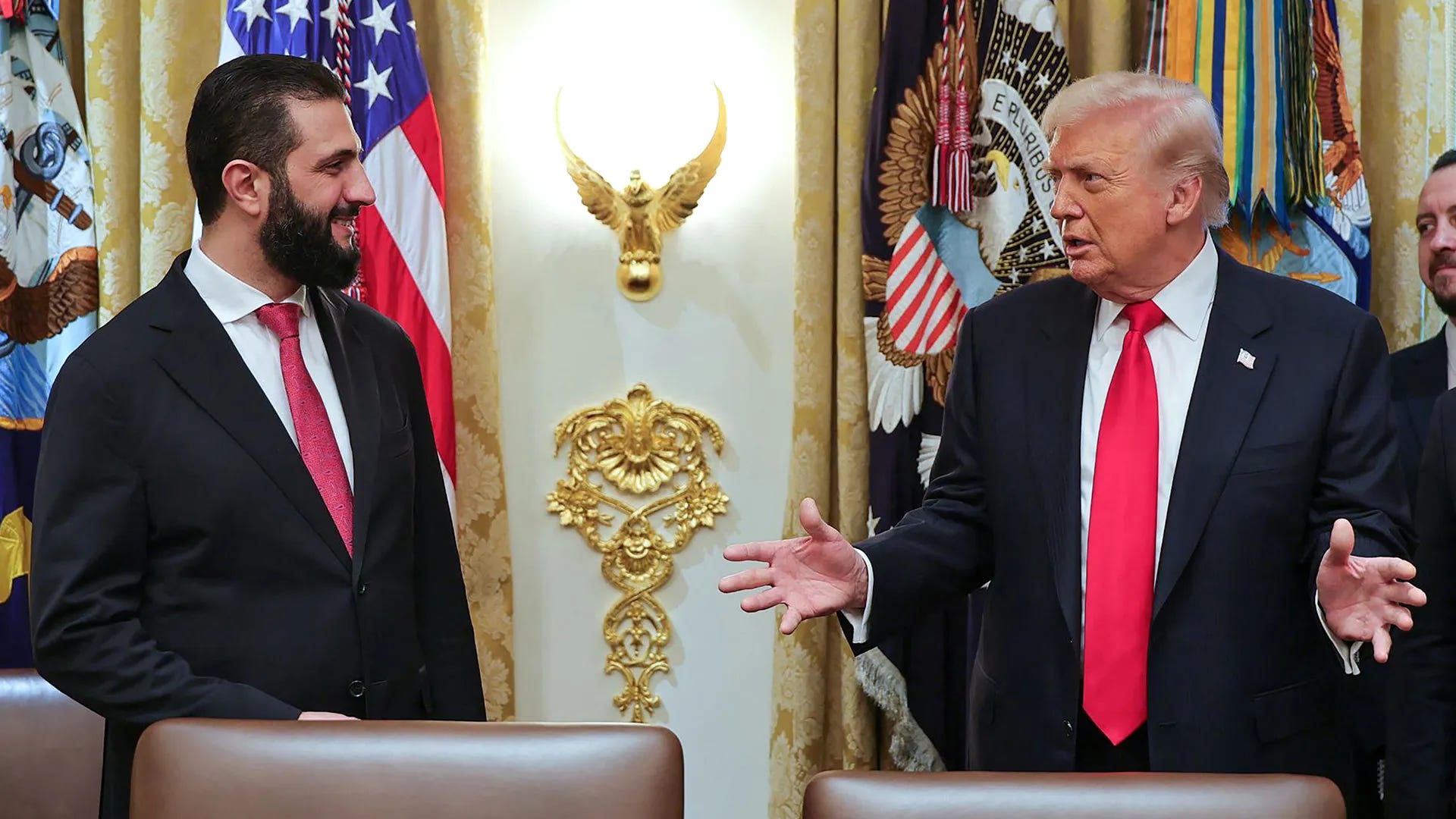
In a development described as the most significant in decades for Syrian-Israeli relations, the United States announced on January 6, 2026, the release of a trilateral statement (American–Israeli–Syrian) outlining practical understandings reached after two days of talks in Paris.
This new agreement, brokered by the United States and attended by high-level Syrian and Israeli delegations, follows a series of secret and public meetings in Baku, Paris, and London. What are the key details of this deal, and what are the prospects for its implementation?
What Did the Agreement Produce?
The negotiations led to an agreement to establish a joint communication mechanism aimed at coordinating security, intelligence, and commercial matters between Syria and Israel under U.S. supervision.
According to the joint statement, the mechanism aims to:
Facilitate continuous and immediate coordination on intelligence sharing between the two sides.
Coordinate de-escalation measures on the ground to prevent clashes or unintended incidents.
Strengthen direct diplomatic communication for the swift resolution of urgent issues.
Explore opportunities for future economic and commercial cooperation.
This platform has been dubbed the “Designated Communication Cell,” envisioned as a permanent hotline between the two parties to quickly resolve misunderstandings and prevent on-the-ground tensions from escalating. All parties acknowledge, however, that the path to a final settlement remains long.
Syria’s Position and Conditions
Damascus has not disclosed further details about the broader issues under discussion, but officials both before and after the agreement have consistently emphasized several core points:
Following the trilateral statement, a Syrian official told Reuters that Damascus would not begin discussions on any “strategic files” with Israel before agreeing on a clear, binding timeline for the withdrawal of occupation forces from all Syrian territories seized after the fall of Bashar al-Assad’s regime.
The latest round of talks in Paris concluded with a Syrian request endorsed by Washington for the United States to propose an initiative to “immediately freeze all Israeli military activity in Syria” during the next phase. The Syrian delegation welcomed the initiative as a step toward creating the conditions for continued dialogue.
Prior to the agreement, another Syrian official described the withdrawal demand as a “red line” that cannot be compromised, affirming Syria’s rejection of any attempt to legitimize the new Israeli occupation, either before or after Assad’s fall, particularly with regard to the Golan Heights.
In previous rounds, Syria accused Israel of stalling the negotiations by fixating on technical and procedural details to delay discussion of core issues. Damascus called on Tel Aviv to abandon its “expansionist mindset” if it genuinely seeks progress.
These accusations reflect a deep-seated lack of trust on Syria’s part regarding Israel’s intentions. Syrian officials argue that the continued presence of Israeli forces on Syrian soil fuels suspicions that Tel Aviv aims to cement a new status quo rather than withdraw.
President Ahmad al-Sharaa has repeatedly stated his unequivocal rejection of any continued Israeli military presence inside Syria. At the same time, he has expressed a clear desire to avoid direct military confrontation with Israel during this critical transitional phase.
Israeli Ambiguity and Intransigence
While Israel has tentatively agreed to the joint security coordination mechanism as a way to avoid direct conflict, it has not made any commitments regarding a full withdrawal from Syrian territory or an end to its recurring airstrikes.
Israel presents its proposals in the negotiations as “security arrangements,” while Damascus views them as an attempt to legitimize a new on-the-ground reality one involving a buffer zone, demilitarization, and restrictions on the Syrian army’s presence in the south, without any clear commitment to withdrawal.
Prime Minister Benjamin Netanyahu’s government has made clear that its top priority is “ensuring the security of its northern border and preventing threats near the occupied Golan region.”
During the latest Paris talks, the Israeli delegation focused on security issues and promoted the notion of “economic cooperation” as a political incentive.
A statement from Netanyahu’s office noted that discussions included what it described as the need to “protect the Druze community in Syria,” a claim Syrian officials have dismissed as a pretext for entrenching Israeli occupation.
Despite talk of potential economic opportunities, Israel has not shown any clear willingness to fully withdraw to pre-December 2024 lines.
Instead, it insists on creating a demilitarized buffer zone in southern Syria as part of any agreement and is also demanding guarantees to prevent the return of Syrian forces to the area.
The Nature of the American Role
The United States is playing the central mediator role in these talks, seeking to promote regional stability following Syria’s internal transformations.
President Donald Trump has publicly expressed support for the al-Sharaa government, viewing it as a key actor in Syria’s reunification process.
As part of this backing, Washington pressured Israel to engage seriously in the negotiations a point highlighted by a late-December 2025 meeting between Trump and Netanyahu in the U.S., during which the American president expressed optimism that “Syria and Israel are close to reaching a security agreement.”
As a result, the pace of negotiations is expected to accelerate this year. In addition to the recent Paris round, intensive regular meetings are expected to be held—possibly in Amman, under U.S. oversight to monitor the work of the joint communication cell and to hash out technical details regarding withdrawal and security arrangements.
Reports suggest that this mechanism may evolve into a permanent coordination center based in the Jordanian capital, tasked with monitoring conditions in southern Syria.
The U.S. has also floated proposals to establish a joint economic zone on both sides of the border, potentially including energy and agriculture projects and even tourist resorts, as part of a broader push toward normalization.
What Are the Prospects?
From the Syrian perspective, the current understandings could serve as a framework for managing tensions rather than resolving them. The most immediate, realistic outcome may be the success of the joint mechanism in defusing security tensions and maintaining stability along the border.
The Jerusalem Post estimates that Netanyahu hopes to present this as a political victory, portraying himself as the architect of robust northern security arrangements. Meanwhile, President al-Sharaa seeks to assert Syrian sovereignty and halt Israeli aggression.
Should the deal lead to a withdrawal to pre-2024 lines, a broader agreement akin to a non-aggression pact or long-term truce could gradually emerge, according to an analysis by Responsible Statecraft, a U.S. foreign policy journal.
The outlet speculates that such a pact could include a temporary delineation of the Golan’s status, whereby Israel retains control over most of the plateau while implicitly recognizing a special status for some areas or villages. This could potentially allow for a symbolic return of some Syrians or joint administration of select sites.
In return, Syria might receive a large incentive package, including Gulf and international funding for reconstruction, the lifting of remaining sanctions, and potentially even formal inclusion in the Abraham Accords normalization framework, Jerusalem Post reports.
Nonetheless, major obstacles remain on the road to a final settlement. Analysts caution that the proposed security agreement is likely to be a temporary measure, aimed at stabilizing the Syrian front without delivering a permanent resolution or comprehensive normalization in the near future.
President al-Sharaa recently emphasized that a security deal “does not equate to full peace or normalization” along the lines of the Abraham Accords. He also reiterated that the fate of the Golan Heights remains a major unresolved issue, calling it a “fundamental matter” that cannot be settled quickly.
Damascus remains adamant about its full sovereignty and the right to reclaim all of its territory, including the Golan, a stance Israel firmly rejects leaving the two sides locked in a prolonged state of neither war nor peace.