

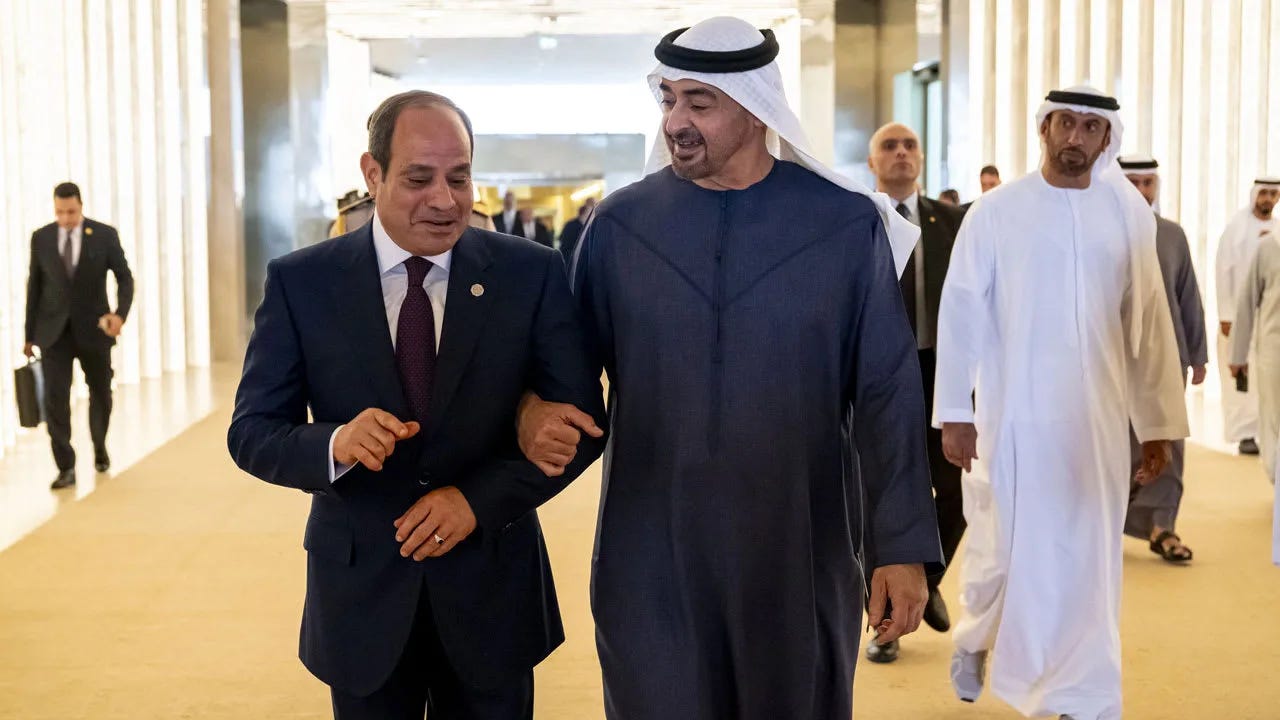
Over the past few days, Abu Dhabi has emerged as a principal destination for Arab and Gulf leaders, at a moment of acute regional sensitivity that coincides with a noticeable strain in Emirati-Saudi relations. According to multiple readings, this tension is linked to the nature of the role the United Arab Emirates has been playing across several arenas from Yemen and Gaza to Libya, Sudan, and the Horn of Africa.
The sequence of visits began with Egyptian President Abdel Fattah el-Sisi on February 9, followed by Bahrain’s Crown Prince and Prime Minister Salman bin Hamad Al Khalifa on February 12. Qatar’s Emir, Sheikh Tamim bin Hamad Al Thani, arrived on February 14, while Kuwait’s Prime Minister, Sheikh Ahmad Abdullah Al Ahmad Al Sabah, had opened this flurry of diplomacy with a visit on February 4.
Although official statements were careful to describe the meetings as “fraternal,” their timing amid profound regional and international shifts, and against the backdrop of geopolitical tensions tied to developments on the U.S.–Iran front lends them dimensions that transcend protocol. They raise questions about the messages and signals embedded within this diplomatic choreography.
A Pressured Context
This burst of diplomacy unfolds as the UAE faces mounting criticism over its regional and security policies criticism that has surfaced in sharper tones even among traditional allies, foremost Saudi Arabia. That dynamic has placed Abu Dhabi in an unfamiliar and complex political test.
Since last December, debate has intensified over the UAE’s foreign policy choices, particularly in light of its controversial rapprochement with Tel Aviv a move critics see as a departure from Arab national security priorities.
As a result, talk has grown of a shrinking regional margin of acceptance for the Emirati role across several files, from Yemen and Sudan to Libya, the Horn of Africa, and Algeria.
These conditions have created an unprecedented level of political pressure on decision-makers in Abu Dhabi, giving the recent visits a significance that goes beyond customary courtesies. Instead, they appear to represent an attempt to break the impasse and open channels to address divergences.
Containment Mediation
Perhaps the most salient feature of this diplomatic activity is the apparent effort by several parties to contain tensions between Riyadh and Abu Dhabi, after their differences reached a conspicuous level last December.
Although relations have not been formally severed, no high-level diplomatic contacts have taken place between the two capitals since the final week of December, according to multiple sources cited by Agence France-Presse.
One of those sources revealed that Bahrain has been leading mediation efforts between the two Gulf neighbors, seeking to resolve misunderstandings, mend the rift, and bring positions closer together.
The issue, the source noted, is sensitive and fundamentally Gulf in nature, and should therefore be resolved “within the Gulf house,” stressing that the initiative is Bahraini rather than a formal move by the Gulf Cooperation Council.
Bahrain’s Crown Prince and Prime Minister, Salman bin Hamad Al Khalifa, met Saudi Crown Prince Mohammed bin Salman in Riyadh before heading to Abu Dhabi to meet UAE President Mohammed bin Zayed.
Cairo has been playing a similar role, working to recalibrate relations and cool tensions between its Saudi and Emirati allies. Just four days before Sisi’s visit to Abu Dhabi, Egyptian Foreign Minister Badr Abdelatty met his Saudi counterpart, Prince Faisal bin Farhan, in Cairo. The following day, Abdelatty spoke by phone with his Emirati counterpart, Sheikh Abdullah bin Zayed a sequence that appears far from coincidental.
According to AFP, Egypt conveyed Saudi messages to the UAE in an effort to build common ground to ease tensions. The Saudi foreign minister had said late last month that “the Kingdom is always keen to maintain strong and positive relations with the UAE.”
Calculations of Cohesion
Despite the sharp criticism, isolating the UAE does not appear to be a preferred option for Riyadh or Cairo. There is a prevailing conviction that preserving Gulf cohesion is a strategic priority, and that any significant rupture could trigger wider regional tremors.
In this light, the current political pressure can be understood as an attempt to recalibrate rather than rupture the partnership. Saudi Arabia and Egypt, in particular, view the UAE as a consequential regional ally whose interests intersect with theirs across numerous sensitive files.
The objective, therefore, is not abandonment, but rather recalibration nudging the Emirati compass back toward shared priorities tied to Arab national security and sovereignty.
From this perspective, the campaign to expose what is described as the UAE’s agenda and alleged conspiracies can be seen as an effort to restrain Abu Dhabi and prompt a reassessment of its policies, easing political tensions with regional allies. Some signs of that adjustment, at least on the surface, have begun to appear.
In Yemen, Emirati forces withdrew in response to a Saudi request. While the UAE has not fully disengaged from the scene, it has adhered to Saudi red lines a move widely interpreted as a desire to avoid escalation with the Kingdom on that front.
In Sudan, developments are gradually constraining Emirati influence through the formation of a regional alliance backing the Sudanese army against the Rapid Support Forces militia, which is supported by Abu Dhabi all without directly confronting the UAE, one of the four members of the quartet tasked with addressing the Sudanese crisis.
In Libya, Riyadh has entered the crisis with its full weight, edging out Emirati influence in the eastern camp by courting General Khalifa Haftar and his forces, reportedly through what has been described as the largest arms deal in Libya’s history, facilitated by the Kingdom’s new ally, Pakistan.
Preserving the Alliance Map
The prevailing view in several Arab capitals is that the current phase demands the highest levels of coordination, and that unilateral moves could carry negative repercussions for all. The priority, therefore, is to keep the alliance system intact amid a rapidly shifting regional balance of power.
From this vantage point, the Saudi-Egyptian camp joined by Qatar, Turkey, and Bahrain — hopes the UAE will internalize the lesson. Potential isolation would be the logical outcome of any disruption to the Arab national security architecture or of unilateral action that disregards the calculations of allies and neighbors.
All of this unfolds under Riyadh’s watchful eye. The Kingdom does not appear intent on sidelining its Emirati ally, but rather on repositioning it within what it sees as the appropriate trajectory one aligned with the broader path that shields the Arab and Gulf order from the political turbulence imposed by recent challenges.
What Does Abu Dhabi Want?
There is little doubt that Abu Dhabi is acutely aware of Riyadh’s approach in backing this diplomatic momentum. Yet its response may not be as predetermined as some expect. The blow dealt to the small but ambitious state is unlikely to pass without consequence.
Operating from a pragmatic standpoint, the UAE appears to be using these incoming visits to signal that it is not in a position of weakness that it remains a pivotal player in the region’s balance of power. By strengthening ties with allies such as Egypt and neighbors like Qatar and Bahrain economically and politically alike Abu Dhabi seeks to deepen these partnerships into a bulwark against any future isolation.
Still, it is too early to predict the outcome of this diplomatic flurry. The moves may succeed in cooling the crisis temporarily and preventing escalation. Yet they could also pave the way for deeper shifts in regional alignments perhaps even ushering in a phase in which the geopolitical map of the Middle East is redrawn along new foundations.
