

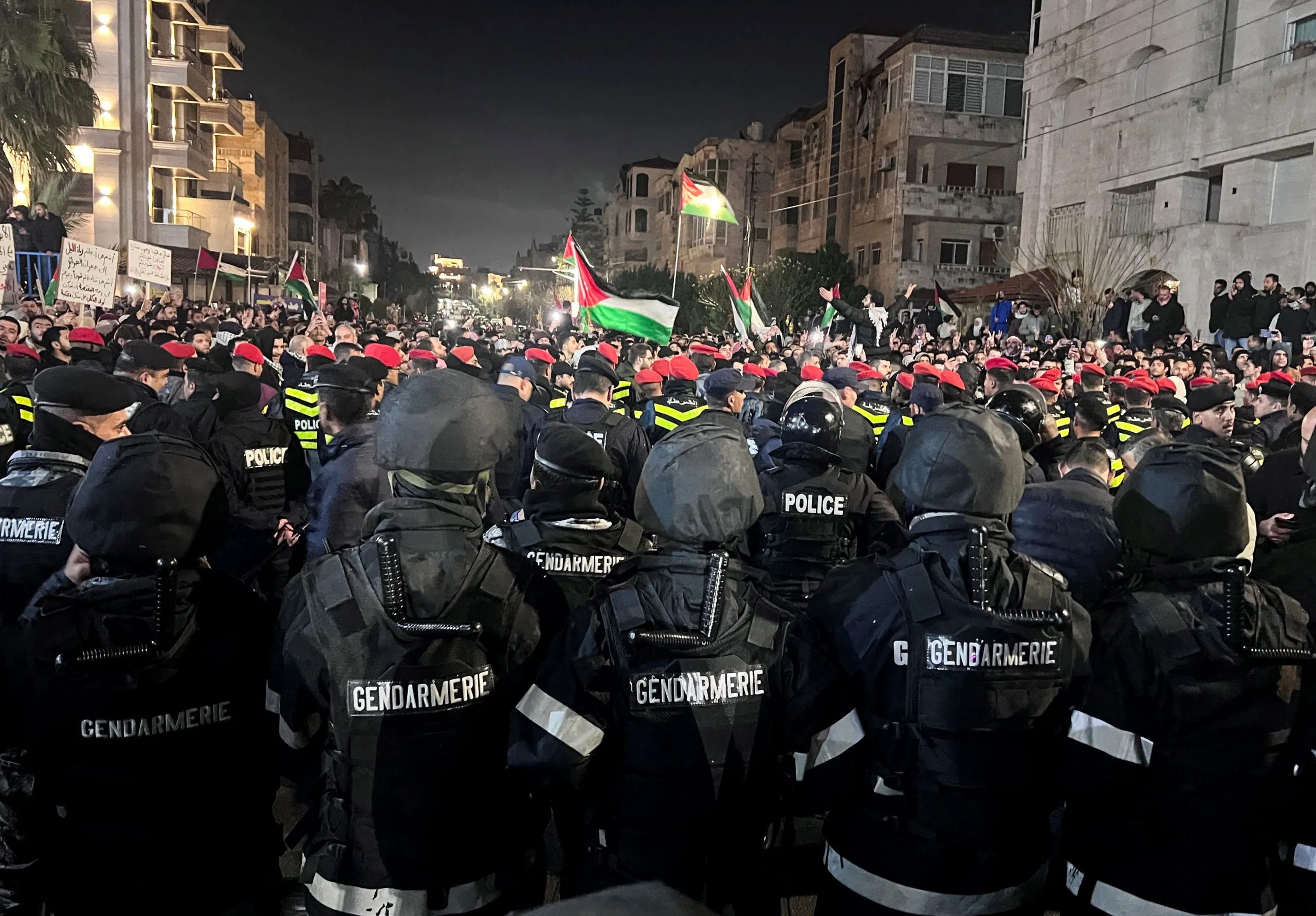
Several months ago, Jordanian security authorities summoned Manal Khaled (a pseudonym) after she published posts on her Facebook account expressing support for the Islamic Resistance Movement, Hamas.
Manal told Noon Post that her phone was confiscated at the time and returned only weeks later. Since then, however, she has been afraid to use it, fearing that her data may have been compromised or that she might be under surveillance. She was also worried that authorities could fabricate charges against her after she transferred money to help an acquaintance in Gaza, particularly if security services read the messages exchanged between them.
Ma’moun Mohsen (a pseudonym), meanwhile, is a well-known activist who had been engaged in activism even before the genocide in Gaza. When he was arrested, security services discovered that his social media accounts were deactivated.
Authorities then searched one of his old accounts, where they found a post supporting the resistance and opposing normalization. According to documents in his case file, he was subsequently sentenced to one year in prison.
Security Agencies and Surveillance
The issue extends beyond forcibly confiscating phones or searching them for information that might lead to charges. Security services have also reportedly engaged in surveillance of activists’ devices.
According to a report titled “From Protest to Peril” published last January by the Citizen Lab, authorities used the Israeli tool Cellebrite to extract data from the phones of activists who support Gaza and its resistance.
The report points to a dramatic contraction of civic space in Jordan, noting that authorities have increasingly adopted both legal and extralegal repressive measures against freedom of expression. Since 2024, Freedom House has classified digital freedom in Jordan as “partly free,” while rating the country’s overall state of freedoms as “not free.”
This trend coincides with security summonses targeting activists for expressing support for the resistance and discussing it publicly, as well as the arrest and prosecution of supporters under the Anti-Terrorism Law.
In an unprecedented move, Jordan’s Court of Cassation the country’s highest judicial body upheld a ruling by the State Security Court sentencing four defendants to twenty years of temporary hard labor on charges of supporting the resistance and attempting to deliver weapons to it.
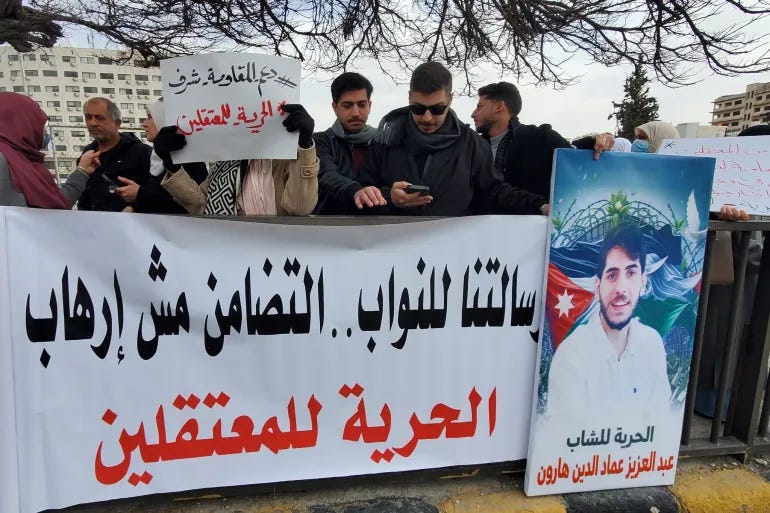
Earlier, the State Security Court sentenced three young men to ten years in prison after accusing them of supporting the resistance and planning to infiltrate the West Bank to attack Israeli targets.
Jordan’s Anti-Terrorism Law defines a terrorist act as “any intentional act, threat, or omission, regardless of its motives, purposes, or means, carried out as part of an individual or collective criminal project that endangers the safety and security of society or incites sedition if it disrupts public order, spreads fear among people, intimidates them, or endangers their lives.”
At the time the law was passed, many voiced concern over this definition. Among them was attorney Fathi Abu Nassar, then head of the Freedoms Committee at the Professional Associations, who said in press statements that the most dangerous aspect of the law is that it fails to distinguish between legitimate resistance and terrorism, effectively criminalizing solidarity with resistance against occupation a charge now used against activists supporting Gaza.
Between Surveillance and Prosecution
Abdul Qader Al-Khatib, a defense attorney representing Jordanians detained over cases related to supporting the resistance, links surveillance directly to prosecutions.
He told Noon Post that security agencies have the authority to refer individuals to court or cybercrime charges if they find anything on their phones that raises suspicion or displeases authorities.
He added that Hamas is not officially classified under Jordanian law as a terrorist organization. Nevertheless, supporting it may still be interpreted as undermining national security even though international law recognizes the legitimacy of resistance. Despite this, such support is effectively treated as terrorism under the Anti-Terrorism Law.
Another legal expert, who requested anonymity for his safety, said that American and Israeli actors stand behind the operation of surveillance programs used by security agencies, allowing them access to activists’ phones and personal data.
He told Noon Post that phone surveillance primarily targets activists active in the streets in order to deter their activism, intimidate them, and track their movements. Spyware is also used against supporters of the resistance and individuals working on files opposing government policies toward Israel, such as the land bridge project, the peace treaty, and U.S. policies and influence in the country. These groups, he said, are among the most heavily targeted by such surveillance tools.
Through these methods, authorities may expose activists to interrogation, security pursuit, prosecution, or referral to cybercrime courts. At times, they may also use the data extracted from phones to identify other individuals whom security services wish to arrest or investigate.
The legal expert criticized the Jordanian authorities for acquiring Israeli surveillance programs to monitor protesters and supporters of Gaza, despite Jordan’s official statements opposing Israel and the genocide in the Gaza Strip.
He warned that this contradiction endangers the security of Jordanians. As many of his clients who experienced surveillance have expressed: “You handed me over and failed to protect my data, exposing it to a party that poses a threat during wartime.”
Calls to Amend the Law
The legal defense committee for detainees accused of supporting the resistance in Jordan has called on the Jordanian parliament to amend the Anti-Terrorism Law. The committee argues that the legislation has become a primary instrument for criminalizing legitimate national activity.
It urged parliament to fulfill its legislative responsibility by introducing amendments that explicitly end the criminalization of resistance and affirm the right to support it.
Yanal Freihat, spokesperson for the parliamentary Reform Bloc, told Noon Post that the bloc has already submitted a draft amendment to the Anti-Terrorism Law that would exclude support for resistance from its provisions. The proposal is currently before the legal committee, which will later present it to parliament for a vote.
At the same time, the parliamentary Palestine Committee has taken no action regarding the criminalization of Palestinian resistance or the surveillance of Gaza supporters and activists. Committee chairman Suleiman Al-Saoud confirmed this to Noon Post.
Amending the Anti-Terrorism Law could halt the criminalization of resistance, potentially curbing security agencies’ surveillance of its supporters and restoring citizens’ confidence in using their phones without fear.
Kamel Al-Shawarib, a researcher at Citizen Lab, described the profound emotional toll experienced by individuals whose devices were confiscated. Drawing on interviews and testimonies, he recalled the words of one victim: “I felt wronged and violated, as if something had been stolen from me. This happened not because they are strong, but because their legal position is weak.”
Through his work with numerous individuals whose phones had been seized, Al-Shawarib observed noticeable changes in their daily digital behavior. Many have turned to secure messaging applications such as Signal and enabled disappearing messages that delete themselves within hours or even minutes.
He said that anxiety has driven users to avoid storing their real names on their devices. Questions such as “Where and how should I keep my private photos?” now dominate their thinking.
The knowledge that security services may be able to access everything from passwords and personal photos to potentially recovering deleted files has significantly altered people’s technological habits in what he described as a desperate attempt to protect their personal space.
According to estimates cited by the lawyer, dozens—perhaps approaching hundreds—have been detained for directly supporting the resistance through alleged attempts to supply weapons or carry out cross-border operations. Meanwhile, thousands face cases related to expressing opinions or participating in protest activities.
The number of people summoned by security agencies is also estimated to be in the thousands. A joke circulating among Jordanians reflects the frequency of these summonses: “They haven’t called you in yet?” or “They haven’t spoken to you?” a reference to the growing number of security interrogations, particularly by the General Intelligence Directorate.
This situation, many argue, calls for legal reform that would prevent security agencies from surveilling phones simply because of supportive activism especially during the genocide in Gaza and halt the transfer of Jordanians’ data to foreign entities or Israeli surveillance programs.