

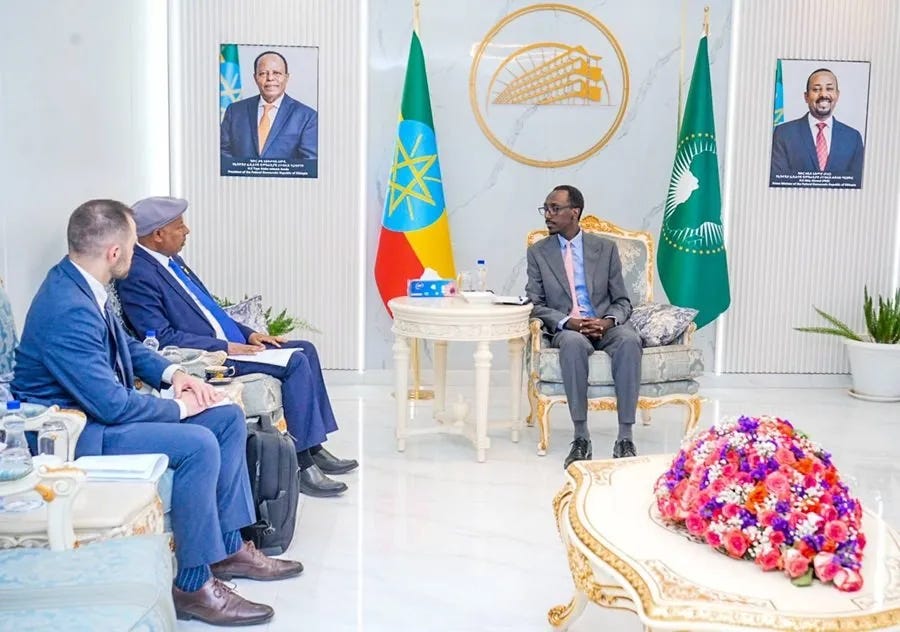
In a lightning visit that immediately raised questions about its timing and objectives, Israeli President Isaac Herzog traveled to the Ethiopian capital of Addis Ababa on Wednesday morning, February 25. During the brief trip, he met with Ethiopian President Taye Atske Selassie and Prime Minister Abiy Ahmed.
Tel Aviv views Addis Ababa as an enduring strategic partner a position previously articulated by Israeli Foreign Minister Gideon Sa’ar, who described Ethiopia as a principal gateway for Israel to consolidate its presence and expand its influence across Africa.
At the same time, Israel’s expanding footprint on the continent particularly in the strategically vital Horn of Africa has stirred mounting concern among several Arab and Middle Eastern states. Many regard this accelerating diplomatic engagement with suspicion, viewing it as a development with potential ramifications for Arab and regional national security. The central question, then, is this: What did Herzog carry in his political briefcase to Addis Ababa, and what messages was he intent on delivering?
A Sensitive Moment
The timing of the visit carried significance well beyond protocol, placing it squarely within a rapidly evolving regional landscape. Herzog’s trip came just one week after Turkish President Recep Tayyip Erdogan visited Ethiopia on February 17 his first trip to the country in 11 years.
The one-day visit, undertaken at the invitation of the Ethiopian prime minister, featured extensive talks on bilateral cooperation and regional issues, foremost among them the shifting balance of power in the Horn of Africa and the Red Sea basin.
During his visit, Erdogan underscored the importance of national unity, respect for sovereignty, and the rejection of separatist tendencies an implicit reference to the issue of “Somaliland.” The trip concluded with a package of agreements that strengthened Ankara’s presence in Ethiopia and across the Horn more broadly, signaling a clear Turkish intent to entrench a firmer foothold in this sensitive geography.
A week earlier, on February 11, Saudi Foreign Minister Prince Faisal bin Farhan Al Saud had met with the Ethiopian prime minister to explore ways to deepen ties and expand cooperation. Riyadh likewise emphasized principles of state unity and sovereignty, aligning with Ankara’s position and reflecting growing Gulf awareness of Ethiopia’s importance within the Red Sea and Horn of Africa equation.
This diplomatic flurry comes amid escalating political and security tensions across the region. As friction intensifies between Washington and Tehran and speculation mounts about a possible confrontation that could redraw regional spheres of influence regional powers are recalibrating their positions, consolidating their footholds, and carving out broader room for maneuver in an unprecedentedly fluid geopolitical moment.
Against this backdrop of diplomatic activism in Addis Ababa and amid competing efforts to reposition within this African logistical nexus Herzog’s visit appears as a calculated move to steady the equation: to preserve alliance bridges with one of Israel’s most important partners on the continent and to prevent erosion of its gains in the face of fast-moving rivals.
What Does Tel Aviv Want?
Herzog’s briefcase likely contained a bundle of files aimed at securing qualitative breakthroughs on several fronts:
First: Undermining Addis Ababa’s Position on “Somaliland.”
Israel has been quietly advancing efforts to broaden international recognition of Somaliland, seeking a more durable opening into the strategically weighty Horn of Africa and its commanding position over the Red Sea. In this context, Tel Aviv may be attempting to sway Ethiopia given its regional clout to support or at least refrain from opposing such a trajectory. The January 6 visit by Foreign Minister Gideon Sa’ar to Somaliland was widely interpreted as an early and conspicuous Israeli signal in that direction.
Second: Curbing Expanding Turkish Influence.
Herzog’s visit is difficult to disentangle from Turkey’s rising profile in Ethiopia and the wider Horn. The divergence between Turkish and Israeli approaches to the region has become increasingly pronounced. Tel Aviv may therefore be offering economic and security incentives designed to temper Ankara’s growing role viewed in Israel as a direct competitor threatening its interests and agenda on the continent.
Turkey’s status as a heavyweight economic actor in Ethiopia, alongside its defense arrangements in Somalia, grants it considerable leverage in sensitive arenas.
Third: Fortifying the Strategic Partnership with Ethiopia.
Israel regards Ethiopia as a pivotal state in its broader African strategy and is keen to repair and deepen ties through expanded economic and investment cooperation. Ethiopia’s ongoing economic pressures render it more receptive to partnerships and assistance. This pragmatic calculus is reinforced by longstanding political and religious ties between the two countries.
Fourth: Enhancing Positioning in the Red Sea and Bab al-Mandab.
Ethiopia may not be the ultimate objective so much as a gateway for amplifying Israel’s presence in the Red Sea theater. The strategic equation revolves around exerting influence—or indirect oversight—over critical maritime corridors, foremost among them the Bab al-Mandab Strait, especially in light of accumulated tensions in that waterway since the outbreak of the Gaza war.
Securing a durable foothold in the Horn particularly through Somaliland could yield strategic dividends tied to maritime security and the protection of Israeli interests, while leveraging Addis Ababa’s political weight as host of the African Union.
Fifth: Leveraging the Visit as Indirect Pressure on Cairo.
Tel Aviv is acutely aware that the dispute between Egypt and Ethiopia over the Grand Ethiopian Renaissance Dam remains one of the region’s most sensitive dossiers. By positioning itself as a potential mediator or as an actor capable of narrowing differences Israel could gain an advanced perch within Africa’s most intricate files.
Simultaneously, this posture may function as a political lever in managing relations with Cairo, whether by improving negotiating terms or expanding the margin for quiet pressure. The strategy, in effect, is to keep channels open with both sides while retaining the dam issue as a card to be played when necessary.
Expanding Israeli Influence in Africa
Since the 1960s, Israel has pursued a methodical policy of outreach toward Africa, seeking to break the diplomatic isolation that Arab states once sought to impose and to cultivate networks of influence with newly independent African countries.
That trajectory suffered a sharp setback following the 1973 October War, when most African capitals severed ties with Tel Aviv under Arab pressure and amid a wave of solidarity with the Palestinian cause.
Relations gradually resumed in the early 1990s and accelerated markedly under Prime Minister Benjamin Netanyahu, who treated Africa as both a diplomatic and strategic priority.
Within this framework, Israel has sought institutional anchoring within continental bodies, including efforts to secure observer status at the African Union an issue that remains contentious among member states.
In rebuilding its African influence, Tel Aviv has deployed a multi-layered toolkit: security and military cooperation; training and technical assistance to various armed forces and security services; and intelligence coordination with select states particularly in the Sahel and the Horn under the banner of monitoring and containing armed groups.
This has granted Israel entry into key decision-making circles. Parallel to the security dimension, Israel has expanded economic channels through trade and investment, exporting agricultural and energy technologies, and engaging in mining and natural resource partnerships soft-power instruments that have bolstered both official and popular ties in several economically vulnerable states.
Against this broader canvas, Herzog’s visit to Addis Ababa fits into a larger contest over influence and strategic anchoring in one of Africa’s most sensitive logistical and geopolitical nodes. In recent months and years, the Horn of Africa has become an open arena for intense regional and international competition, where security and economic interests intersect with calculations over maritime corridors and shifting balances of power.
This momentum underscores the scale of challenges posed by Israeli movements in the region—and the potential for a gradual reshaping of influence maps and trajectories of power, with implications for maritime security and the fragility of the Arab world’s southern flank.
In this increasingly overt contest, traditional management tools appear less effective. The moment calls, instead, for deeper Arab coordination and more cohesive regional blocs capable of balancing Israel’s forward push backed by the United States toward reconfiguring the regional order along new rules and parameters.
