

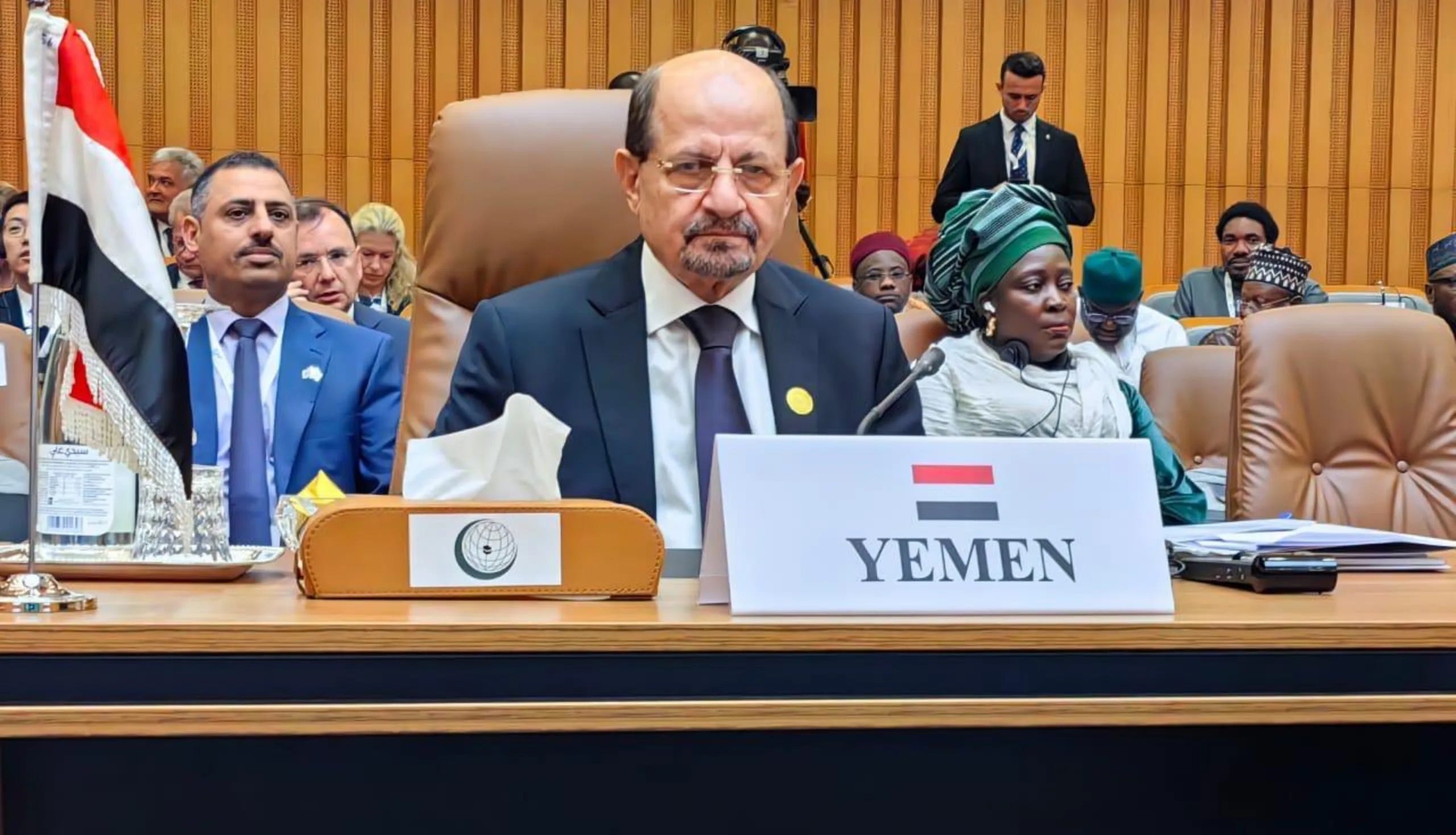
On January 15, 2026, President of the Presidential Leadership Council Rashad al-Alimi appointed Shaea Mohsen al-Zindani as Prime Minister, tasking him with forming a new government following the resignation of former Prime Minister Salem Saleh bin Buraik.
The Presidential Council described the move as part of efforts to “strengthen sovereign decision-making,” amid recent field developments in southern Yemen. According to the official Yemeni News Agency (SABA), the internationally recognized government regained control after the retreat of the Southern Transitional Council (STC) forces, which had previously held sway over Hadramawt and Al-Mahrah governorates.
Against this backdrop, al-Zindani’s appointment coinciding with the inclusion of two new members in the Presidential Council, Mahmoud al-Subaihi and Salem al-Khanbashi cannot be viewed as a routine bureaucratic reshuffle. Rather, it represents a pivotal political moment that transcends administrative reform, reaching into the heart of the struggle over the very concept of the Yemeni state.
It places the legitimacy project in a critical test against the logic of de facto authority, within an open-ended contest over sovereignty, national representation, and decision-making.
A Defining Moment
This decision comes amid a deeply complex domestic landscape and intertwined regional dynamics, transforming it from a procedural step into a landmark moment in the effort to redefine the Yemeni state.
The equation can no longer tolerate the notion of the state as a “pie” to be carved up for influence and positions. The debate is no longer about names or titles within the government; it has extended to the essence of power itself: who controls decisions? Who holds the weapons? And what moral responsibility does the state bear toward its citizens in times of war and collapse?
This leads to the essential question hanging over the political scene not who leads the government or which figures hold ministerial portfolios but what the new government is tasked with, what objectives it seeks to achieve, and what kind of state it intends to build.
Put differently: Is Yemen on the threshold of a new phase that lays the foundation for a long-term institutional national project? Or are we merely witnessing a recycling of the old order, one that ultimately reproduces the same chaos, albeit under different banners and identities?
In this light, the appointment of Shaea al-Zindani to form a new government takes on greater significance. It signals the nearing end of ambiguity and political gray zones, and suggests a declared intent to name things clearly and move toward the future with new mindsets and tools.
However, if this transformation is real, it comes with formidable challenges. The new government will face four sensitive and decisive tests that will determine its ability to translate this political declaration into concrete reality.
Military Decision-Making Unity
The first challenge facing the new government regardless of its composition or political leanings is the unification of military decision-making. This is a foundational prerequisite for state-building and the restoration of state authority. There can be no effective governance or full sovereignty while armed factions operate outside the state framework and beyond its official military institutions.
A state that does not monopolize the use of force, fails to nationalize arms, and does not impose strict controls on unofficial armed groups remains structurally vulnerable. This gap becomes a permanent weak point or a dagger in the state’s side that can be used at any moment to destabilize it, turning the state into a soft, penetrable entity.
Unifying military command becomes even more critical in light of the role played by various armed formations in southern governorates, some of which supported recent STC mutiny efforts and actively obstructed any momentum toward national unity.
Ignoring these formations or leaving them unaddressed is not a realistic option—it would be a political and security gamble that risks rendering any reform or national project hollow.
Political Decision-Making Unity
Closely tied to the military question is the need to unify political decision-making. A coherent state requires alignment between military and political leadership. Just as armed factions cannot be allowed to exist outside the official state framework, political authority cannot be entrusted to figures or entities that espouse ideologies fundamentally at odds with the goals and unity of the state. Political “cleansing” of sovereign and executive posts becomes an unavoidable imperative.
This necessity was underscored in late December 2025, when a number of governors, ministers, general directors, and institutional heads publicly declared their support for secession, aligning themselves with STC leader Aidarous al-Zubaidi, treating him as a political authority superseding the Presidential Leadership Council.
Keeping such figures in office post-government formation, without accountability or dismissal, would sabotage any serious attempt at state unification. It would entrench fragmented political “cantons” prone to further division, and send a dangerous message: that political mutiny and open disloyalty to national unity can be tolerated. This would undermine the principle of deterrent justice at a time when the state must reassert law and legitimacy.
Countering Incitement Narratives
Since the flight of Aidarous al-Zubaidi and the effective collapse of the STC, southern Yemen has been bombarded with an unprecedented wave of systematic incitement, orchestrated from abroad by al-Zubaidi and supported by networks inside the country.
This rhetoric is no longer spontaneous outrage or protest it is now a deliberate political tool aimed at reshaping public sentiment and pushing the crisis toward dangerous escalation.
Multiple indicators suggest this campaign is strategically directed, aiming to stir unrest and turn the political situation into a widespread public uprising threatening to derail state reunification and institutional restoration.
This incitement relies heavily on populist, emotionally charged language that exploits identity, nationalism, and separatism, tapping into deep public frustration and exhaustion in the south.
Addressing this rhetoric is a national imperative that cannot be delayed. It must be countered through parallel tracks: holding its promoters accountable both legally and politically, and launching a compelling national narrative capable of exposing its contradictions and dismantling its inciting premises.
Still, this remains an uphill battle, given the sharp divisions within the south and the complex roles played by certain regional actors in perpetuating these divisions.
Rebuilding the Internal Front
Alongside efforts to unify military and political leadership and counter incitement, the government must prioritize repairing Yemen’s deeply fractured internal front a product of years of war and division. This cannot be achieved through exclusion or dominance but only through inclusive policies grounded in justice and partnership.
All political stakeholders recognize that southern separatist sentiments enjoy genuine grassroots support, which cannot be dismissed or underestimated. Ignoring this reality or confronting it solely through coercive means will only deepen the crisis and provoke further instability.
Thus, political and social engagement with these constituencies becomes a strategic necessity not as a concession on state unity, but as a method of strengthening the internal front and preventing its exploitation by anti-unity forces. The success of this approach will largely determine whether unity becomes a sustainable reality or remains a political slogan.
A Historic Responsibility
Against this backdrop, Shaea al-Zindani’s mandate to form a new government is not merely a transitional assignment it is a historic responsibility at a moment of exceptional gravity. He is now tasked with reshaping the very model of governance in Yemen.
He must deliver a government fundamentally different from its predecessors one that champions the idea of a unified national state over sectarian or regional fragmentation; a government built on inclusion, attuned to public sentiment and social needs, rather than autocratic instincts detached from the populace.
This responsibility requires that he treat Yemen as a sovereign nation and unified national project not a prize to be divided among competing factions. It also demands he repair the broken trust between Yemenis and their institutions arguably the most daunting task, given the cumulative disillusionment after years of conflict.
To succeed, the prime minister must be granted full political and executive authority, free of restrictions or external interference that might reduce the cabinet to a symbolic shell or powerless secretariat.
On the flip side, the greatest pitfall the new government could fall into would be reverting to the logic of quotas and sectarian-geographic balancing the very approach that doomed past cabinets. Today’s context is far more fragile and complex, and any deviation from the path of inclusive statehood could exact a political and national cost that Yemen may no longer be able to afford.
Diplomatic and Political Credentials
Born on September 16, 1954, in Jahaf district, Al-Dhalea Governorate in southern Yemen, Shaea Mohsen al-Zindani brings with him decades of academic, political, and diplomatic experience qualifying him to lead at this critical juncture.
A law graduate with a PhD in philosophy specializing in legal studies, al-Zindani entered public life early through student activism, serving as head of the General Union of Yemeni Students in 1974 and as Secretary-General of the General Union of Arab Students in 1976. He later taught at the University of Aden from 1978 to 1981.
He then moved into diplomacy, holding multiple posts domestically and abroad. He served as chargé d’affaires in Baghdad (1981–1982), Deputy Foreign Minister in South Yemen (1986–1990), and Deputy Minister of Foreign Affairs post-unification (1990–1991).
Al-Zindani also held high-profile diplomatic roles, including ambassador to the United Kingdom (1991–1994), advisor to the UN mission in Geneva (1994–1997), and ambassador to Italy and other European states (2005–2010). He was Yemen’s permanent representative to the UN’s Food and Agriculture Organization (FAO) between 2008 and 2010.
More recently, he served as Yemen’s ambassador to Jordan (2010–2015), then to Saudi Arabia and the Organization of Islamic Cooperation (2017–2024), before being appointed Minister of Foreign Affairs and Expatriates on March 27, 2024.
He has participated in numerous official and intellectual forums and led Yemen’s delegation during key events including the Arab Foreign Ministers’ summit on May 22, 1990, the day of Yemeni unification. His career lends both political and symbolic weight to his current role and its national stakes. But can he succeed in this monumental task?
