

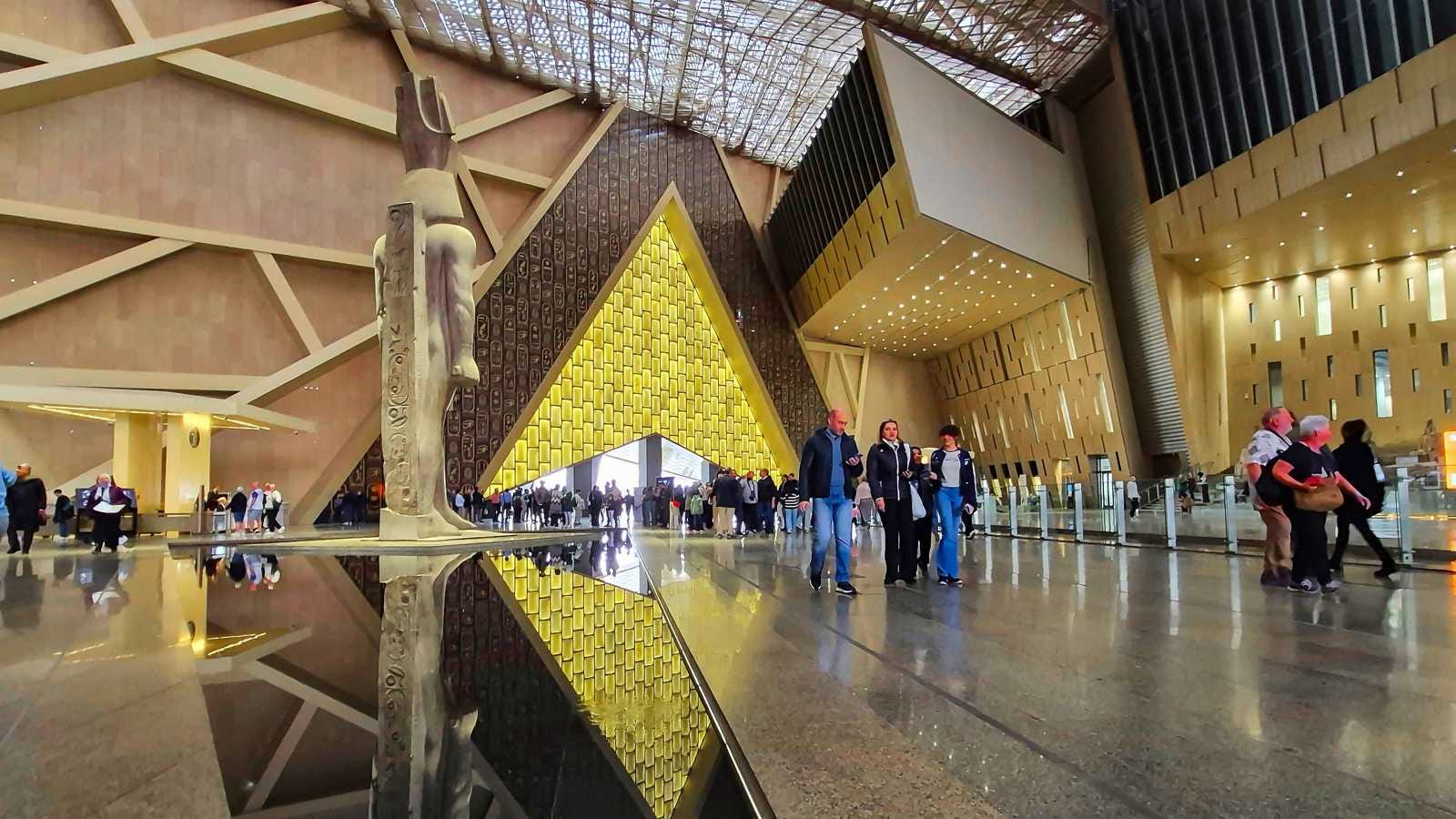
With the opening of the Grand Egyptian Museum, the question of identity has reemerged forcefully in Egypt’s public sphere. Public discourse has largely celebrated Pharaonic civilization as the root of modern Egyptian identity.
Yet as I followed this discussion, I felt the questions ran far deeper than the celebratory surface, and required a voice capable of unraveling these complexities at their core. That’s when I naturally turned once again to Dr. Ali Shariati’s book Return to the Self.
I wasn’t invoking Shariati the man, but rather his book, as if to sit with me before these pressing questions. I read, annotated, and compared his ideas to what’s unfolding in Egypt today.
Gradually, it seemed as though Shariati was answering these dilemmas with remarkable clarity even though his book was written in an entirely different context. What’s striking is that the ideas he proposed still illuminate wide areas of the current Egyptian debate.
In Return to the Self, Shariati argues that identity is not what we place in museums, but what we live in our everyday lives. Identity is not the past that survives in artifacts and statues; it’s that part of the self still alive in the popular consciousness shaping meaning, guiding behavior, and forming the collective conscience.
He draws a clear distinction between heritage and identity: heritage is vast and includes both the living and the dead; identity includes only what is alive and active.
When I applied this framework to Egypt’s situation, the picture became clearer. Pharaonism is an integral part of Egypt’s heritage, and no Egyptian can deny the pride it brings. But it is not the component that animates daily life today.
The language Egyptians speak, the values they hold, their religious conscience, traditions, relationships, and worldview all these were shaped in eras that came after the Pharaonic age. What we see in the museum is part of the memory, but not of the living identity that drives people today.
As I kept reading, I found Shariati restating the same idea in a different form: nations are not built on the past as mere history, but on the parts of it that can be transformed into energy. A past that remains confined to the museum is simply that a past. A living identity is built on the elements people actually experience, not on those they admire in moments of celebration.
In this sense, Shariati through his book helped me see that Egypt’s living identity today is formed from other, more tangible elements: religion, which shapes the collective conscience; the Arabic language, which remains the vessel of awareness and imagination; the modern sense of nationalism, born from Egyptians’ struggles over the past century; the deep partnership between Muslims and Christians; and a unique Egyptian spirituality that’s present in the texture of everyday life.
These aren’t just layers of history they are the active components through which Egyptians move, express themselves, and understand the meaning of homeland and belonging.
As I read on, it became clear that Shariati wants to remind us: memory itself isn’t the problem. Celebrating the Grand Egyptian Museum is natural and necessary. The real danger lies in mistaking memory for identity, and in assuming that the past alone can forge the future.
The museum is a project of memory, not a project of identity. Identity is built in schools, homes, language, and everyday interactions not in glittering halls.
Toward the end of the book, it felt as though Shariati distilled everything into a single sentence: “Returning to the self is not a return to the entire past, but to that part of the past and present that is still alive and gives humans power and vitality.”
And that is precisely what Egypt needs today: to distinguish between memory that evokes pride and identity that breathes life.
I began reading the book in search of answers to the present, and ended up realizing that returning to the self doesn’t mean returning to what was but to what lives in us now and what still inspires.
Egyptian identity today urgently needs this understanding: to be built not on what gleams in a museum, but on what pulses within people. Because the future will not be built by mummies however majestic but by a living identity that gives people clarity of purpose and the power to renew themselves.