

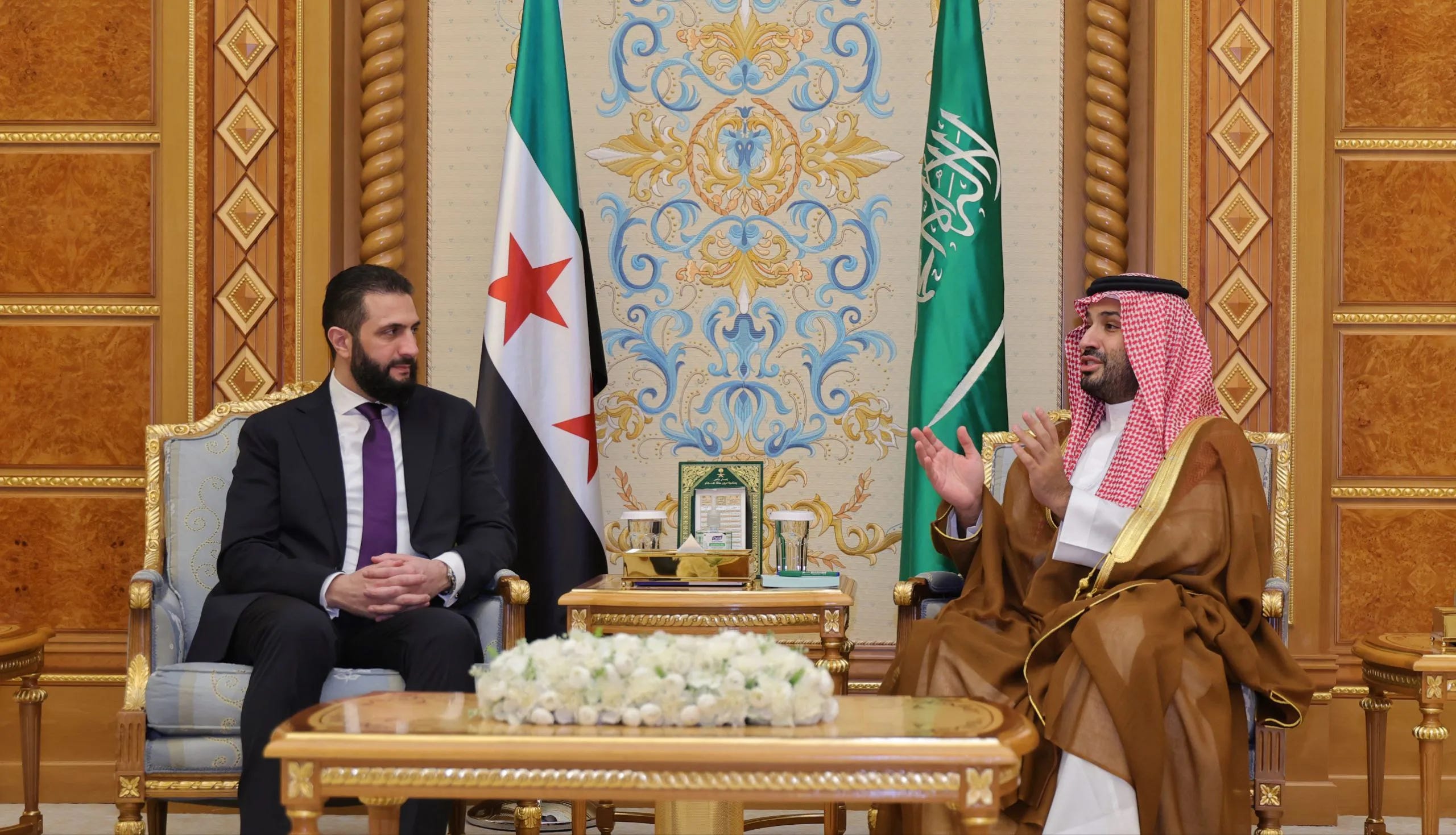
Saudi Arabia has emerged as the leading foreign investor in Syria, with investments worth billions of dollars across a wide range of sectors.
After signing around 47 agreements and memoranda of understanding on July 24, 2025, valued at approximately $6.4 billion, the kingdom significantly expanded its economic presence in the country. The deals involved more than 100 Saudi companies operating in sectors including energy, real estate, industry, infrastructure, financial services, healthcare, agriculture, telecommunications, information technology, construction, and education.
Saudi Arabia further intensified its engagement when Saudi Minister of Investment Khalid Al‑Falih (who was later relieved of his position) announced on February 7, 2026, a $10 billion investment package for Syria. The initiative covers aviation, telecommunications, energy, water, industry, real estate, and development finance, and involves both public and private Saudi entities. The move comes as Riyadh positions itself as a key supporter of Syria’s new leadership.
As Saudi investments in Syria expand, questions are emerging about the kingdom’s motivations and the potential long-term implications. Analysts are asking whether these investments could affect Syrian sovereignty in the future, especially given that Syria remains a high-risk transitional market with limited short-term profitability compared with more stable regional economies.
Strategic Objectives for Saudi Arabia in Syria
Riyadh has reportedly requested that Syria—rather than Israel—serve as the transit country for a fiber-optic cable linking Saudi Arabia to Greece through the Mediterranean as part of the “East to Mediterranean Data Corridor” (EMC) project, according to regional officials cited by Middle East Eye.
Recent agreements also include upgrading Syria’s telecommunications infrastructure through the “Silk Link” project, which aims to connect the country regionally and internationally through a fiber-optic network extending more than 4,500 kilometers. The project, estimated at around $1 billion, will be implemented in two phases over 18 to 48 months, with gradual operational rollout.
A Western official familiar with Riyadh’s investment efforts told Middle East Eye:
“For Saudi Arabia, Damascus represents the heart of regional connectivity. The Saudis want roads, cables, and railways to pass through Syria.”
Saudi Arabia’s attempt to integrate Syria into such projects highlights how the kingdom is leveraging its wealth to support regional allies while competing with the United Arab Emirates and Israel for influence in the region. It also signals a broader regional vision from Riyadh.
According to Mulham Al‑Jazmati, a researcher at Karam Shaar Advisory, the strategy aligns with Saudi Arabia’s domestic transformation. Saudi companies supported by institutions such as the Public Investment Fund are increasingly seeking to expand regionally and export their expertise in energy, infrastructure, and large-scale project management.
Political economy researcher Yahya Al‑Sayed Omar believes Saudi investment in Syria reflects strategic considerations that extend beyond immediate financial returns.
He told Noon Post that the decision is not based on a conventional comparison between stable and high-risk markets. Instead, it reflects the belief that early presence in an economy undergoing restructuring provides advantages that are difficult to replicate later.
Economic expert Mohammad Alabi similarly argues that investing in Syria could give Saudi Arabia long-term structural influence through financial tools, which are more sustainable and less costly than military or ideological instruments. Such investments could fill the economic vacuum in Syria that historically attracted interest from Turkey, Iraq, and Iran.
A Shift in Tools and Saudi Reassertion
Saudi Arabia’s approach to the Syrian file has undergone a notable transformation. The kingdom has shifted away from reliance on military tools toward economic instruments that are quieter but potentially more effective.
After years of backing armed factions, Riyadh is now focusing on investment, financing, and participation in reconstruction projects as alternative channels of influence.
Economic expert Younes Karim told Noon Post that success in managing the Syrian file could open the door for Saudi Arabia to address more complex regional issues in Iraq and Yemen. A breakthrough in Syria could facilitate broader Saudi engagement across the region and possibly reshape Riyadh’s approach to the Lebanese file as well.
Yahya Al-Sayed Omar stressed that the political dimension remains clearly present behind the economic engagement. Strengthening economic ties reinforces political alignment as Arab states reassess their relations. A stable Syrian economy, he argued, would contribute to broader regional stability—an outcome that aligns with Saudi interests in reducing conflict and expanding cooperation.
Investment therefore serves a dual function: it is both an economic instrument and a long-term mechanism of influence that positions Riyadh as a direct participant in Syria’s reconstruction phase.
Could Investments Affect Syrian Sovereignty?
Syria’s geographic location makes it a crucial logistical hub, sitting at the crossroads linking the Gulf to the Eastern Mediterranean and serving as a natural extension toward the markets of Iraq, Turkey, and Europe.
Any investment in Syria therefore provides access to broader transportation and energy networks while enhancing investors’ ability to benefit from shifts in regional trade routes.
According to Yahya Al-Sayed Omar, establishing a foothold in this location fits within Saudi Arabia’s long-term strategy of diversifying economic partnerships and securing flexible supply chains.
One of the most prominent recent deals is the agreement between Saudi low-cost carrier Flynas and the Syrian Civil Aviation Authority to establish a new airline called Nas Syria. Under the arrangement, the Syrian side will hold 51% of the company, while the Saudi partner will own 49%.
Al-Sayed Omar argues that the impact of Saudi investments on Syria’s economic sovereignty will ultimately depend on the institutional framework governing those investments. Large investment volumes alone do not necessarily undermine national decision-making if contracts clearly define state rights, oversight mechanisms, and revenue shares.
The real risk, he said, lies not in partnerships themselves but in weak legal structures or a lack of transparency. Properly managed agreements could transfer expertise and modernize the economy, while poorly regulated deals could restrict economic decision-making in the future.
Alabi echoed this view, stating that sovereignty is not stripped away through investment but lost when state institutions lack capacity and negotiations are conducted without oversight.
He also noted that Syria’s transitional government has amended the investment law through a presidential decree without a legislative framework, granting extensive exemptions and concessions while lacking parliamentary oversight and an independent judiciary conditions that could transform foreign investments into what he called a “sovereign constraint.”
Growing Reliance on Saudi Investments
The Syrian economy could benefit not only from Saudi capital but also from the accumulated expertise of Saudi companies in managing large projects and structuring public-private partnerships.
Over the past decade, Saudi firms have developed contracting models that tie financing to implementation and clear performance indicators. If these models are introduced in Syria, Al-Jazmati argues, the result would not simply be an inflow of money but the introduction of modern management and operational tools capable of addressing long-standing institutional gaps.
However, knowledge transfer is not automatic it depends on contractual design. Investments can easily become long-term concessions that generate little local value unless agreements include clear requirements such as local employment, training, local content, and transparent reporting.
At a time when the Syrian government struggles to pay public-sector salaries in line with rising living costs, the promotion of projects worth billions of dollars highlights a stark gap between announced ambitions and actual capabilities.
According to Younes Karim, this contradiction reflects the transformation of the Syrian economy into one driven by promises and unrealistic projections, undermining effective and sustainable planning.
The government, he argues, increasingly looks to Saudi Arabia for financial backing, logistical support, and technical assistance for exports, rather than pursuing domestic solutions or independent national strategies.
This dynamic could create new centers of influence within state institutions as networks of investors, advisers, and stakeholders align their decisions with Saudi priorities. Over time, such dependency could weaken institutional autonomy and push the state closer to administrative paralysis.
Karim warns that when Saudi Arabia declines to finance certain projects, the result is often not the search for alternative partners but a lowering of ambitions and a retreat from declared goals deepening policy fragility.
Yahya Al-Sayed Omar, however, sees Saudi investment as a calculated bet on geography, political alignment, and Syria’s recovery phase. Its success will depend on careful management by both sides: Riyadh must balance risks and returns, while Damascus must establish a transparent legal environment that protects national interests. If this balance is achieved, investment could become a genuine pillar of economic stability rather than merely deferred financial commitments.
Why Have Announced Projects Not Yet Been Implemented?
Despite the strategic importance of Saudi investment in Syria, many projects announced in July 2025 have yet to move forward.
The head of Syria’s Investment Authority, Talal Al‑Hilali, told Reuters during the World Governments Summit in Dubai that the new investment wave represents the largest since the United States lifted a strict sanctions package on Syria in December 2025. He added that most potential investments would be structured as ready-to-implement contracts rather than non-binding memoranda of understanding.
The lack of implementation reflects the gap between announcements and execution. Memoranda of understanding are often non-binding statements of intent, and implementation faces obstacles including an evolving legal framework, complex property issues, and an undercapitalized banking sector.
Investors also require clearer mechanisms for dispute resolution and guarantees for profit repatriation—elements that remain incomplete in Syria.
Financial transfer complexities and currency volatility also slow the flow of funding, pushing companies to adopt a gradual investment approach tied to measurable stability indicators.
Alabi argues that the delay should not be interpreted as a Saudi retreat but rather as a reflection of Syria’s challenging environment. Like any sovereign fund or multinational company, Saudi investors do not release funds immediately after signing memoranda.
Many previously announced agreements also carried symbolic political significance, serving as signals of support and openness rather than fully prepared projects backed by completed feasibility studies and financing arrangements.
Once technical and financial reviews began, numerous gaps emerged ranging from unprepared infrastructure and unreliable economic data to legal risks and a lack of monetizable sovereign guarantees, aside from limited gold reserves.
New Agreements Announced in 2026
Among the additional agreements announced in February 2026:
The launch of a $2 billion investment fund in Syria to develop two airports in the city of Aleppo in multiple phases, including runway upgrades, expanded passenger terminals, and logistics facilities transforming the northern city into a regional transport and cargo hub.
An agreement between Syria’s Ministry of Water and ACWA Power, one of the world’s largest desalination and renewable energy companies.
Completion of a deal to operate and manage the Modern Syrian Cables Company in partnership with Riyadh Cables Group and the Syrian sovereign fund.
Three additional agreements for major real estate developments aimed at expanding residential and commercial infrastructure under the supervision of the Saudi-Syrian Business Council.