

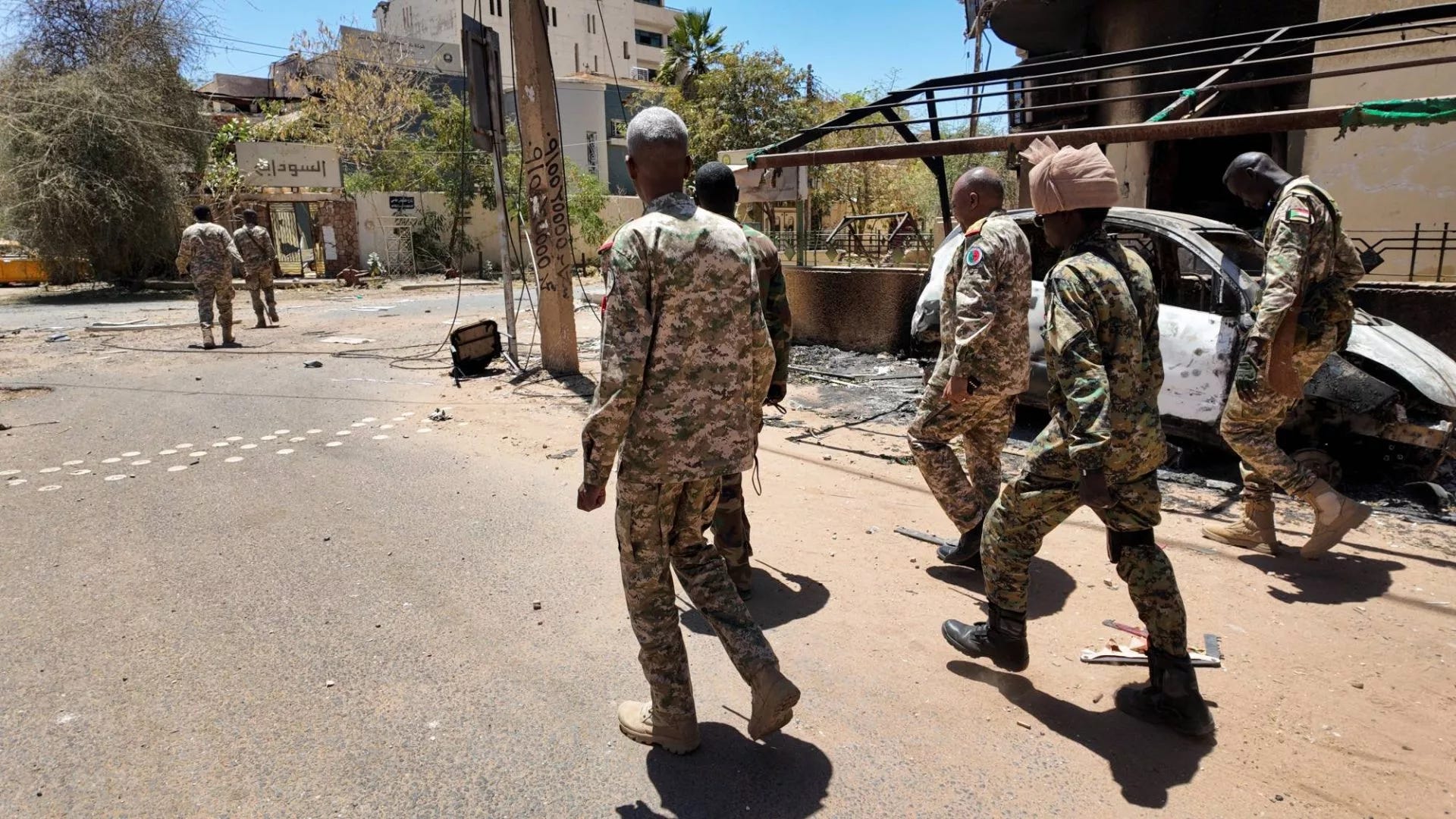
In January 2024, the Rapid Support Forces (RSF) were riding a wave of swift military victories, reaching a peak with the capture of Al-Jazirah State in central Sudan. But it wasn’t long before the Sudanese army regrouped bolstered by various factors, chief among them the resilience of its forces in Babanusa, West Kordofan.
When the RSF first launched its assault on Babanusa in early 2023, the army had yet to establish advanced defensive positions. The militia quickly reached the outskirts of the 22nd Infantry Division and the 89th Brigade inside the city, which had been entirely emptied of its civilian population within days. Yet, RSF suffered a crushing defeat at the hands of besieged army units cut off from external reinforcements.
The RSF withdrew from Babanusa but maintained a land blockade from surrounding towns like Muglad and Al-Fula. A year and a half later, in June 2025 just one month after seizing the town of An-Nuhud the RSF renewed its offensive, only to suffer another setback and retreat once again.
Today, Babanusa is facing a third major assault from the RSF. This time, the militia has returned with significant reinforcements, advanced weaponry, Emirati-supplied armored vehicles, drones, and a Chinese-made FK-2000 air defense system. On November 6, 2025, the system shot down a military transport plane delivering supplies to the 22nd Division.
The 22nd Division comprises several main infantry brigades spread across greater West Kordofan: the 18th Brigade in An-Nuhud, the 89th in Babanusa, the 90th in oil-rich Heglig near the South Sudanese border, the 91st in Al-Fula, and the 92nd the largest stationed across Miram, Hiloof, Al-Qaranti, and Muglad.
A Strategic Location
The 22nd Division is unique among Sudan’s 18 army divisions in that it is based in a non-capital city. While Al-Fula is the capital of West Kordofan, the 22nd operates out of Babanusa underlining its strategic significance as a link between East Darfur and North and South Kordofan.
Babanusa lies 700 kilometers from Khartoum, 360 kilometers from Nyala in South Darfur, and 420 kilometers from El Fasher in North Darfur. It is also the closest city to Ed Daein in East Darfur.
The city hosts the Western Region’s railway headquarters, including one of the most important rail junctions connecting to Wau in South Sudan. It is also home to the Babanusa Dairy Factory, making it an economic and labor hub. The ongoing conflict has devastated the region’s agricultural and economic activities.
Major General Muawiya Hamad Abdullah, commander of the 22nd Division, has vowed that his forces will not negotiate, surrender, or retreat from Babanusa. “There is no money or vehicles here only death for those who approach. We will fight until victory,” he declared.
His statement came after the collapse of a local initiative by the Misseriya tribe proposing a safe withdrawal of army forces from Babanusa and the Heglig oil field without weapons or military equipment so that the RSF could assume control and install a loyal police force in the city.
A Fractured Brotherhood
Misseriya tribal leaders are well aware that the current round of fighting in Babanusa risks spiraling out of control. Nearly all fighters on both sides belong to the same ethnic group many are cousins or even siblings.
This fratricidal conflict threatens widespread destruction of farmland and grazing areas, as well as catastrophic damage to oil fields, with long-term environmental consequences amid an already dire situation.
Following the RSF’s second failed assault on Babanusa, militia leader Mohamed Hamdan “Hemedti” could not hide his frustration. He publicly denounced Hassan Darmoud, commander of the 89th Brigade and deputy commander of the 22nd Division, as a “mercenary.”
In contrast, he praised his own nephew, Ahmed Hamad Darmoud fighting with the RSF and promoted him to First Lieutenant.
This awkward promotion downgrading the apparent rank on his uniform from captain to lieutenant underscored the tribal tensions within Babanusa, where most soldiers of the 22nd Division hail from the Misseriya, whose leaders support the RSF, and some of whose sons fight within its ranks.
From the outset, the conflict in Babanusa has carried strong tribal undertones. Misseriya leaders—part of the largest tribal grouping in West Kordofan and second only to the Rizeigat in terms of their combat presence alongside the RSF had warned against attacking the 22nd Division, fearing an intra-tribal bloodbath and what they described as “creative chaos.”
As polarization deepens within the Misseriya, tribal leaders have once again stepped in to mediate. Throughout the war, Misseriya fighters have worked to secure major cities like Muglad, Al-Fula, and Miram extending as far as Lagawa for the RSF.
The RSF has consistently exploited inter-tribal divisions to recruit as many fighters as possible, including from the Misseriya. These fighters, once deployed in distant battles, now find themselves in direct conflict with their own kin raising the specter of internal fragmentation within RSF ranks.
Thus far, the RSF appears unconcerned with these dangers. It continues to pour reinforcements into Babanusa and arrests civilians including women and children accused of having relatives in the army. This signals the RSF’s intent to turn Babanusa into a full-fledged tribal conflict it can later manipulate to its advantage.
The Next Tribal War
The fighting in Babanusa, though confined geographically, could drag on for months. As clashes continue, they risk evolving beyond conventional warfare into a battle for influence within the tribal landscape itself.
What began as a confrontation between state forces defending Sudan’s sovereignty and a militia seeking profit from chaos now threatens to morph into a tribal conflict potentially destabilizing much of West Kordofan. The internal contradictions within the Misseriya—who form the RSF’s social base in Kordofan could ignite an intra-communal civil war.
Divided loyalties within a single ethnic group battling across the same terrain are bound to escalate into internal rifts and revenge-driven reprisals, fueled by the entrenched culture of vendetta in western Sudan. These dynamics could severely undermine RSF positions across West Kordofan.
The RSF’s continued attempts to overrun the 22nd Division widely seen as the last institutional embodiment of the state in the region will have dire social repercussions.
Such confrontations could fracture the militia’s cohesion and reshape power dynamics in the event of internal defections, especially given the decentralized structure of the RSF, whose fighters pledge allegiance to individual commanders rather than a unified hierarchy.
In the end, what is unfolding in Babanusa cannot be reduced to a simple military confrontation. At its core, it is a test of tribal solidarity one that may lead to lasting internal divisions and long-term instability far exceeding the scope of the current war.
