

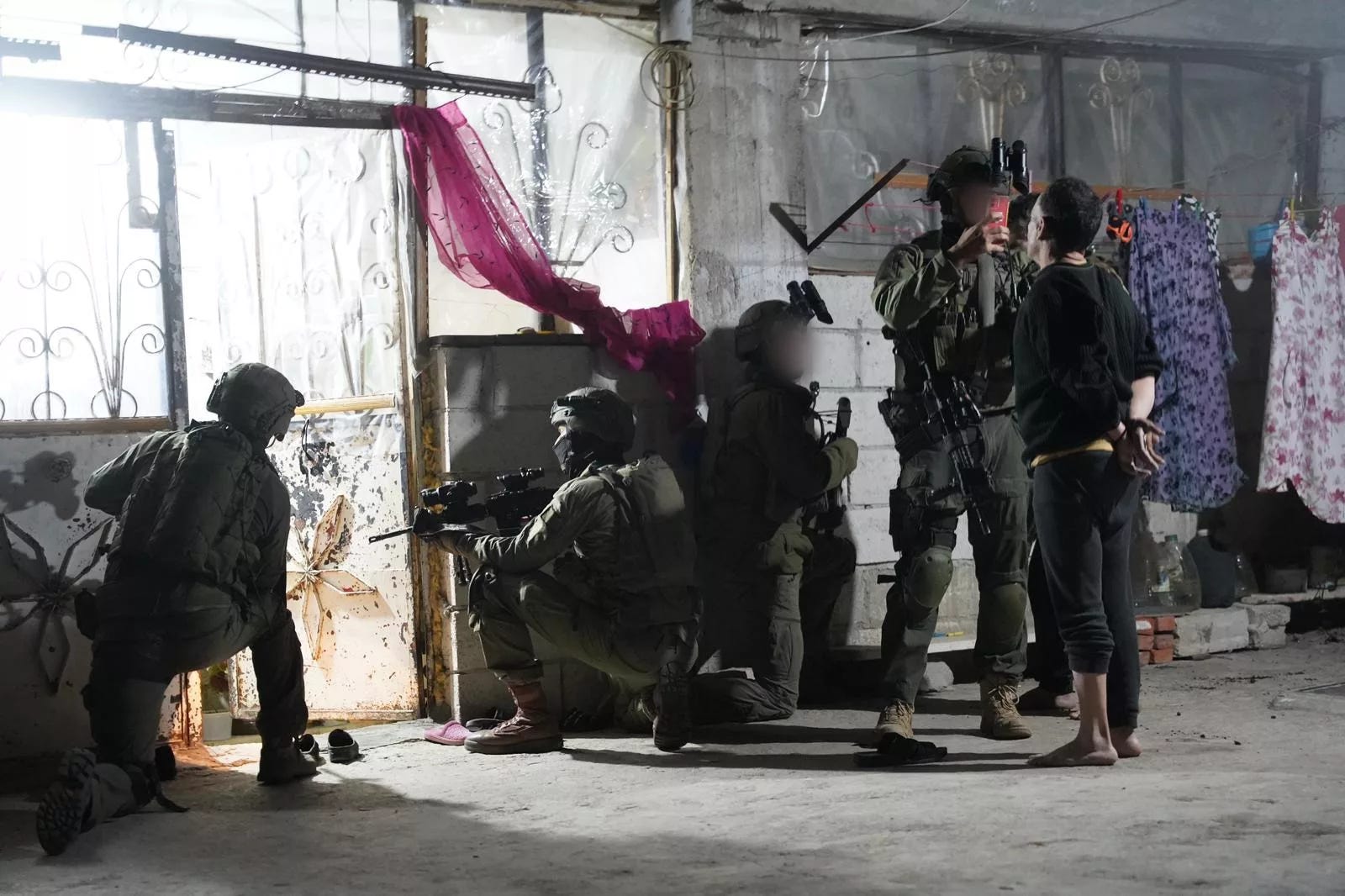
In what stands as the first direct gun‑battle of its kind in the town of Beit Jin on the outskirts of Damascus between residents and Israeli soldiers multiple Israeli narratives have emerged regarding who was behind the incident.
The first accused “the Islamic Group” in Lebanon, only for that group to swiftly deny any connection, just days after Israeli media had circulated claims of Islamic factions operating in southern Syria.
The second Israeli version of events alleges that some of those organizing attacks in Syria against Israel were working for the General Intelligence Directorate of the regime of Syrian President Ahmad al‑Sharʿ a claim attributed by Israeli media to sources described as “security and high‑level.”
A third narrative, reportedly from a “regional source,” speaks of confessions by individuals arrested during the operation, admitting ties to the Hamas, Iran, and the Hezbollah, and to having received funding to arm themselves and carry out assaults against Israel.
All recent Israeli accounts remained within the sphere of accusing Islamic groups and movements. This followed public remarks by Israeli War Minister Yisrael Katz, who referenced the presence of the Houthis in southern Syria a claim at odds with Damascus’ insistence that Syrian territory poses no threat to any party, and casting doubt on the coherence of the security narrative between the two capitals as their stalled security agreement shows.
Massacre in Beit Jinn
At dawn on Friday, November 28, Israeli forces launched an incursion into Beit Jin under the pretext of arresting individuals purportedly affiliated with “the Islamic Group.” The incursion quickly escalated into direct firefights with residents and bombardment of residential districts, resulting in the deaths of 13 people and injuring 24 others including women and children.
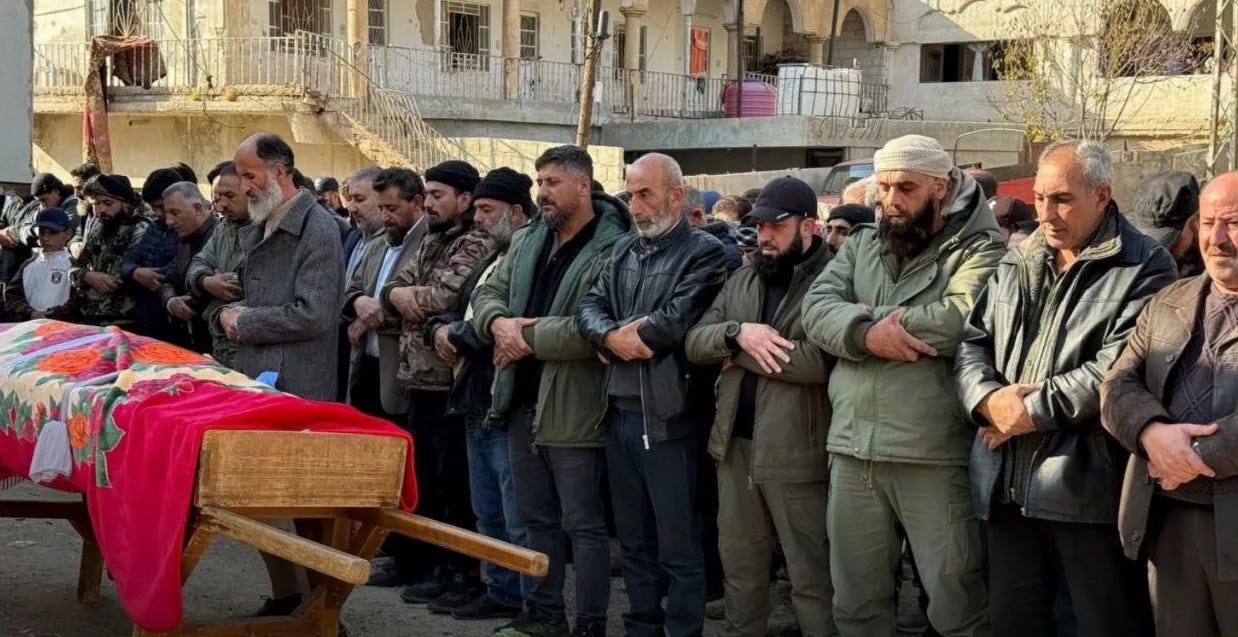
The Israeli occupation army announced it had detained three individuals it claimed were linked to “the Islamic Group,” and said that six of its soldiers were injured. Other Israeli media sources reported as many as 13 soldiers wounded.
According to Syrian civil defense sources, one Israeli military vehicle was struck inside Beit Jin. Civil‑defense teams were initially unable to enter the town because Israeli drone sorties targeted any movement at the town’s entrances, prompting civilian displacement as people fled in fear of further abuses and escalating violence.
While these clashes marked the first of their kind in Beit Jin, they are part of a broader pattern of sustained Israeli escalation in Syria since the fall of the regime of Bashar al‑Assad especially in the south where Israeli forces carried out repeated incursions, established military posts, razed land, and conducted arrests and killings that claimed civilian lives.

On the other side, the new Syrian administration continues to pledge a political path and adherence to international law. The Syrian Ministry of Foreign Affairs condemned what happened in Beit Jin as a “fully constituted crime and a blatant criminal attack on civilians and their property, a horrific massacre.”
It called on the United Nations, the Arab League, and the United Nations Security Council to take urgent, firm action to halt repeated Israeli aggression and violations.
Following the Israeli attack came waves of condemnation from a host of states and regional and international organizations including the European Union, the United Kingdom, Turkey, Saudi Arabia, Kuwait, Qatar, Jordan, the Arab League, the Gulf Cooperation Council, the United Nations in addition to denunciations from Hamas, the Islamic Jihad Movement in Palestine, and the Muslim Brotherhood in Syria.
Implications and Signals
Despite an intensification of Israeli military operations in Syria since the fall of Assad’s regime on December 8, 2024 including incursions, arrests, and similar clashes in towns like Koiya west of Daraa, which claimed seven lives in March the Beit Jin operation represents the broadest ground incursion by Israel into the town.
What made it distinct was the scale of the fighting and the use of attack helicopters.

This uptick comes at a time when the new Syrian administration is pursuing a policy of “zeroing out problems,” aiming to bolster Syria’s regional status and reengage with the international arena including efforts to revive relations with Washington.
It also seeks to secure a security agreement with Israel, a process derailed by Israeli demands to open a “humanitarian corridor” to Suwayda Province.
Notably, on November 19, Israeli Prime Minister Benjamin Netanyahu visited an advanced position within the buffer zone in southern Syria, accompanied by senior officials an act Damascus labeled “illegal” and a violation of Syrian sovereignty.
During his meeting with troops there, Netanyahu declared: “This mission could evolve at any moment we rely on you.”
According to Syrian‑Israeli relations analyst Khaled Khalil, what transpired in Beit Jin constitutes a crime and a flagrant violation of international laws and norms part of a broader strategy by Israel’s far‑right, serving both ideological and personal aims of Netanyahu.
Khalil told “Noon Post” that the escalation in Beit Jin has three dimensions: first, a disruption of ongoing regional power balances with Syria forging new alliances while Israel swims against the tide; second, a derailment of prior diplomatic and negotiating efforts between Damascus and Tel Aviv; and third, a cheap propaganda ploy by Netanyahu to buttress his election campaign a tactic he argues contradicts the “new U.S. Middle East architecture.”
He adds that Israel is giving Damascus an ultimatum: war or surrender. Given the Syrian regime’s limited capabilities, fragile transitional phase, and near‑total collapse of its military deterrence, Damascus opted for a strategic approach: negotiations and diplomatic pressure aimed at reaching a security agreement that would halt Israeli attacks and allow reconstruction at home.
In contrast, Israel is practicing outright duplicity: negotiating while simultaneously launching blatant, unprecedented incursions exploiting current conditions to preempt emerging regional understandings. According to Khalil, Israel is alarmed and anxious about the rapprochement between Syria and the U.S., especially after al‑Sharʿ’s visit to the White House.
A report by the Jusoor Center for Studies concludes that the Beit Jin operation carried a number of messages Israel sought to deliver, encapsulated in five main points:
Opposition to policies of the U.S. administration under Donald Trump toward the new Syrian government viewing any lifting or suspension of sanctions prior to a signed peace deal as premature, and aiming to control the pace of Damascus–Washington relations.
Rejection of the joint Russian–Turkish–Syrian patrol conducted south of Syria on November 17, and any Turkish presence or partial security accord.
Exploitation of minority unrest after protests by Alawite communities along the Syrian coast and in Homs portraying support for minorities to showcase the regime’s weakness and encourage continued rebellion.
Rolling back the new government’s achievements destabilizing security, preventing economic recovery and international reintegration.
Interference in the domestic and foreign policy of the new government pressuring Damascus to sign a peace treaty as other Arab states have, rather than reverting to the 1974 Disengagement Agreement or modifications of existing security rules.
“Manufacturing a Sunni Enemy” to Weaken Syria
After President Assad fled to Russia, Israel stepped up its military operations across Syria justifying strikes on military capabilities and arms depots under the pretext of preventing their seizure by “extremists,” as well as citing the need to protect its security and to counter growing Turkish influence among other reasons such as supposedly defending the Druze in tense areas like Sahnaya and Suwayda.
Talk of Islamic groups active in southern Syria began surfacing publicly recently, only to be denied both by the groups themselves and by the Syrian government. For example, the Islamic Jihad Movement in Palestine dismissed as “entirely fabricated” the claims by Israeli media about bolstered military capabilities inside Syria.
Likewise, the Lebanese “Islamic Group” denied any link to the Beit Jin operation.
Responding to Israel’s allegations, Syria’s ambassador to the United Nations, Ibrahim al‑olabi, said Syria would not accept such “spurious excuses,” calling talk of Houthi presence in southern Syria “a flight of fantasy.”
Syrian Information Minister Hamza al‑Mustafa, who visited Beit Jin after the attack, asserted that Israel is trying to impose faits accomplis in southern Syria since the fall of Assad’s regime, and that the “counter‑aggression” came in response to Israeli calculations stressing that Netanyahu’s extremist government seeks to provoke the Syrian government into confrontation.
According to Khalil, Israel has escalated its media campaign against Syria over the past two weeks, with Yisrael Katz presenting contradictory stories about alleged infiltrations accusing groups ranging from the Islamic State of Iraq and the Levant (ISIS), the Houthis, Iran, and Palestinian factions.
After the Beit Jin operation, a new narrative emerged, blaming members of the Lebanese “Islamic Group” which the group denied.
Khalil argues this confusion reflects Israel’s attempt to manufacture a new Sunni enemy amid rising sectarian and identity‑based discourse targeting Syria.
The conflicting narratives, he says, underscore Israeli disarray: the escalation does not stem from credible national‑security threats, but from political considerations tied to the far‑right and to Netanyahu’s electoral ambitions.
He adds that the contradictory Israeli stories reveal the military‑intelligence failure of the operation Israeli authorities were surprised by the spontaneous and unplanned popular backlash. Israeli media, according to him, denied that there was any ambush or intelligence check or carefully prepared operation.
Meanwhile, researcher Mohammad Suleiman at the Jusoor Center asserts that Israel is deploying a narrative attributing the region’s instability to alleged terrorist activity real or fabricated to rationalize its recent frequent incursions, which no longer hold credible justification before the international community.
Suleiman argues this narrative is also geared toward pressuring the Syrian government by suggesting it fails to track and pursue terrorist groups inside its territory allowing Israel to depict its operations as “self‑defence.”
This boosts Israel’s political and security pressure on Damascus, which Israel still deems unstable. The ultimate goal, he says, is to impose a security agreement that ensures a depopulated buffer zone avoiding revisiting occupied territories like the Golan or parts of Quneitra.
Suleiman adds that Israel is exploiting tensions in the south and recent events in Suwayda to garner sympathy from the U.S., which faces mounting pressure to stop violations and incursions inside Syria thereby weakening Syria’s position before Washington, Ankara, Moscow, and Arab states, and encouraging the international community to accept a narrative of southern Syria as a security threat run by Islamic factions a claim rooted more in politics than reality.
The approach also appears aimed at undermining Syrian–American ties and preventing the lifting of sanctions once promised by former U.S. President Donald Trump.
What Comes Next?
After the Beit Jin attack, Israel’s Channel 13 reported that Tel Aviv is considering a large‑scale operation against the regime of Ahmad al‑Sharʿ, should it confirm involvement of any of his men. The incident could push the Israeli military to shift tactics on the Syrian border scaling back ground arrests and pivoting toward intensified targeted aerial assassinations.
Khalil says the popular resistance reaction in Beit Jin had a significant impact on Israel’s strategic plans, prompting reconsideration of its intervention and aggression tactics in Syria.
He predicts a sharp escalation ahead, given the sensitive timing with about ten months remaining in Netanyahu’s current term, which could bring unexpected developments as he seeks an “honorable exit.”
As for Syria, the country is undergoing a delicate foundational transition phase. Yet its future remains key since it aligns with new regional security equations and American visions for a Middle East distanced from perpetual conflict, while safeguarding the interests of Israel’s allies, notably Turkey and Saudi Arabia.
Syria remains the lynchpin, standing against the brashness and arrogance embodied by Netanyahu.
Meanwhile, researcher Mohammad Suleiman warns that what happened in Beit Jin could trigger a wave of increased Israeli incursions in the short term, with a likelihood of further escalation in those areas.
At the same time, Damascus is banking on its regional alliances with Turkey, Russia, Gulf states, and the United States to exert counter‑pressure. If successful, Tel Aviv may be forced to scale down military aggression to preserve its interests with Washington.
International relations expert Mahmoud Aloush argues that Israel will, as usual, attempt to exploit the Beit Jin massacre to reinforce its security narrative. But the incident has unnerved Israel despite its posture because turning against local southern Syrian communities through bloodshed is birthing an environment increasingly ready for resistance and long‑term mobilization.
The vacuum that Israel aims to sustain in southern Syria cannot be filled alone, he says. Israel may be adept at manufacturing enemies but over time it finds itself trapped in managing them.
Meanwhile, researcher Abd al‑Rahman al‑Hajj considers that ongoing Israeli incursions into Syrian soil, alongside the lack of direct governmental response, inevitably lead to the rise of local resistance.
People are defending their dignity and lives as they did in Beit Jin and previously in other regions such as Daraa affirming that every Israeli intrusion prompts stronger, more organized reaction.
