

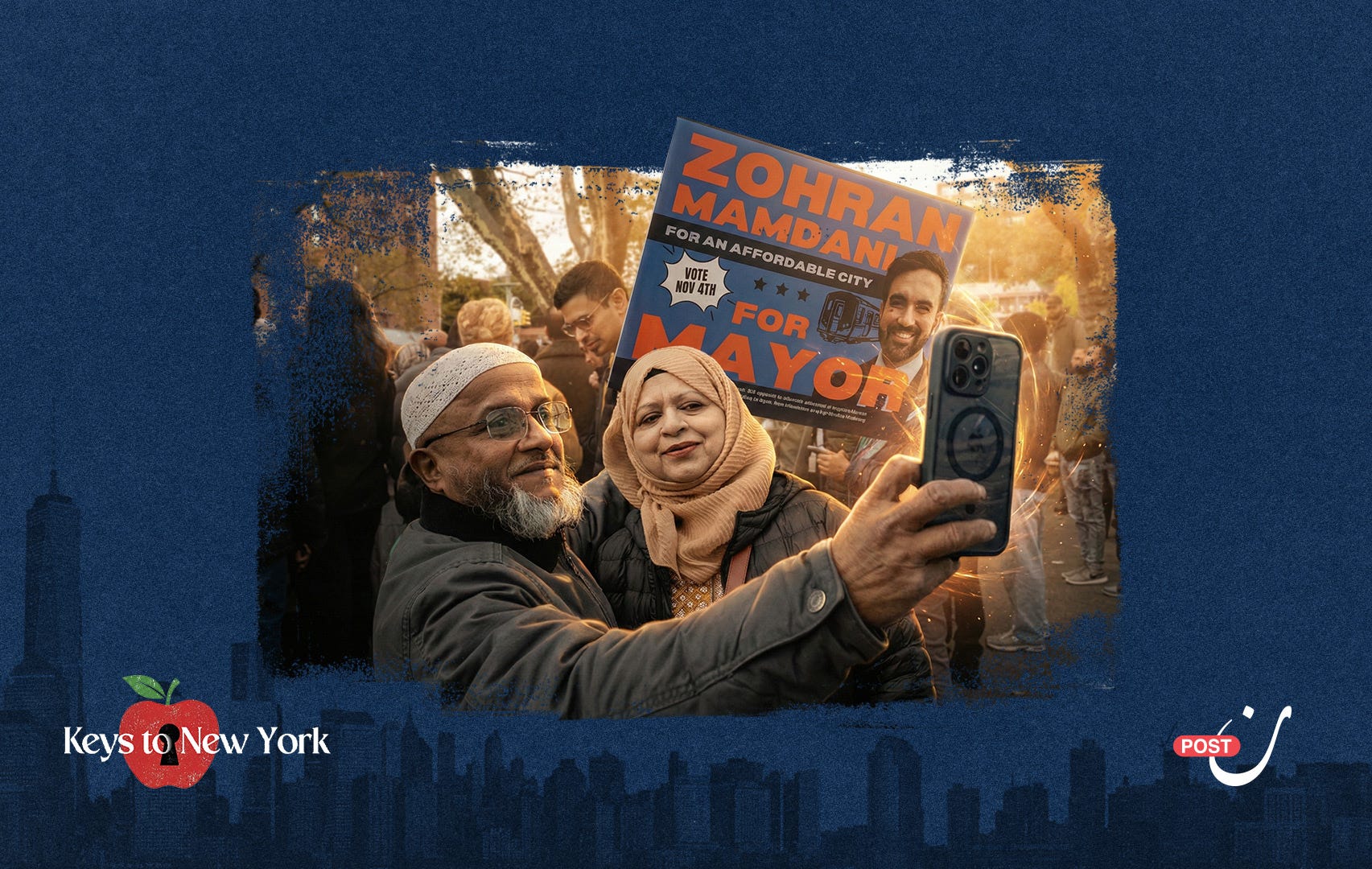
Zahran Mamdani’s election as mayor of New York City is remarkable on several fronts. A newcomer to politics, the son of immigrants of color who arrived in pursuit of a better future in a white supremacist society, Mamdani brings a clear socialist worldview to a city gripped by rampant capitalism.
On top of that, he is a practicing Muslim who embraces his religious identity, even invoking it when addressing major global injustices most notably, the Palestinian cause, despite its sensitivity among some of the city’s most powerful and wealthy groups.
But Mamdani’s mayoralty resonates even more powerfully with the communities from which he emerged those long marginalized in the city. Muslim New Yorkers, who have endured waves of Islamophobia since the September 11 attacks. Immigrants, hounded through the streets under Trump-era policies.
And pro-Palestinian advocates, whose voices fueled one of the city’s largest grassroots uprisings in recent years in response to the massacres in Gaza, atrocities New York institutions have indirectly funded through financial and educational systems.
So what impact will Mamdani’s administration have on religious freedom in the city? How will he deal with the Zionist movement that dominates much of the city’s political and financial power structures? Will he risk an early clash, or compromise on the principles that helped him win?
And where does he stand on the pro-Palestinian movement will he fully embrace its demonstrations, boycotts, and activism, despite the potential backlash from Zionist institutions? Or will he opt for a diplomatic balancing act between opportunity and risk?
Islamophobia Shadows Mamdani
Mamdani has faced a barrage of Islamophobic attacks rooted in both his identity and political positions. According to a report by the Council on American-Islamic Relations (CAIR), Islamophobic content on X (formerly Twitter) surged during the New York mayoral election cycle, with over 35,000 anti-Muslim posts between June 24 and October 31. Politicians and media outlets hostile to Mamdani painted him as an “external threat” to the city’s security and culture ignoring his deep roots in New York’s neighborhoods.
He was smeared as a “jihadist,” “radical Muslim,” and someone pushing for Sharia law, further endangering Muslim communities by inciting hate and potential violence.
The campaign against him intensified dramatically in October, with Islamophobic posts on X rising 450% compared to the previous month 43% of all posts on the platform during that period were anti-Muslim. Mamdani responded with a press conference on October 24 to counter the accusations against him and his campaign.
Even political rivals joined in. Former New York Governor Andrew Cuomo, a Democratic contender, mocked Mamdani on a radio show by asking how he would handle “another 9/11,” laughing when the host joked he would celebrate it. CAIR condemned Cuomo’s remarks as flagrantly anti-Muslim.
Sensitive to the complex religious makeup of New York, Mamdani pledged during his campaign to increase funding for hate crime prevention by 800% and to support interfaith and cross-cultural initiatives. In his victory speech, he vowed to build an inclusive, diverse administration that would stand against both antisemitism and Islamophobia.
A Unique Relationship with the City’s Jews
Mamdani took a proactive approach in his campaign to engage the Jewish community, visiting prominent synagogues such as Park Slope to reassure congregants. Olivia Ringold of The Free Press claimed he promised to appoint Zionists to his administration, though his office neither confirmed nor denied the report.
The city’s Jewish leadership remains divided. Rabbi Elliot Cosgrove of Park Avenue Synagogue views Mamdani as a threat due to his outspoken calls for a Gaza ceasefire and opposition to U.S. arms to Israel. Conversely, Jamie Beran of Bend the Arc praised his anti-antisemitism agenda, emphasizing that criticism of Israeli policies should not be conflated with hatred of Jews.
Despite the controversy, Mamdani secured 33% of the city’s Jewish vote. By comparison, 63% went to Cuomo and just 3% to Curtis Sliwa. Mamdani dominated among secular and Muslim voters, earning 75% of the non-religious, 70% of Muslims, 42% of Protestant Christians, and 33% of Catholics.
He also garnered significant support from the city’s Satmar Hasidic community, which is staunchly anti-Zionist and has Eastern European roots. Mamdani met with Satmar leaders several times and was warmly received.
Zionist Efforts to Discredit Mamdani
Zionist groups in New York have mobilized to undermine Mamdani under the guise of protecting religious freedoms. The Anti-Defamation League (ADL) launched “Mamdani Watch: Accountability for NYC’s Government,” vowing to scrutinize his policies, appointments, and actions for any ties to Palestinian advocacy.
Labeling Mamdani antisemitic, the ADL claimed his administration could endanger Jewish institutions already facing rising harassment post-October 7. The group reported 976 antisemitic incidents in 2024 in New York alone and established a hotline to report future cases, preemptively blaming Mamdani for any uptick.
Other Zionist organizations followed suit, painting Mamdani as biased toward pro-Palestinian voices. Yet he held his ground. When accused of endorsing a protest outside Park East Synagogue where chants included “Globalize the Intifada” and “Death to the IDF,” he responded that sacred spaces should not facilitate violations of international law a veiled reference to Israeli settlements. He later clarified that while protest is protected speech, calls for death are unacceptable.
Despite this, the ADL and other groups intensified accusations that Mamdani was failing to safeguard Jewish New Yorkers. The American Jewish Committee (AJC) further fanned the flames, demanding that most of the city’s hate crime prevention funding go toward Jewish communities and pushing Mamdani to equate anti-Zionism with antisemitism a controversial definition adopted by some Holocaust remembrance institutions but criticized by civil rights advocates.
Inherited Institutions and Strategic Shifts
Mamdani inherits a complex web of religious and community initiatives from former Mayor Eric Adams, including the Office of Faith and Community Partnerships, which has funneled over $1.5 million into religious organizations. Under Adams, Christian and Jewish groups received the lion’s share of this funding, with minimal outreach to Muslims.
Now, with Mamdani at the helm, Zionist outlets have begun preemptively accusing him of using this office to favor Muslim institutions. They also point to programs like “Breaking Bread, Building Bonds,” designed to foster interfaith dialogue but, in practice, used to promote a Zionist narrative under Adams.
Mamdani is expected to pivot promoting equality among religious groups while resisting the conflation of Judaism with Zionism. The New York chapter of the Center for Constitutional Rights has urged his administration to ensure city funds do not entrench religious favoritism.
Reverend Chloe Breyer of the Interfaith Center of New York called Mamdani’s election a landmark in the fight against religious bias, particularly in a post-9/11 city where a Muslim mayor once seemed unthinkable.
Dancing with Serpents
Mamdani’s toughest challenge lies in navigating the deliberate conflation of Judaism and Zionism, a tactic used to suppress Palestinian solidarity. Any misstep could lead to accusations of antisemitism, amplified by Zionist control over major financial and political institutions in the city.
Notably, Mamdani chose to retain NYPD Commissioner Jessica Tisch, a known pro-Israel Zionist, signaling a pragmatic desire to avoid open confrontation. Yet his earlier statements such as calling Israel’s war on Gaza “genocide” and vowing to arrest Netanyahu for war crimes have alarmed Zionist circles from Washington to Wall Street.
While Mamdani has softened his rhetoric in recent months, backing away from slogans like “From the river to the sea” and “Globalize the Intifada,” critics argue that his shift was politically motivated rather than ideological. In a secret December meeting with prominent New York rabbis including his fiercest critics—Mamdani struck a diplomatic tone. The rabbis described the discussion as “constructive,” though some, like Rabbi Hirsch, admitted to lingering fears.
A BDS Standard-Bearer
Mamdani’s support for the Boycott, Divestment, and Sanctions (BDS) movement is another flashpoint. He plans to dismantle the New York-Israel Economic Council and divest city pensions from Israeli bonds, calling such investments a violation of international law. However, he clarified that private companies would retain freedom of association with Israel.
In anticipation, Adams issued executive orders banning BDS policies within city agencies and tightened restrictions on protests near places of worship. One order bars city staff from discriminating against Israeli entities in contracts and investments.
While Mamdani could reverse many of Adams’s executive decisions, including the controversial definition of antisemitism that equates it with anti-Zionism, doing so will invite intense scrutiny and backlash. He may need to restructure rather than abolish some city bodies targeting antisemitism.
Netanyahu Behind Bars?
Among Mamdani’s most dramatic promises is to have Netanyahu arrested in New York if he visits, based on an ICC warrant for war crimes. Legally, Mamdani lacks the authority to enforce such an arrest; the U.S. is not party to the Rome Statute, and foreign leaders enjoy immunity. Congress members have already proposed legislation to block funding to any U.S. city attempting such arrests.
Netanyahu mocked the threat, calling it a joke, but said he would gladly meet with Mamdani if the latter changed his views.
Campus Protests and Free Speech
Mamdani has a personal history of student activism and pledged to defend campus protests and freedom of assembly. As a student at Bowdoin College, he co-founded Students for Justice in Palestine and later went on hunger strike demanding a Gaza ceasefire.
Though the mayor has limited formal authority over universities, his office influences policing, public order, and funding tools that can shape campus climates. This sets up a likely showdown between Mamdani’s support for protest rights and pressure from pro-Israel groups citing “public safety” and so-called “hate speech.”
Mamdani’s four-year term beginning January 1 will test not only his resolve but the city’s very definition of justice, pluralism, and international solidarity. New York may become a global battleground where the fight for Palestinian rights, and broader struggles against religious discrimination, will either be crushed or find renewed strength. Mamdani, his supporters, and his detractors all know: the stakes could not be higher.
