

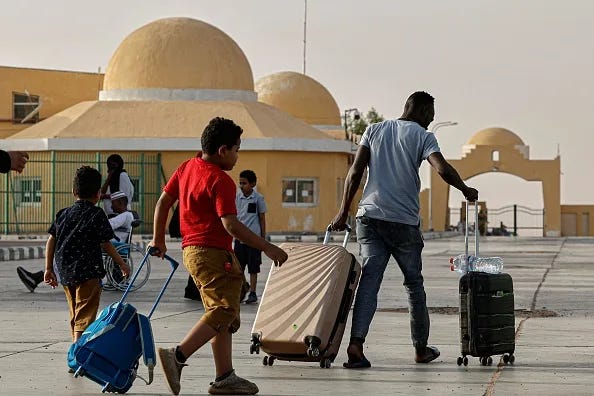
In recent days, human rights platforms and organizations have documented a significant escalation in repressive measures targeting refugees, asylum seekers, and migrants in Egypt. This escalation marked by broader scope and official decisions appears to exceed the patterns of previous years, sparking serious concerns over its potential consequences for tens of thousands of individuals, particularly regarding their physical safety, legal standing, and access to livelihoods.
According to monitoring reports, Sudanese and Syrian nationals have borne the brunt of these crackdowns, which now extend beyond Cairo to several governorates. This shift suggests an emerging pattern that transcends individual or situational actions, hinting at a more systematic policy that could effectively amount to informal, forced expulsions.
This development follows major legislative and institutional shifts in Egypt’s asylum system, particularly the enactment of Law No. 165 of 2024 on asylum. The law transferred core responsibilities for managing refugee affairs from the UN High Commissioner for Refugees (UNHCR) to national government agencies with expanded powers.
The move has triggered a wave of criticism and warnings from rights advocates and refugee community representatives, who fear it could undermine protection guarantees and due process.
UNHCR data shows Egypt currently hosts over 914,000 registered refugees and asylum seekers from 61 nationalities. By contrast, Egyptian government estimates cited by Prime Minister Mostafa Madbouly put the number of foreign residents at around nine million, with an annual cost exceeding $10 billion. The government cites these figures as evidence of the burden it carries amid ongoing economic challenges.
Intensified Arrest Campaigns
Sudanese human rights advocate Marwa Hegazy, a volunteer working with UNHCR in Egypt to monitor detainee conditions, describes recent Interior Ministry raids on migrant communities as “unprecedented.”
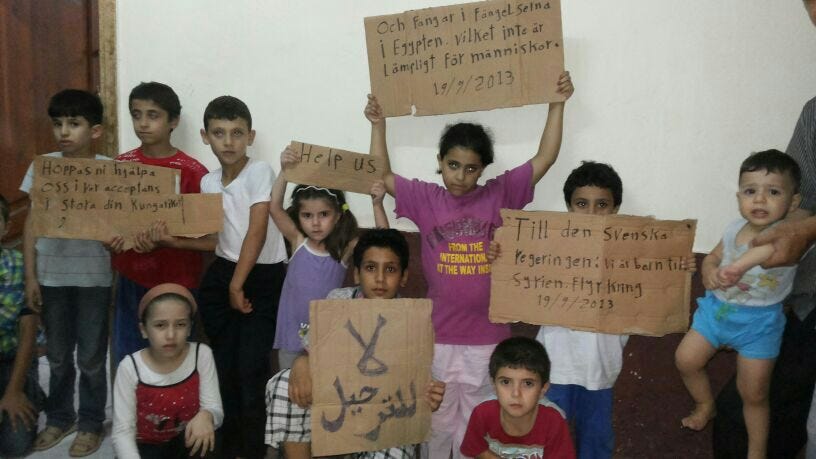
Speaking to the press, Hegazy said the operations have been indiscriminate, affecting the elderly, the sick, and children alike. What were previously seen as occasional or seasonal actions have now turned into a sustained campaign, particularly targeting Sudanese and Syrian nationals. These practices, she emphasized, violate international protection obligations, especially the principle of non-refoulement.
Based on her daily rounds of police stations in Alexandria where many refugees are currently detained—Hegazy noted that the frequency of arrests has surged, even against holders of valid UNHCR cards. “These actions used to happen annually at lower intensity. Now, we’re seeing random arrests,” she said.
“There are mass detentions across more than ten police stations in Alexandria. The situation is dire—most detainees have UNHCR cards and are simply waiting for renewal appointments. I visit police stations every day to monitor detainees and report to UNHCR lawyers, but unfortunately, the embassy and UNHCR’s presence is barely visible.”
UNHCR’s role, according to Hegazy, is typically limited to dispatching a lawyer to accompany detainees during prosecution hearings. However, she criticized the convoluted administrative release process, where detainees are referred between police, immigration, national security, and even the embassy, often stuck in this loop for up to ten days.
Notably, Hegazy added that the crackdown isn’t limited to adults. “Just days ago, I learned that children under sixteen were detained, even though they held valid residency permits. This is the first time we’ve seen refugees with legal status still being apprehended.”
Tariq, a young Syrian who has lived in Sixth of October City for over a decade, echoed these concerns. He told Noon Post that inspection raids in public spaces targeting Sudanese and Syrians have intensified so severely that many have opted to remain at home to avoid arrest.
Despite having proper documentation, he said he does not feel safe. “The complications around renewing residency or temporary cards mean many end up in legal limbo—making them easy targets for arrest under the guise of law enforcement.”
A Parallel Digital Campaign
Alongside the physical crackdowns, a digital campaign has gained traction on social media, tracked by the “Sahih Masr” platform, which analyzed online activity and hashtags between January 20 and 26.
Their findings suggest a coordinated effort: posting volume surged dramatically over short periods, then dropped just as abruptly. The analysis revealed a network of accounts playing specific roles some driving traffic by tagging official government handles like the Ministry of Interior and the Cabinet, others amplifying messages to keep them trending.
Sentiment analysis by TalkWalker showed that over 43% of posts conveyed negative sentiments toward refugees, while only 14% expressed supportive views. A significant portion of the discourse focused on criticizing businesses run by Syrians, accusing them of selling substandard goods or undercutting economic opportunities for Egyptians. Instances of hate speech and discriminatory language targeting both Syrians and Sudanese were also recorded.
The hashtag cloud revealed that #DeportAllRefugeesIsAPublicDemand led the conversation, averaging around 1,200 posts per day during the monitoring period. Other widely used hashtags included #EgyptForEgyptiansNotForGuests, #DeportAllSyrians, and #DeportingRefugeesIsANationalDuty.
Patterns of Abuse and Restriction
The violations reported against refugees, asylum seekers, and migrants in Egypt have taken many forms, according to the “Refugees in Egypt” platform, which issued a report covering December 20, 2025, to January 31, 2026.
The report highlighted recurring abuses affecting multiple nationalities, suggesting a systemic rather than isolated trend. One tactic involves exploiting residency renewal delays and chronic registration backlogs at UNHCR and Egyptian agencies, placing many individuals in technical “violation” of the law even when structural barriers prevent timely compliance.
The report also documented repeated instances of authorities confiscating protection documents, including UNHCR cards, during detentions. This effectively strips refugees of their legal status and facilitates deportations outside the bounds of international protection and non-refoulement guarantees.
The scope of these detentions has also widened from border regions to urban areas, including checkpoints, transportation hubs, residential neighborhoods, and workplaces engulfing everyday life in a climate of fear.
The pressure extends to refugee community institutions themselves. Some schools and grassroots initiatives especially those run by vulnerable groups—have faced closures or restrictions, cutting off critical educational and support services for wide swaths of the population.
Escalating Risks for Syrians and Sudanese
The report outlines dual escalations affecting Syrians and Sudanese. For Syrians, recent months have brought increasingly stringent residency rules, including the halting of tourist visa renewals and the imposition of burdensome, costly procedures. This has forced many into “involuntary irregularity,” exposing them to detention at any moment.
For Sudanese nationals, the crackdown reached a peak in late 2025. Investigative reports confirmed that large numbers were detained in preparation for transfer to Aswan and repatriation to Sudan. The platform reported hundreds of detentions over recent months, including more than 1,500 deportations since August 2025 the sharpest spike yet.
Europe’s Gatekeeper
The timing of these crackdowns coincides with deepening Egyptian–European cooperation on migration and border control. Observers argue the crackdown cannot be separated from this context. It signals a shift in how Egypt manages the presence of refugees and migrants paired with a noticeable decline in protection guarantees.
Viewed through this lens, the campaigns are tied to the political and financial benefits Egypt could secure by positioning itself as Europe’s frontline migration partner. Between 2024 and 2027, over €7 billion in aid is earmarked for Egypt, a portion of which supports migration control programs, border surveillance, and at least €200 million allocated for combating irregular migration and funding “return and reintegration” efforts.
Rights groups and international organizations have warned that outsourcing “gatekeeping” roles to transit states like Egypt risks making the EU complicit in potential abuses, including arbitrary detention, inhumane conditions, or forcible return to war-torn countries like Sudan.
Coercive Return Pressures
Many analysts argue that the recent escalation in deportation campaigns is driven by more than just migration diplomacy. Refugees interviewed by Noon Post pointed to possible political pressure from Sudan’s government to encourage returns potentially as a symbolic gesture amid the collapse of the “voluntary return” process.
Others suggest that slight improvements in conditions in Damascus and Khartoum may have encouraged Egyptian authorities to promote repatriation.
This narrative is compounded by Egypt’s economic crisis, where public discourse has increasingly blamed migrants for imposing fiscal burdens. Yet, alternative assessments highlight the positive economic contributions of certain communities especially Syrians to Egypt’s market.
Ultimately, rights advocates argue that managing a complex issue like migration through purely security-driven policies exposes critical gaps in public policy particularly when blanket actions fail to distinguish between legally settled individuals and those caught in bureaucratic limbo. Continuing down this path, they warn, will only deepen criticism of Egypt’s human rights record and heighten international pressure.