

Since the meeting between Franklin D. Roosevelt and King Abdulaziz aboard the USS Quincy in February 1945, in Egypt’s Great Bitter Lake, Saudi Arabia’s place in the regional order has rested on a clear equation: oil in exchange for protection. For decades, despite periods of tension and mutual leverage, this formula governed Riyadh’s relationship with Washington.
Accordingly, by virtue of its position and interests, the Kingdom has tended to favor stability over transformation, and to defend the existing balance rather than seek to reshape it. Yet that very world one that has provided its overarching security umbrella since the end of World War II now appears to be eroding rapidly.
This is not only due to the rise of new global powers such as China, but also because the United States itself no longer represents a guarantor whose reliability can be taken for granted. Meanwhile, Israel’s occupation, in its sweeping military escalation from Gaza to Iran, is pushing the entire region toward a logic of raw power rather than negotiated settlements.
At such a moment when protection itself becomes uncertain—a country like Saudi Arabia, one of the world’s largest arms importers, finds itself compelled to reconsider the very meaning of security. It must ask, albeit belatedly: can security be bought? And should the Kingdom’s security remain a service imported from abroad, or become a structure gradually built through diversification of suppliers, technology transfer, localization of industry, and the distribution of political and military reliance across multiple capitals?
This context may explain Riyadh’s push over the past two years to expand its defense network—from Washington to Seoul, Ankara, and Islamabad particularly as the ongoing Israeli-American war on Iran and the disruption of navigation and energy flows in the Gulf reveal the fragility of the old regional formula.
The United States: The Backbone of Fragile Security
The central question gains weight from the fact that Saudi Arabia has remained among the world’s top arms importers in recent years. It ranked as the second-largest importer globally between 2019 and 2023, according to the Stockholm International Peace Research Institute (SIPRI), before dropping to fourth place in 2020–2024, while still remaining among the top ten importers between 2021 and 2025.
At the same time, the General Authority for Military Industries announced that the localization rate of military spending reached 24.89 percent by the end of 2024. The World Defense Show 2026 also saw the announcement of 60 defense deals valued at approximately 33 billion Saudi riyals.
Here lies the core point: Saudi Arabia is not withdrawing from its partnership with the United States, but rather seeking to reduce the risks of overreliance on a single partner. On May 13, 2025, Washington announced, in a White House fact sheet, a defense cooperation package with Saudi Arabia described as involving deals with more than a dozen U.S. companies, valued at around $142 billion.
On the same day, the Saudi Press Agency reported the signing of a letter of intent to develop cooperation in ammunition, training, support services, maintenance, system upgrades, spare parts, military education, and medical services for the Saudi armed forces.
This trajectory advanced further in November 2025 with a strategic defense agreement signed by the Crown Prince and the U.S. president, according to official statements from both sides.
Yet the significance of the American track lies not only in its scale, but in the limits of trust that now shape it. Reuters reported on May 8, 2025, that the Trump administration had separated civil nuclear cooperation talks with Saudi Arabia from the normalization condition with Israel whereas the Biden administration had previously linked normalization, security guarantees, and nuclear cooperation.
With the escalation of the war on Iran and its widening repercussions, some analyses suggest potential impacts on U.S.-Saudi security relations. More likely, however, the issue is not a decline in the American position per se, but rather that Saudi Arabia now views it with greater caution and pragmatism.
According to the Center for Strategic and International Studies (CSIS), Saudi security remains deeply anchored in its partnership with the United States in terms of armament structures, training, exercises, and supportive American military presence.
The report also downplays the likelihood of a serious defense relationship with China, as Washington would view it as conflicting with its primary defense partnership with Riyadh. Thus, rather than abandoning a decades-long relationship, Saudi Arabia is likely seeking greater clarity within it.
Turkey: A Manufacturing and Knowledge Partner, Not Just a Supplier
The Turkish track reflects a shift from simple “importing” to “conditional importing tied to localization.” While the landmark drone deal dates back to July 2023 before the region’s escalation its significance has endured because it included technology transfer and joint production, according to Reuters and statements from Baykar, rather than merely delivering ready-made systems.
On March 12, 2025, the Saudi defense minister received his Turkish counterpart in Jeddah, followed by agreements signed on July 24, 2025, with Turkish firms such as Nurol Makina, FNSS, and Aselsan. These explicitly focused on technology transfer and local manufacturing of land systems and military vehicles.
On February 5, 2026, Turkish President Recep Tayyip Erdoğan stated that there is a direction toward deepening defense cooperation with Saudi Arabia, including potential joint investment in the KAAN fighter jet project.
The implication is that Turkey fulfills a role the United States does not to the same extent: faster delivery, greater willingness to transfer industrial know-how, and relatively lower costs in certain sectors particularly drones, land systems, and electronics.
Ankara, therefore, does not appear as a substitute for Washington in Saudi calculations, but as a functional complement that expands maneuverability and ties defense procurement to a broader domestic goal of building a local industrial base.
South Korea: Sensitive Diversification in Air and Missile Defense
The South Korean track illustrates the same trend, but in a more sensitive domain: air and missile defense. On February 5, 2024, a memorandum of understanding was signed to expand defense cooperation, including a joint committee and working groups for research, development, and production.
The following day, South Korea’s Defense Ministry announced that LIG Nex1 had secured a $3.2 billion contract to export ten Cheongung M-SAM II batteries to Saudi Arabia a medium-range system capable of intercepting ballistic missiles and aircraft.
However, the current war and reports that Washington has redeployed Patriot systems from South Korea to the Middle East highlight that reliance on the American umbrella remains tied to U.S. priorities. This helps explain Riyadh’s earlier pivot toward Seoul as part of a broader effort to reduce single-source dependence.
Britain: A Secondary Western Support Layer
Britain plays a different role: a longstanding Western partner, perhaps more reliable in terms of continuity and operational integration than the United States, but not a gateway to a separate strategic shift.
In November 2024, UK Defense Secretary John Healey visited Riyadh to advance defense cooperation with Saudi Arabia and Turkey. Then, on March 31, 2026, the British government announced the deployment of the Sky Sabre air defense system to Saudi Arabia, along with additional forces and equipment, to protect allies from Iranian retaliation.
London’s role here is not to compete with Washington, but to mitigate risks stemming from U.S. unpredictability. By deploying advanced air defense systems, Britain adds an additional support layer within the broader Western security architecture consistent with Saudi Arabia’s approach of redistributing dependence rather than severing ties.
France: A Strategic and Operational Partnership
France’s trajectory over the past two years appears more focused on deepening political-military partnership than on major arms deals. In December 2024, both sides signed a strategic partnership roadmap and a memorandum of understanding establishing a joint council, expanding cooperation in defense, security, training, and military capabilities.
This translated into practice when France deployed more than 50 personnel to Saudi Arabia for the SPEARS OF VICTORY 2025 exercise, alongside Rafale fighter jets and support units.
In terms of procurement, one confirmed deal was Saudi Arabia’s July 2024 contract with Airbus Defence and Space for four additional A330 MRTT aircraft. However, this is better understood as part of a broader European track rather than a purely French one.
For Riyadh, France matters not only as a defense partner, but as a political-security actor particularly in coordination over Lebanon and joint support for the two-state solution. Paris provides both operational cooperation and a European platform for addressing regional security issues.
Pakistan: From Historic Ties to Elevated Deterrence
Pakistan represents the most controversial link. On September 17, 2025, the two countries signed a mutual strategic defense agreement stipulating that an attack on one would be considered an attack on both.
Many analysts interpret this as a major shift, given Pakistan’s status as the only nuclear-armed Muslim state. However, there is no official indication of a direct nuclear guarantee.
Still, some see the agreement as signaling that Saudi deterrence is no longer solely anchored in Washington, but may also rest on deeper military ties with Islamabad. As one Chatham House researcher put it, the deal opens a precedent toward “extended deterrence,” while Reuters suggested it implicitly introduces Pakistan’s nuclear capabilities into the regional security equation.
Ukraine: Combat Experience as Strategic Capital
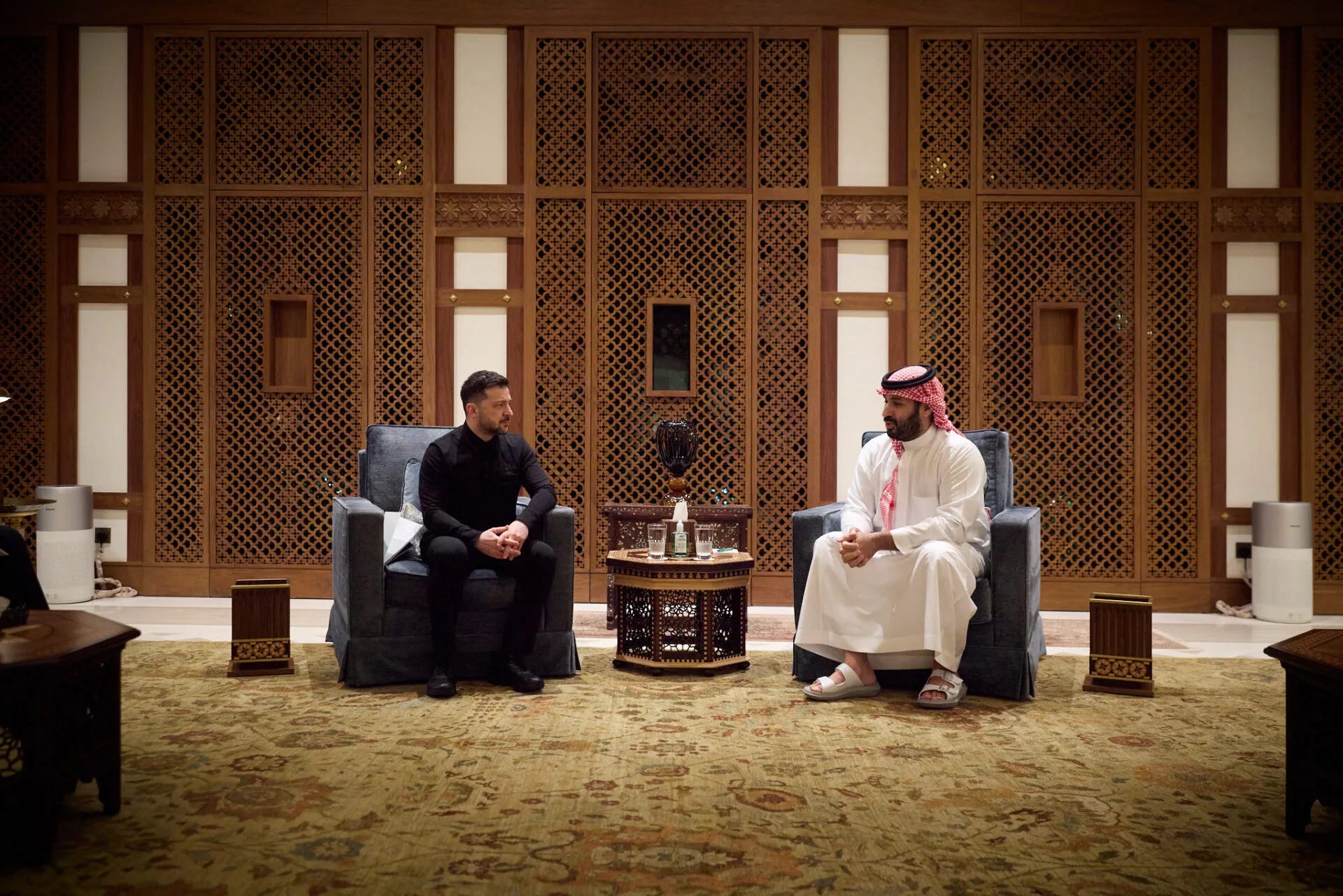
On March 27, 2026, Ukrainian President Volodymyr Zelensky announced a defense cooperation agreement with Saudi Arabia, focusing on future contracts, technological collaboration, and air defense.
Ukraine also dispatched over 220 military experts to Middle Eastern countries, including Saudi Arabia, where they provided briefings on protecting energy infrastructure and countering asymmetric aerial threats.
In this sense, Ukraine is not entering Saudi calculations as a traditional arms supplier, but as a source of battlefield-tested expertise particularly relevant in countering drone threats.
Conclusion: Reducing Vulnerability, Not Abandoning Alliances
It remains too early to draw definitive conclusions about regional alignments. What was expected to be a swift and decisive war has instead unsettled calculations across the region and beyond, exposing the fragility of arrangements once considered stable.
Against this backdrop, Saudi Arabia’s moves are better understood not as a shift from one camp to another, nor as a break from the American umbrella, but as an effort to construct a more layered and complex security architecture. This involves maintaining the U.S. partnership while expanding cooperation with other powers and placing greater emphasis on defense localization.
The goal is not full independence, but reduced vulnerability broadening strategic options in a region where old guarantees no longer suffice.