

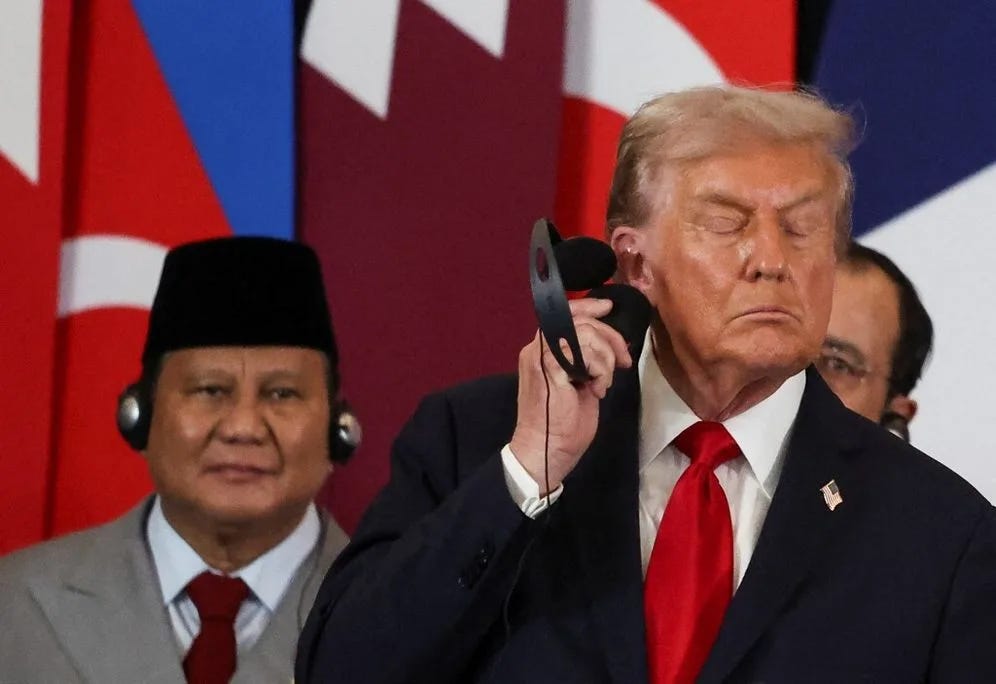
On the morning of February 10, 2026, as Gaza was still gathering the remains of its dead under the weight of a fragile “ceasefire” brokered by U.S. President Donald Trump, Palestinians awoke to news that, at first glance, seemed like an act of Islamic solidarity. In reality, however, it carried the seeds of what many fear could become a new “administrative catastrophe.”
Indonesia the Muslim giant long celebrated for its support of liberation movements officially announced its readiness to deploy 8,000 troops to the Gaza Strip as part of a so-called “peacekeeping force.” Many Palestinians view the mission not as a shield for victims but as a Trojan horse designed to entrench the security architecture of the occupation rather than protect those living under it.
Particularly troubling are the details that have emerged regarding the force’s mandate, conditions of establishment, and operational scope. According to these reports, its soldiers would not serve as human shields to protect Gaza’s children from bombs, but rather as traffic wardens regulating movement inside what critics describe as a vast prison designed by “Tel Aviv” and Washington to isolate Gaza’s population.
Early Signals: What Were the Key Milestones?
Indonesia appeared among the most eager and swiftest nations to offer troops and receive hundreds of wounded Palestinians, with Israel’s public broadcaster reporting that the first soldiers in the international force would arrive from Jakarta.
The following infographic traces the timeline of this early “interest” up to the announcement of the 8,000-troop contribution.
Timeline of Indonesia’s early “interest” in the Gaza file leading to the announcement of 8,000 troops
Timeline of Indonesia’s early “interest” in the Gaza file leading to the announcement of 8,000 troops
The momentum did not stop at rapid-fire announcements. Statements by Indonesian President Prabowo Subianto completed the picture, clarifying his future direction and shedding light on the motivations behind this “interest.”
In September 2025, standing at the podium of the United Nations General Assembly, he delivered what Hebrew-language media described as a “historic” speech. He did more than offer troops; he uttered what many saw as the password to entry into the Western club: “We must ensure Israel’s security, and only then can we achieve true peace with no place for hatred.”
He concluded his remarks with the word “Shalom” (peace), a gesture of allegiance delivered in Hebrew, seemingly directed at the ears of Trump and Israeli Prime Minister Benjamin Netanyahu.
During a summit meeting in New York, Trump praised the Indonesian president, describing his General Assembly speech as “excellent,” adding: “You did well to bang the table,” referring to his emphasis on “Israel’s security.”
The matter did not end with speeches. Intelligence reports and leaks in Hebrew media Yedioth Ahronoth and The Times of Israel revealed a darker chapter. In October 2025, secret arrangements were reportedly made for a historic visit by Prabowo to “Tel Aviv.”
Netanyahu even asked the court to postpone a session in his corruption trial on the grounds of an “urgent and highly important political visit.” Sources indicate that Prabowo had given the green light for the trip, which was to include security meetings and the signing of understandings concerning Indonesia’s role in the “day after” the war.
But when news of the visit leaked to Israeli media, panic reportedly spread within Jakarta’s Merdeka Palace over fears of backlash from Indonesia’s Muslim public. Jakarta retreated tactically, and the Indonesian Foreign Ministry categorically denied the reports.
What Drives Indonesia?
1. Securing OECD Membership
Indonesia has been pressing hard to join the Organisation for Economic Co-operation and Development (OECD), the “club of wealthy nations” that opens the door to investment inflows and improved credit ratings.
Yet the organization’s rules are strict: any new member requires unanimous approval from existing members. Israel, a member of the OECD, holds veto power.
“Tel Aviv” appears to have wielded this card as overt political leverage. According to The Times of Israel, the OECD had already begun Jakarta’s accession process, but Israel objected due to the absence of diplomatic relations between the two sides.
The U.S.-funded Alhurra website reported that former foreign minister and current defense minister Israel Katz refused to withdraw the objection unless normalization came first.
Leaks point to discussions between the Israeli and Indonesian foreign ministries and OECD Secretary-General Mathias Cormann, culminating in Indonesia’s pledge to normalize relations as a condition for lifting the veto.
An Atlantic Council analysis suggested that the Trump administration offered incentives to support this trajectory, including backing Indonesia’s OECD bid and granting trade and investment exemptions.
2. Commercial Interests and Deals with Trump
In February 2026, Reuters confirmed that Prabowo hoped to sign a trade agreement with Trump during his visit to Washington for the inaugural meeting of the Gaza Peace Council.
Permanent membership in the council reportedly carries a $1 billion price tag, making Indonesia’s participation appear part of a broader matrix of political and economic interests.
For Jakarta, the pathway offers an opportunity to elevate its regional standing and expand military and technological cooperation with the United States and “Israel,” particularly in cybersecurity and biotechnology.
3. Seeking International Legitimacy and Expanding Influence
The Times of Israel noted that the Indonesian government also seeks to bolster its international stature as a mediator between the Islamic world and the West.
Participation in a Gaza stabilization force allows Jakarta a role in managing a complex file of deep significance to Muslims, enabling it to present itself as a defender of Palestinians while simultaneously opening channels with “Israel” and Washington.
Thus, the language of “ensuring Israel’s security” and building “peace,” as articulated by Prabowo at the United Nations, becomes the rhetorical framework for rapprochement.
Giora Eliraz of the Truman Institute at the Hebrew University stated that “Indonesia has international ambitions, and normalization is part of its self-perception as a state that must be active across various arenas, including the Middle East, where it seeks to play an active political role.”
He added, in remarks to Israel’s Channel 12 website, that its participation remains limited for now due to the absence of formal relations with both parties to the regional conflict—Israel and Palestine.
Presidents of the United States and Indonesia at the Sharm el-Sheikh Summit
Presidents of the United States and Indonesia at the Sharm el-Sheikh Summit
Why Is “Israel” Interested in Indonesia?
1. The Largest Muslim Nation and a Vast Market
Indonesia represents a massive market of more than 280 million people and is the world’s largest Muslim-majority country.
For “Israel,” Indonesia is the dominant power in Southeast Asia, and some projections suggest it could rank among the world’s five largest economies within two decades. It is already a member of the G20, according to Israel’s Channel 12 website.
Opening relations with Jakarta would grant “Israel” symbolic Islamic recognition, ease its isolation, and unlock economic opportunities in technology, agriculture, and tourism.
Israeli officials reportedly believe that success with Indonesia could pave the way for similar breakthroughs with Malaysia, Brunei, and other Muslim-majority states.
2. Normalization as Pressure Relief After the Assault
Following Israel’s assault on Gaza and accompanying allegations of war crimes, “Israel” has sought a political breakthrough to ease mounting international pressure.
Indonesia’s participation in an international force provides an opportunity to market a narrative of Islamic cooperation with “Tel Aviv,” allowing the far-right government to claim support from the “moderate Sunni world.”
A normalization agreement with Indonesia could also revive stalled talks with Saudi Arabia, which faltered after the massacres in Gaza.
At first glance, Indonesia’s offer to host wounded Palestinians and dispatch international troops may be viewed as a humanitarian gesture aimed at assisting victims of the assault.
Yet a closer reading suggests it is part of a broader bargain: the Trump administration’s attempt to promote a tilted “peace plan,” Israel’s drive to normalize ties with the world’s largest Muslim nation to mitigate its isolation, and Jakarta’s ambition to secure political and economic gains on the global stage.