

The Caesar Act derives its name from Farid al-Madhhan, a defector from the Syrian military and former chief forensic photographer in the military police in Damascus. Originally from Daraa, al-Madhhan leaked thousands of photos and documents between 2011 and 2014, exposing torture victims in Assad’s prisons.
On November 15, 2016, the U.S. House of Representatives passed the Caesar Syria Civilian Protection Act to sanction the Assad regime for its crimes against Syrians. President Donald Trump signed the bill into law on December 21, 2019, during his first term.
The Act aimed to exert direct pressure on the Assad regime by imposing sweeping economic sanctions, becoming one of Washington’s primary policy tools against the former Syrian government and its allies.
On December 10, the U.S. House of Representatives voted in favor of a new defense budget bill that included a clause repealing the Caesar Act. The move followed intense diplomatic efforts involving Saudi Arabia, Turkey, and Qatar, alongside lobbying from the Syrian interim government and the Syrian-American community.
Three Steps to Full Repeal of the Caesar Act
The Caesar Act has been one of the most consequential measures enacted by Washington against the former Syrian regime and its affiliates. Due to its secondary sanctions mechanism, it allowed the U.S. to penalize foreign individuals and entities doing business with already-sanctioned Syrian actors.
In a meeting held in Saudi Arabia in May, former President Donald Trump announced his intention to lift all sanctions on Syria. His administration later suspended some penalties temporarily. However, a full repeal of the Caesar Act requires formal congressional legislation.
International law expert Moatasem al-Kilani told Noon Post that repealing the Caesar Act entails three critical steps before it becomes final.
House Approval: The first step is the House of Representatives’ vote already secured as the repeal is embedded in the National Defense Authorization Act (NDAA), marking a significant step toward nullification.
Senate Vote: Next, the U.S. Senate must vote in favor of the same provision. The Senate must approve the final defense bill version, including the Caesar repeal, before forwarding it to the President.
Presidential Signature: Finally, the President must sign the NDAA into law. Once all three branches House, Senate, and Executive approve, the Caesar Act will be officially repealed.
Al-Kilani adds that even after repeal, oversight mechanisms will remain. The U.S. President must submit periodic reports to Congress every 90 days, then every 180 days for four years.
These reports will monitor progress on issues like counterterrorism, minority rights, refraining from unilateral military actions, and may serve as a basis for re-imposing targeted sanctions if benchmarks are unmet.
A draft of the NDAA outlines key conditions Syria must meet over four years, reviewed biannually:
Cooperate with the U.S. to defeat ISIS and prevent its resurgence.
Remove foreign fighters from senior government and security roles.
Protect ethnic and religious minorities and ensure fair representation.
Refrain from unjustified military aggression against neighbors.
Implement the March 10 agreement with the Syrian Democratic Forces, including political and security measures.
Combat money laundering, terrorism financing, and proliferation.
Prosecute individuals responsible for gross human rights violations since December 8, 2024.
Take verifiable steps to halt the production and trafficking of narcotics, including Captagon.
Economic Implications of the Caesar Act Repeal
The Caesar Act imposed broad sanctions across Syria’s energy, infrastructure, banking, and aviation sectors. Since the regime’s fall, the interim government has sought relief from these restrictions to enable recovery and development.
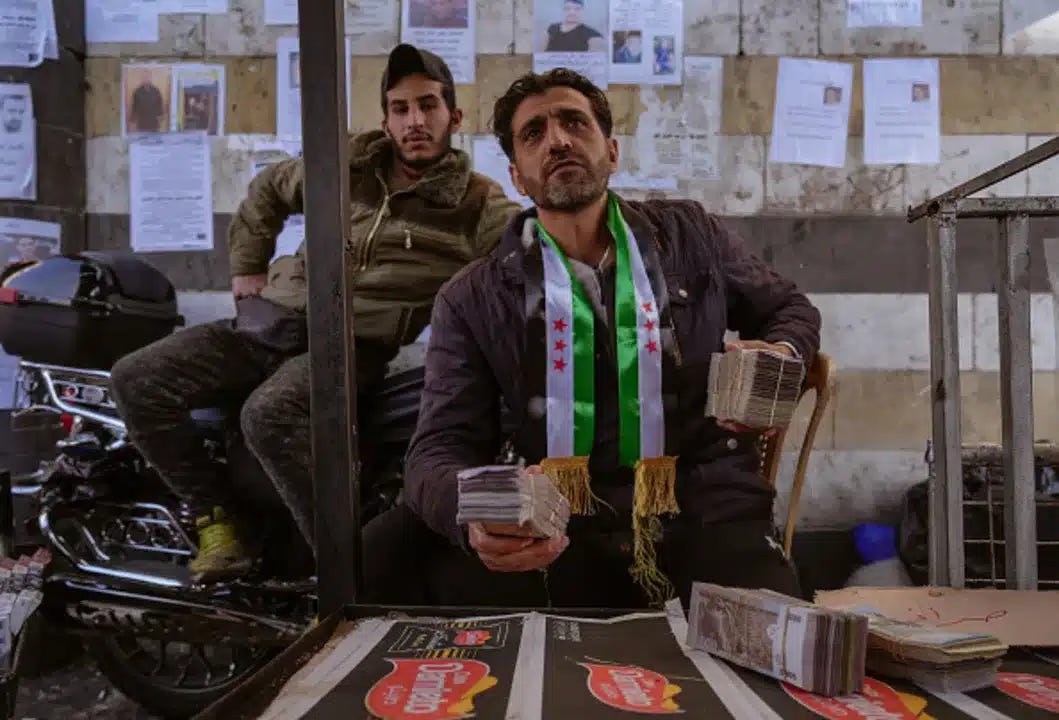
Economist Firas Shaabo told Noon Post that the immediate effects of the repeal on the exchange rate have already appeared, albeit limited and expected. The change, he said, is more psychological than structural, driven by optimism rather than real economic shifts.
Shaabo notes that the Syrian pound’s slight rebound has not been accompanied by a drop in prices, indicating the improvement is temporary. Real recovery will depend on increased foreign currency inflows, resumption of banking operations, and the reopening of supply chains.
He projects modest improvement over the first two to three months, with the potential for significant economic transition within one to two and a half years contingent on infrastructure readiness and effective use of sanctions relief.
Regarding increased competition and market supply, Shaabo considers this plausible but conditional. The removal of Caesar eases legal barriers to trade and investment, fostering competition. Yet, weak consumer purchasing power may result in a supply glut without sufficient demand, limiting the impact on price reductions.
Post-Caesar Investment Outlook
Shaabo expects that lifting the sanctions will reduce supply chain risks, encouraging foreign investors and financial institutions to reengage with Syria. This could boost imports and trade credit especially in construction, building materials, and spare parts sectors.
However, he cautions that excessive imports may drain foreign reserves, necessitating a balanced policy between imports and exports.
He also emphasizes that removing sanctions does not automatically reintegrate Syrian banks into global financial networks. Compliance, governance standards, and relationships with correspondent banks remain key hurdles.
Even if Caesar is lifted and Syria rejoins the SWIFT system, major banks such as Citibank, JPMorgan, and HSBC require stringent due diligence before handling international transfers. Without meeting these standards, Syrian banks will struggle to facilitate global transactions.
Shaabo argues that despite the repeal, Syria’s banking sector faces technical and legal obstacles, requiring enhanced governance, transparency, and compliance certifications, as well as trust-building with global correspondents. The sector, he says, needs a deep structural overhaul.
As for Gulf and Western investment, he foresees acceleration post-repeal, especially in energy, infrastructure, ports, roads, housing, and real estate. However, Caesar’s repeal alone is insufficient. Investors demand security, legal clarity, international guarantees, and anti-corruption assurances. There must also be a well-defined reconstruction plan and capable state institutions.
He concludes that while Caesar’s repeal is an important and positive step, it will not yield immediate results. Recovery should not be seen as dependent solely on lifting the Act, but rather as an opportunity to implement a comprehensive and sustainable development strategy.
Shaabo estimates that the first few months will show minor improvements in the exchange rate, followed by larger investment flows and SME growth over the next six to eighteen months. Nevertheless, challenges like unemployment and inflation will persist in the short term.
Currency Volatility and Central Bank Response
A day after the U.S. House vote to repeal Caesar, the Syrian pound saw a modest appreciation against the U.S. dollar in parallel markets. However, trading remained volatile. The Central Bank of Syria maintained its official exchange rate, and by December 13, the pound had resumed its decline.
At the time of writing, the dollar traded at around SYP 11,750, according to the currency-tracking site “Lira Today.”
Abdelqader al-Hasriyyeh, Governor of the Central Bank, told state media SANA that repealing the Caesar Act marks a turning point for Syria’s economic and monetary stability. He remarked, “If repealing Caesar seems miraculous, the real miracle lies in how we seize this opportunity to rebuild our country and institutions, strengthen economic and social stability, and attract investment.”
He added that lifting the sanctions would facilitate financial transfers, streamline trade flows, and restore confidence in the Syrian banking sector.
Earlier, on November 10, the U.S. Treasury and Commerce Departments announced a six-month extension of the partial suspension of Caesar-related sanctions. In a joint statement, the departments said this update replaces the May 23 exemption, freezing most Caesar sanctions while maintaining restrictions on dealings with Russia, Iran, and other sanctioned entities.
The announcement followed a visit by Syria’s transitional president, Ahmad al-Sharaa, to the White House.
The U.S. stated that the move aims to “enable American and international firms to participate in economic and development projects in Syria,” while preserving sanctions on what it called “the worst of the worst” including Bashar al-Assad, his inner circle, human rights violators, Captagon traffickers, and destabilizing regional actors.