

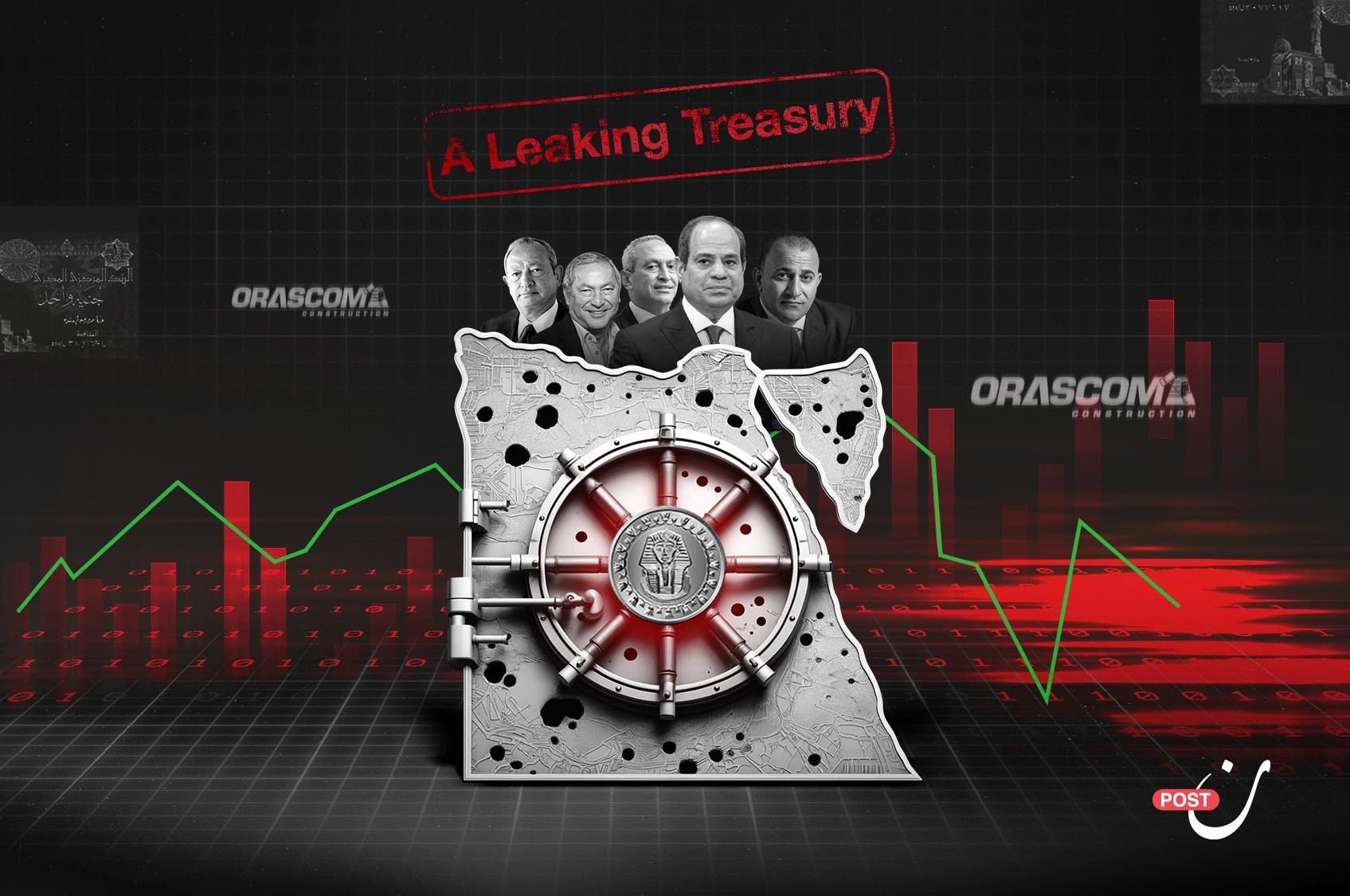
The first seeds of the capitalist classes in their current form in Egypt emerged with the onset of the openness policy the country witnessed in the 1970s, when President Anwar Sadat opened the door to foreign investments, transforming the Egyptian economy into one dominated by the private sector, and the size of private sector companies expanded during the 1970s and 1980s.
According to a report by economist Amr Adly at the Carnegie Middle East Center, the sector’s share expanded through engagement in capital‑intensive activities with higher value added, and private sector companies became involved in manufacturing sectors such as tourism, construction, importing technology, in addition to export activities such as exporting agricultural crops of fruits and vegetables, along with manufactured goods like ready‑made garments and carpets.
Mubarak Era: Transferring Public Wealth to the Private Sector
The biggest takeoff for the private sector and large capital came in the early 1990s, when the Egyptian government then signed an agreement with the International Monetary Fund aimed at gradually privatizing public sector companies, which was a key pillar in transferring wealth to the private sector.
In addition to easing and removing restrictions in many economic sectors that were dominated by public sector companies, this led to an unprecedented increase in the private sector’s share in Egypt’s GDP.
By 2004, with Nazif’s government taking office, a new phase began: businessmen and capital owners entered as partners in governance, taking on direct political responsibilities and assuming ministries that oversaw their business interests.
The new government provided unprecedented support to the private sector in the form of tax exemptions, investment incentives, allocation of land at low prices, and subsidized energy.
Egypt thus shifted toward an economy dominated by the private sector, with high accumulation of capital and production among families owning vast business groups operating in multiple sectors.
Here emerged what is known as “crony capitalism” (in the expression of Egyptian economist Mahmoud Abdel‑Fadil), which describes an economic pattern characterized by reciprocal benefits and services between the ruling political class and businessmen. Under this system, the political class could issue legislation and laws serving specific purposes in production, import and export, and executing state infrastructure projects.
In his book Crony Capitalism, Mahmoud Abdel‑Fadil, economics professor at Cairo University, argues that this situation enabled a faction of businessmen close to the narrow circle of political power, and who displayed loyalty to it, to benefit from these laws and regulations. As a result, these individuals amassed enormous financial wealth, laying the foundation for the uninterrupted rise of this class to the present.
A World Bank study issued in 2015 revealed the impact of what it called “Pyramid Capitalism” on productivity in Egypt, demonstrating the link between political connections enjoyed by businessmen close to the Mubarak regime and a network encompassing 469 companies controlling certain sectors and earning massive profits.
The study shows how these companies benefited from preferential regulatory transactions such as trade protection, energy subsidies, land acquisition, and avoidance of laws giving them better financial performance compared with companies whose owners had no relationship with the regime or the ruling party, ultimately creating a distorted economic environment dominated by politically connected firms.
Economic researcher Wael Gamal argues in his book The Egyptian Economy in the Twenty‑First Century that Mubarak’s project to pass power to his son Gamal was not fundamentally Gamal’s project, but rather the project of the rising businessman class, who were fighting the old guard within the ruling coalition (state bureaucracy and security apparatuses, especially the armed forces).
Their companies’ power abroad also expanded, becoming multinational firms with values in the billions of dollars. Amid monopolistic conditions and unlimited state privileges alongside institutional weakness in markets, they acquired unprecedented weight in the economy.
Years of Upheaval: Preparing Ground for a New Ruling Alliance
The January Revolution came against the ruling alliance, of which the upper class of capital owners was an inseparable part. Under public pressure in the squares, the regime was forced to imprison some of its businessmen for a period.
Wael Gamal notes that “businessmen began losing many of the privileges they had enjoyed for many years during the Mubarak era, and a series of judicial rulings were issued against them, but their influence and external alliances persisted.”
As popular pressure declined, this class regained its strength and influence starting in 2014. Legislation returned to serve its interests, such as the law protecting government contracts, the law of reconciliation with businessmen, and amendments to bidding laws allowing the government to award land titles and other contracts directly to aligned businessmen, in addition to tax reductions and other privileges that revolutionary years had stalled.
This group benefited from liberalization of the gas and water sectors, and from public companies’ offerings on the stock exchange benefiting brokerage firms and investment banks, as well as the transfer of more public assets into private hands.
Gamal’s study revealed that the financial sector (banks and brokerage firms) continued accumulating and achieved immense profits in recent years not from core banking activities related to lending to diverse economic sectors, but from risk‑free lending to the government at high interest on treasury bills.
In other words, Egyptian banks collect deposits and savings from Egyptians, lend them to the state, and profit from the interest rate difference bringing huge gains to bank executives and shareholder businessmen. This activity continues to this day, benefiting primarily bank shareholders and, of course, executives.
Orascom: A Case of Private Gain under Sisi
The most striking example of business benefit under President Sisi relates to “Orascom Construction,” owned by the Sawiris family Egypt’s and Africa’s wealthiest. In October 2012, the Tax Authority demanded the company pay $2.2 billion in tax on the sale of Orascom Building to French group Lafarge for $12 billion in 2007.
A dispute arose due to the company’s refusal to pay, leading the finance minister at the time to involve the public prosecutor to pursue criminal charges for tax evasion.
In March 2013, the then‑Attorney General, Talaat Abdullah, placed businessman Onsi Sawiris, founder of Orascom, and his son Nassef Sawiris, the company’s chairman, on travel ban lists, straining relations with then‑President Morsi’s government.
About a month later, in April 2013, the company reached a settlement with the Tax Authority to resolve the dispute by paying EGP 7.1 billion in installments, and the names of the Sawirises were removed from travel ban lists.
The company paid EGP 2.5 billion, then ceased payments after political circumstances changed on June 30. In September 2014, Nassef Sawiris was sentenced to three years in prison and fined EGP 50 million for refusing to pay checks owed to the Egyptian Tax Authority.
But days later in November 2014, the Tax Authority’s appeal committee acquitted him of tax evasion and suspended all judgments against the company.
After Morsi’s removal, the company submitted a request to annul the settlement agreement, arguing it was signed under political pressure. The ruling went in its favor and it recovered the EGP 2.5 billion previously paid. Company officials then donated that amount to the “Tahya Misr” Fund established by President Abdel Fattah el‑Sisi.
The Orascom case exposed the continued role of capital in playing a vital part in the transitional phase Egypt has witnessed since 2011, and in its principal participation in ousting former President Mohamed Morsi, supported by the Muslim Brotherhood, in 2013.
This took place through pressures of stop‑go investment strategies to compel the regime to ensure no action was taken against companies and investments they owned, as well as using their media outlets to oppose the Brotherhood, stir public demonstrations, and strip political discourse of social dimensions, reducing it to battles defending Egypt’s secular national identity.
In this context, businessmen were alarmed by the rising political power of labor under the revolutionary mood, frustrated by the Brotherhood’s inability to rein in labor militancy, and fearful of competition from Brotherhood‑linked commercial interests nearing control over legislative and administrative state apparatuses that grant contracts, distribute deals, create jobs, and write laws to their benefit.
Thus, the business class mobilized all its financial resources and media tools to eradicate any form of democracy by allying with the military institution, whose leadership had the greatest interest in regaining power, and strongly backed the new ruling alliance led by Field Marshal Abdel Fattah el‑Sisi, soon to become president.
Those Aligned with Sisi and Their Victims
Economist Amr Adly, in his study of transformations witnessed by major private companies after the January Revolution, argues that although the revolution and subsequent developments did not reduce the actual economic weight of large private sector firms, their political clout diminished significantly compared to the Mubarak era. Most economic decision‑making shifted primarily to the military and other parts of the state bureaucracy.
From this standpoint, the new regime worked to dismantle the old networks of corruption and cronyism that had benefited big companies under Mubarak, restructuring them by excluding previous beneficiaries and making deep structural changes to the economic power aligned with the ruling apparatus to ensure the continuation of close ties between the state and capital but in a different form by reshaping networks of patronage.
This resulted in replacing old “cronies” with new ones, who managed to exploit their connections to support the regime and obtain unlimited privileges and access to rent resources, which flowed in various ways into the Egyptian economy.
Government Spending—and Business Profits
In recent years, the Egyptian government has expanded constructing major national projects, focusing on sectors such as energy, water, and transport. At the same time, these projects were financed through loans from major international institutions and foreign banks, which prefer working with private sector partners rather than the military or other bureaucratic institutions.
Hence, these projects were awarded to multinational Egyptian companies with presence in many countries and trusted by international financing institutions, foremost among them Orascom Construction (owned by the Sawiris family) and El Sewedy Electric (majority owned by the El Sewedy family).
Orascom can be seen as an example of the tremendous gains the private sector achieved from unprecedented government spending. A Matasdash investigative report shows how Orascom turned from posting losses of about EGP 9.1 billion in 2012 and EGP 1.4 billion in 2013 into massive profits due to government spending on infrastructure projects.
Company financial disclosures show unprecedented revenue and profit growth resulting from a substantial increase in annual project contract awards since President Abdel Fattah el‑Sisi assumed office in 2014.
Between 2014 and 2023, Orascom’s total revenues reached approximately $35.6 billion with net profits of about $866 million. Although the company expanded geographically into the United States and the Gulf, infrastructure projects implemented by the Egyptian government represented the bulk of its work’s volume and value.
During the same period (2014–2023), Egypt’s average share of projects executed by the company was approximately 68%, according to analysis of budgets and annual results by Matasdash.
On many occasions, the Sawiris family criticized state intervention in the economy and the shrinking role of the private sector. But in reality, the government’s increasing economic role in recent years effectively expanded Orascom’s business, as the figures show achieving significant foreign currency revenues and profits while low‑income citizens shoulder the burden of these debts through indirect taxes.
Control of Land and Resources
Unlike the Sawiris family, the Talaat Moustafa family never criticized state intervention in the economy not because family head Hisham Talaat Moustafa was spared life imprisonment after being accused of killing Emirati singer Suzanne Tamim in exchange for state deals that resulted in the acquisition of vast land in the new administrative capital and participation in several real estate developments but because its relationship with the state was the locomotive of the family’s wealth.
This occurred both during the Mubarak era, when land for the “Madinty” project (covering 33.6 million square meters) was allocated to Talaat Moustafa in 2005 in violation of the law by an Egyptian court; and under Sisi, when the “Celia” project lands were allocated in 2018, and in 2021 the “Noor” project lands were allocated under a veil of secrecy through the previously mentioned bidding law.
In January of this year, Talaat Moustafa entered a partnership with the Armed Forces Engineering Authority for an investment project called “South Mid” after the military expropriated 23 million square meters of land in the Jumeima area from residents, compensating them EGP 2,500 per square meter of residential land. Meanwhile, Talaat Moustafa Group offered units six months later at EGP 180,000 per square meter.
In late February, Hisham Talaat Moustafa appeared alongside Prime Minister Mostafa Madbouly and Mohammed Al‑Suwaidi, Director of the Abu Dhabi Fund, signing an agreement to develop the Ras Al‑Hikma area as the local Emirati partner, though the exact role of Talaat Moustafa whether owner of the land or partner in development remains unclear.
In both cases, land grants were the royal road to rapid wealth for businessmen in general and Talaat Moustafa specifically; acquiring it at low cost and selling planned housing units in the market to raise construction capital yielded profits and created vast wealth. Hisham Talaat Moustafa thus became, with government backing, one of the largest landowners in Egypt.
But land allocation was not the only path to ascendancy. Obtaining government contracts was an even shorter route to wealth accumulation, as seen in the striking case of Sinai businessman Ibrahim Al‑Arjany.
Al‑Arjany, released from prison in 2010 after serving nearly two years following an armed conflict with police and detaining dozens of security personnel, now has a name synonymous with close ties to sovereign entities and the highest levels of power.
He began his activities after founding “Sons of Sinai” in El Arish, North Sinai in 2010, but his name did not enter the spotlight until the company supplied materials for rebuilding the Gaza Strip after the 2014 Israeli offensive. Al‑Arjany’s business then expanded thanks to government contracts that made him the sole controller of all contracting work in Sinai.
Through these government contracts, Al‑Arjany transformed in a decade from a smuggler released from prison into the owner of a sprawling economic empire from transporting Palestinians between Gaza and Egypt (with bribes), to acquiring rights to develop the zoo in partnership with foreign and Arab entities, to obtaining the BMW agency jointly with Al‑Safy Group (Sisi’s son‑in‑law) and the Al‑Ghanim family. He became known as “Abu Essam,” one of the country’s most prominent and powerful businessmen.
The Disfavored
While remaking the ruling alliance, President Sisi, early in his rule weeks after taking power in 2014, asked a number of businessmen to make donations to “Egypt,” invested later in infrastructure projects.
According to Mada Masr, attendees thought the donations would be one‑off or occasional, but they did not imagine that these requests would intensify over time and escalate with the economic crisis in 2022.
In the last quarter of 2022, Sisi convened another meeting of businessmen, asking them to partner with the state in advancing projects either through direct financial contributions, managing projects in the state’s interest, or purchasing these projects.
Over the decade, businessmen were offered a choice between donating to “Egypt” or rather to the Tahya Misr Fund overseen personally by Sisi or imprisonment. For example, Salah Diab, whose businesses span oil and agriculture and who owns Al‑Masry Al‑Youm newspaper, was twice detained for failing to donate to Tahya Misr:
first in 2015 on charges of possessing an unlicensed weapon (released after four days due to swift Emirati intervention), and again in September 2020 a detention that ended after 40 days once he complied with demands, including donating a fixed amount to Tahya Misr, relinquishing some land assets, and crucially surrendering his shares in Al‑Masry Al‑Youm, turning the opposition newspaper into regime‑aligned media.
A more severe case occurred with businessman Ragab El‑Suweirki, owner of the famous “Al‑Tawhid wal‑Nur” stores, charged with “financing a terrorist group.” In April 2021, he was convicted on unrelated charges of failing to adopt industrial safety precautions at some store branches, sentenced to three months’ imprisonment and fined EGP 30,000.
Yet El‑Suweirki remained in prison for a year and two months, released only after surrendering assets seized from his and aides’ homes, including multiple stores and land, according to Mada Masr.
Mada Masr reports that the list of businessmen targeted in recent years also included Ahmed El‑Azby, owner of the “El‑Azby” pharmacy chain, who was arrested in September 2022 and agreed after release to relinquish part of his business and quickly facilitate a donation to a government entity.
Such detentions affected many businessmen who failed to take seriously the signals to donate to the Tahya Misr Fund. Those not detained sold shares in their companies to foreign firms while ensuring stakes in companies abroad such as the heirs of the late Mohamed Farid Khamis in “Oriental Weavers” a pattern repeated with Domty in the food industry.
In sum, all businessmen—whether favored or disfavored—understand the necessity of forging strong relations with the state, which distributes contracts and awards deals. In a country like Egypt, wealth is never generated in isolation from the state.
However, those relationships vary between cronies with patronage whether due to security roles in isolated regions like Sinai or because they activate the economy and pump money into major real estate projects undertaken by the regime and those viewed by the state principally as sources of donations in exchange for being allowed to operate without obstruction or detention.
In light of the current economic crisis, the state can no longer ignore what it expects from businessmen. But the state now recognizes the importance of businessmen in providing employment and achieving any meaningful economic growth. Therefore, it has moved away from a policy of detaining businessmen that drew criticism from international financial institutions for violating economic freedom principles and attacking private property.
After the recent agreement with the International Monetary Fund in March, the authority is compelled at the fund’s directive to open broader spaces for the private sector in most activities.
In this context, every gain will gradually translate into political influence, especially as the narrowing circle of “patronage” compels businessmen to unite and defend their collective interests, which is expected to happen if international financing institutions provide protection from security‑driven dealings a possibility now more attainable than before.