

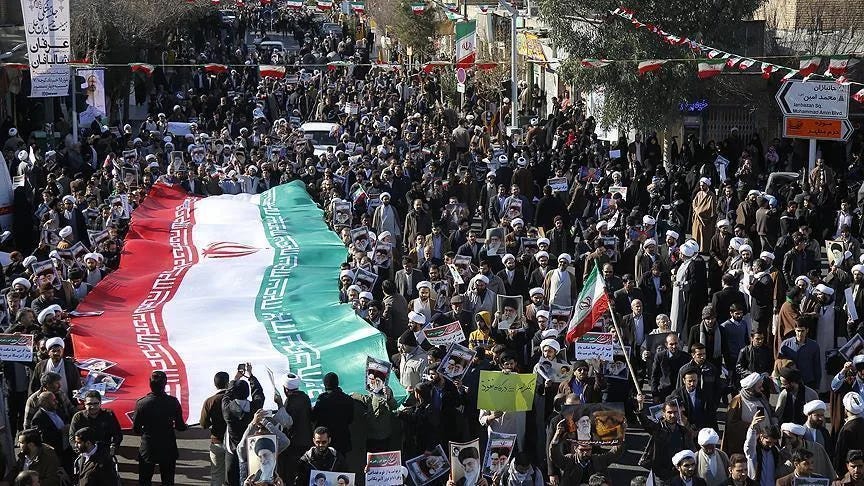
The situation on the streets of Iran appears to be moving toward a degree of calm following more than twenty days of protests, described as the most widespread and violent since the 1979 Islamic Revolution. In recent hours, the protest movement has shown signs of losing momentum compared to the intensity witnessed across the country since late December.
There has been a relative decline in the intensity of the demonstrations, which initially erupted over economic and livelihood grievances before swiftly escalating into political slogans demanding regime change. The protests extended to at least 26 of the country’s 31 provinces and over 20 universities.
The authorities responded with a combination of on-the-ground repression and political delegitimization, accusing protesters of serving foreign agendas an attempt to strip their demands of legitimacy. This reflects a deep structural crisis within the Iranian regime, which continues to struggle under the weight of international sanctions and a record of administrative failures.
As options dwindled, the authorities appeared to fall back on security-based measures as their last resort to contain the public outrage, which has gone beyond economic concerns to challenge the very core of state policies and governance.
In a sign of a possible shift in strategy, Iran’s three branches of government the executive, legislative, and judiciary issued a joint statement pledging broad reforms to improve living conditions.
They emphasized the need to “give justice to the protesters” who took to the streets in peaceful expression of economic grievances, while also vowing to punish those labeled as “saboteurs.”
Acknowledgment and a Dual Message
The statement from Iran’s three branches of government cannot be seen as isolated or detached from the directives of the Supreme Leader’s office. Rather, it reflects a centralized political decision and signals that Iran’s ruling elite both religious and political now officially recognize the sensitivity and danger of the moment.
This statement implicitly acknowledges deep-rooted structural dysfunction in economic and administrative performance. It represents an admission that ignoring public demands is no longer a viable or sustainable option. The authorities are effectively conceding to mismanagement and the rising influence of sustained protest.
Viewed in this light, the statement appears to be a political maneuver aimed at containing the wave of anger before it spreads further and threatens internal cohesion especially amid compounding economic and social crises, and the apparent inadequacy of security responses alone to manage unrest.
The promise of reform thus serves a dual purpose: one directed inward to calm the streets and absorb protest momentum, and another outward to assert that the regime remains in control and capable of managing crises within a calculated political framework.
Unprecedented Toll of Bloody Repression
It has become increasingly clear that this ostensible alignment with protester demands is less a product of genuine reformist intent and more a consequence of the security strategy’s failure to quell unrest. Iran’s decision-makers now realize that force alone is insufficient to suppress public fury even if the streets experience temporary calm.
This is evidenced by the mounting death toll and the growing resolve among citizens to continue demonstrating in various forms.
In a recent update on the toll of the unrest, the head of Iran’s parliamentary National Security and Foreign Policy Committee, Ebrahim Azizi, announced at a January 19 press conference that more than 3,700 police officers had been injured during the protests.
He also reported damage to over 2,200 security vehicles, 250 schools, and 300 mosques, without providing any official figures on civilian or security forces killed.
Meanwhile, Iran’s semi-official Tasnim news agency reported that 111 security personnel were killed. In stark contrast, the US-based human rights organization HRANA reported 3,919 civilian deaths and more than 24,600 arrests numbers that underscore the wide gap between official narratives and rights groups’ estimates.
International human rights organizations, most notably Amnesty International, have warned that Iranian security forces used excessive and unlawful force against largely peaceful demonstrators.
They cited credible evidence of widespread killings and linked the internet shutdowns with peak periods of repression moves seemingly aimed at preventing the dissemination of information and obscuring the scale of abuses.
The continued impunity for perpetrators, Amnesty noted, has emboldened authorities to persist in their systematic use of violence, deepening the crisis and expanding domestic anger.
Simultaneously, the United Nations issued a stern warning against Iran’s use of executions as a “state terror tool,” condemning the sharp rise in global executions during 2025.
UN High Commissioner for Human Rights Volker Türk stated that Iran carried out approximately 1,500 executions last year, based on credible reports contributing directly to a worrisome global surge, in his words.
Scramble to Contain the Anger
Iranian authorities are racing against time to quell the wave of popular anger before it reaches a tipping point that could uproot the regime entirely an implicit acknowledgment of their waning capacity to control the situation through traditional security approaches. In this context, the state has turned to a series of initiatives intended to project stability and strike a balance between force and conciliation.
The government reopened schools following several days of closure, a clear attempt to pacify the streets and restore normalcy, alongside relatively tight security control in key areas.
This mix of threat and appeasement has helped de-escalate the protests and prevent them from spiraling into further escalation. Public response to repeated calls for mass demonstrations has also diminished, particularly as some opposition figures have come under scrutiny from within Iranian society most notably Reza Pahlavi, whose recent statements supporting normalization with Israel and ending the nuclear program sparked widespread outrage.
Simultaneously, the regime has attempted to reassure the public by pledging improvements to living conditions as echoed in the joint statement from the three branches of government and by working to restore normal life and key services, most notably telecommunications and internet access.
Iranian President Masoud Pezeshkian confirmed his decision to restore international internet access swiftly. Parliamentarian Ebrahim Azizi added that top security agencies would soon rule on the full restoration of services once stability is reestablished.
This comes after strict limitations were imposed on internet and international phone services following the outbreak of protests in late December.
Easing International Pressure
The regime’s measured approach to managing the unrest would not have been possible without a perceived decline in international—particularly American—pressure. The Trump administration’s apparent retreat from launching a military strike on Iran lifted what many inside the regime had felt was a sword hanging over their heads, granting the leadership a much-needed window to regroup both internally and externally.
In this vein, Tehran sought to send both conciliatory and reassuring messages to Washington. The Washington Post revealed two days ago that Iran’s foreign minister had sent a “secret” text message to US Special Envoy Steve Witkoff, pledging an immediate halt to the killing of protesters and the cancellation of pending executions for around 800 protest leaders. The move appeared to signal a willingness to de-escalate and make limited concessions.
According to the Post, this gesture played a role in Trump’s decision to hold off on the planned strike—even though the US had completed full military preparations, including repositioning strike ships within CENTCOM and raising alert levels at Al Udeid Air Base in Qatar. The president had also reviewed field reports and videos documenting violations against demonstrators.
Regardless of whether this was the decisive factor in delaying the strike, the nature of the US response has arguably placed the Iranian regime under more pressure than a military assault would have. The constant anticipation of a potential attack has generated a state of prolonged uncertainty arguably more destabilizing than an actual strike.
A Fragile Calm and Deceptive Retreat
Despite the relative calm currently prevailing on Iran’s streets, the protest movement has not disappeared entirely. Public suffering continues, and few if any of the demonstrators’ demands have been met. The scene remains a political volcano, ready to erupt again should the underlying causes of discontent resurface.
As for the US decision to postpone a strike, the real issue is not the reasons—declared or hidden—but rather that the cancellation is far from permanent. In essence, this is a form of maximum pressure, keeping the regime in a state of perpetual anticipation and strategic paralysis, which comes at a high cost to its internal stability and political maneuvering.
It could be argued that Trump—unlike Tel Aviv—may not be aiming to topple the regime outright but rather to coerce it into submission on his own terms. However, he could still opt for military action at any moment, based on pragmatic calculations. Iranian officials are keenly aware of this.
Thus, all options remain on the table. The current calm and Washington’s apparent de-escalation may merely represent a temporary breather a moment to catch one’s breath and reassess. Whether this fragile equilibrium holds will depend on the regime’s ability to genuinely absorb public anger while avoiding open confrontation with the United States, at least for now.
