

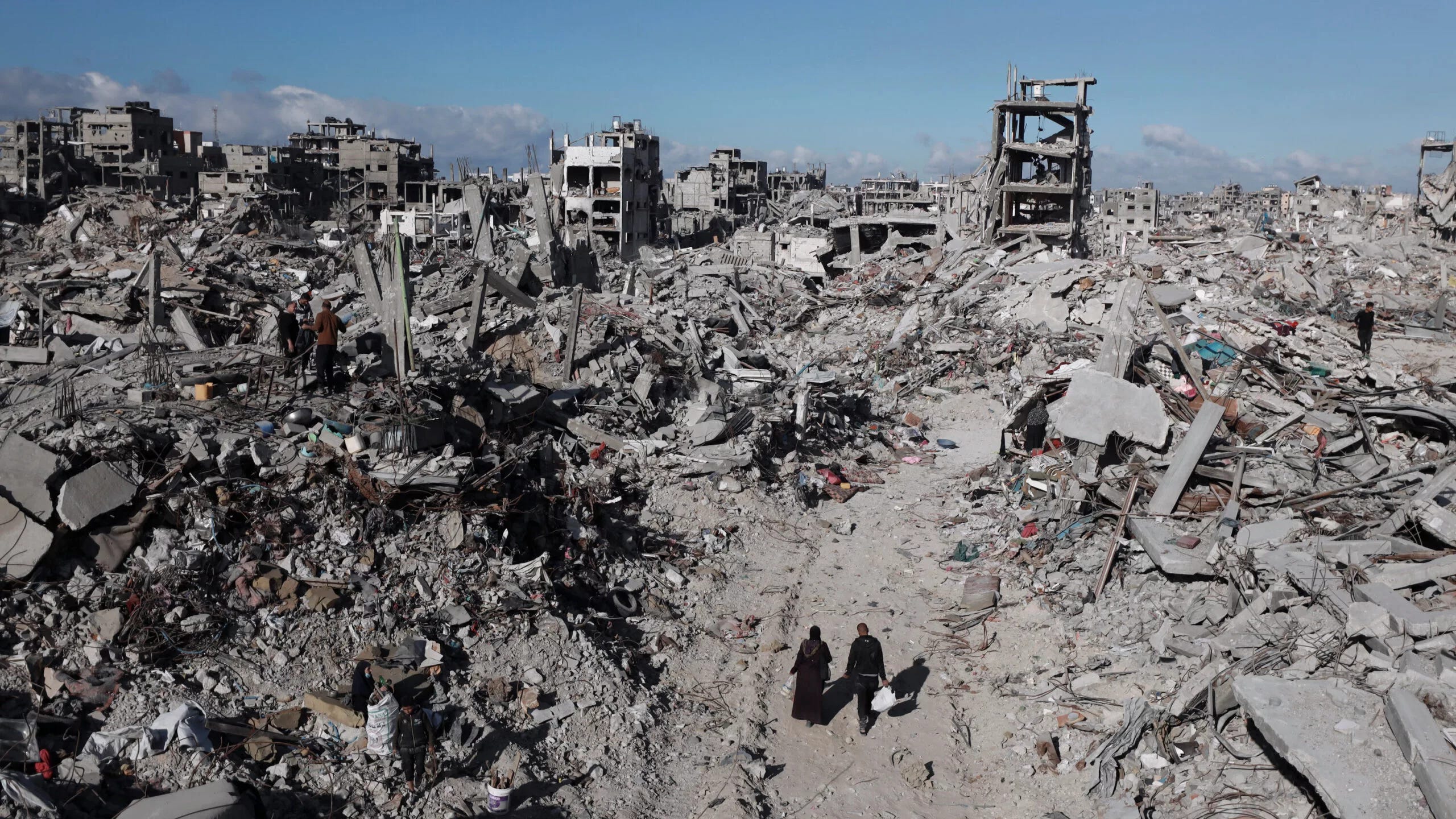
In Gaza, rubble is not merely the aftermath of bombing or a product of Israeli efforts to destroy the present. It is a deliberate colonial structure that persists within civilian time, shaping the daily lives of Palestinians and redefining their relationship with space, time, and the body.
Rubble is not a temporary state between destruction and reconstruction; it is a lived temporality and an intentional political space, continuously reproduced to suspend the future. It compels Palestinians to exist in a reality saturated with ruin, with no clear horizon for rebuilding or reclaiming a sense of normal life.
What appears to be the collapse of physical infrastructure is, in essence, the creation of a new form of spatial colonization. Life in Gaza is managed through destruction a process that transcends mere logistical failure or postwar mismanagement.
It reflects a conscious Israeli policy to keep the strip in a suspended material and temporal state, where life and death coexist in the same scene, and destruction becomes a daily colonial practice of control.
Rubble thus transforms from a wartime remnant to a material instrument of governance, from a marker of death to a new form of life within a shattered landscape. It must be read as a distinct socio-political structure a living archive that both documents and administers death and destruction, while also regulating survival.
It confirms the enduring Israeli grip on Palestinian space and daily life, where bodies are forced to adapt to a devastated environment and live among the ruins.
Violence does not end with the airstrike; it continues through the physical space that becomes a lethal environment impeding movement, disrupting basic services, and posing constant danger. This violence surpasses bodily harm, extending into the very spaces meant to shelter life.
Rubble becomes an active agent in shaping daily existence, reproducing systems of restriction and deprivation, and imposing a new mode of life in cities suspended between reconstruction and destruction.
It thus exerts symbolic domination and functions as a policy in its own right keeping Gaza in a state of perpetual ash and managing Palestinians socioeconomically through their own ruins, imposing constraints on both the present and the future.
In this context, rubble emerges as a central symbol in understanding the relationship between colonial violence and space. It reflects how the political economy of control entangles with civilian temporality and social space, defining Palestinian life within the ruins and perpetuating domination through the very materiality of destruction.
1. Rubble as a Living Colonial Archive
With over 60 million tons of debris, Gaza’s rubble is not merely physical remnants of destruction to be cleared for reconstruction. It constitutes a spatial-temporal archive of colonial control over the population.
Homes, streets, schools, and hospitals along with the interactive systems and collective memory they embody become colonial tools, functioning as daily registers of material and political domination.
The ash is not just a visual residue of ruin, but a symbolic and political apparatus that forces Gazans to coexist within a suspended rhythm of life between ruin and rebuilding, memory and loss, past and future.
Sociologically, rubble represents a living temporal space where power is inscribed. Its influence extends beyond the cessation of hostilities, affecting social organization, relationships, daily routines, and even Palestinians’ perceptions of their future.
The destruction strips architecture not only of its function but also of its socio-cultural meaning, forcing people to redefine their relationship with place.
The ruined environment acts as a coerced archive, documenting death and genocide, while simultaneously serving as a mechanism for the systematic reproduction of colonial domination in the present and future.
By preventing rubble removal through restrictions on equipment and material entry Israel enacts a deliberate political will to perpetuate dominance over Palestinian life, politically, socially, and symbolically.
Destruction becomes a tool for managing Palestinian time, embedding the colonial regime into the very fabric of daily civilian life, even after ceasefires. Life is forced to unfold within the temporal landscape of ruins, where destruction is not a moment of the past but an enduring presence.
Socially, rubble acts as a coercive mechanism for reshaping interactions and relationships under the conditions of devastation. It becomes part of an ongoing archive of control in a space where life and death are deeply intertwined.
This is a collective experience shaped by continued policies of erasure and forced adaptation to survival patterns, reorganizing shelter, displacement, and movement during and after war, all within a public sphere governed by rubble and devoid of civil or political oversight.
In this way, rubble transcends being merely a physical environment it becomes an invisible daily institution that shapes social behavior and collective interactions, stripping residents of their autonomy.
The forced dependency on colonial infrastructure becomes central to daily life. Thus, rubble is not a relic of a finished war it is an enduring colonial structure that continues to manage the present and dictate the future.
2. Rubble as a Tool of Temporal and Civil Death
In Gaza, rubble serves as a complex instrument of domination—an everyday mediator between life and death. It reproduces their governance under what Achille Mbembe terms “necropolitics.” Even after the bombardments stop, the Strip remains a lethal environment.
Israeli control over death continues through its management of post-strike life: the obstruction of rubble removal, the prevention of reconstruction, and the deliberate prolongation of danger through the unresolved presence of explosive remnants.
Rubble becomes a sustained site of violence a conscious colonial policy by Israel where every movement is shadowed by potential death. The presence of 70,000 unexploded ordinances, structurally unsound buildings, toxic materials, and decomposing bodies beneath the rubble transforms Gaza into a geography of slow death extending the moment of killing into a drawn-out temporal and spatial condition. This could be described as a regime of “partial-daily death.”
In this environment, new social dynamics emerge. Palestinians are forced to adapt to a deliberately destabilized and deadly landscape an environment crafted by a war of annihilation.
Social interaction becomes a form of survival, mediated by destruction. Ruin becomes the instrument of control over all aspects of life, obstructing mobility, housing, rehabilitation, and any return to pre-war normalcy. Every element of daily life is tied to the presence and peril of rubble.
Here, even the present becomes a tool of domination, while the future is indefinitely suspended. Rubble is transformed into a mechanism of colonial control over Palestinian lived time. The occupation does not only enact immediate violence; it also captures the horizon of life itself, trapping residents in a suspended temporality caught between death and survival, unable to reclaim a natural rhythm of living.
Thus, rubble functions as a dual-purpose colonial instrument: it reinforces domination while transforming the material landscape into a necropolitical space. It dictates both life and death, restricting social movement and forcing the population to exist in a state of continuous adaptation to destruction.
It becomes a persistent colonial structure that entrenches Israeli dominance after the war, just as during it, reproducing both material and symbolic violence in every aspect of daily life.
3. Rubble as a Mechanism for Economic and Civil Time Control
Israel exercises total control over the temporality of rubble deciding when it can be removed, accessed, or used for reconstruction. This is not merely a matter of logistical management; it is the transformation of rubble into a resource that ensures the continuation of economic fragility and coerced dependence on the occupation.
Any form of civil or economic planning is indefinitely postponed, making rubble a political and economic tool that governs the rhythm of daily life and the Palestinian future under permanent precarity, subject to the occupier’s decisions.
This form of control creates three levels of dependency:
Daily dependency, where movement and access to resources hinge on the clearance of roads and debris.
Economic dependency, where recycling or utilizing rubble for rebuilding requires Israeli approval.
Symbolic-political dependency, where time itself becomes a tool of domination, as every delay in rubble removal reinforces colonial authority.
As a result, the civil cycle becomes a theater of power. Destruction becomes the means through which daily life is regulated and held in perpetual limbo. Rubble becomes a deferred economy life is managed through a disabled timeline shaped by military, bureaucratic, and colonial calculations. Time is no longer a neutral dimension but a governing apparatus. Material devastation is not merely the outcome of war; it is a means of controlling the future.
With the accumulation of debris and the indefinite suspension of its removal, rubble institutionalizes waiting and prevents the formation of a future. Delayed reconstruction, limited access, high-risk zones, and a removal process that could take years—all generate a colonial temporality designed to keep Palestinians in permanent suspension. Rubble freezes the present and narrows the future to uncertain, externally dictated possibilities.
In this sense, civilian time itself is colonized. The natural life cycle is disrupted, the economy paralyzed, and the future confined to the realm of the unknown.
This article demonstrates how rubble in Gaza functions as an extended colonial structure that penetrates and reshapes every aspect of daily life. It controls time, space, and possibility, turning each moment into a battleground where destruction is not just a consequence of war but an integral part of the colonial system that persists even after the bombs stop falling.
Rubble is an archive of death and domination, an instrument of necropolitics, and a medium for reproducing forced dependence on the occupation. It carries political and economic value, turning destruction itself into a form of capital for control and population management.
The ruined material becomes a political actor that reinforces symbolic and social domination and transforms devastation into an economy of survival.
From a political economy perspective, rubble produces a deferred economy in which investment and civil organization are paralyzed and wholly subordinated to Israeli conditions. Civil life is stifled by the materiality of destruction, which restricts mobility, limits access, and embeds the control of civilian and economic time within the logic of colonial power.
In essence, Gaza’s rubble represents a comprehensive colonial model for managing society interweaving matter, time, and politics. Its effects endure long after the bombing ceases, rendering destruction a living extension of domination, not a relic of the past.