

Despite the icy chill and snowy peaks of the Swiss Alps, this year’s World Economic Forum unfolded under far warmer and far more fraught conditions. The mood in Davos was charged with tension, as sharp disruptions and intensifying global crises dominated discussions, exposing the growing fault lines fracturing the global order.
In stark contrast to the forum’s theme, “The Spirit of Dialogue”, many sessions bore the marks of confrontation rather than consensus. Dialogue gave way to division, and ideological clashes overshadowed attempts at mutual understanding.
Rather than a platform for shared vision, Davos became a stage where the realities of international rivalry and conflicting interests played out underscoring the deepening fragmentation of the global system.
This high-stakes atmosphere framed a summit convened at a uniquely sensitive moment, where geopolitical dangers collided with economic and security challenges. More than ever, the gathering served as a litmus test for global resilience in a world where power projection is rapidly eclipsing diplomacy.
Held from January 19 to 23, under the banner “The Spirit of Dialogue”, the 2026 edition of the forum witnessed an unprecedented scale of participation: roughly 3,000 attendees from over 130 countries, including nearly 400 senior political leaders and 65 heads of state or government. Six leaders from the G7 were also in attendance, adding weight to the summit and underscoring the high stakes on the table.
An Exceptional Edition
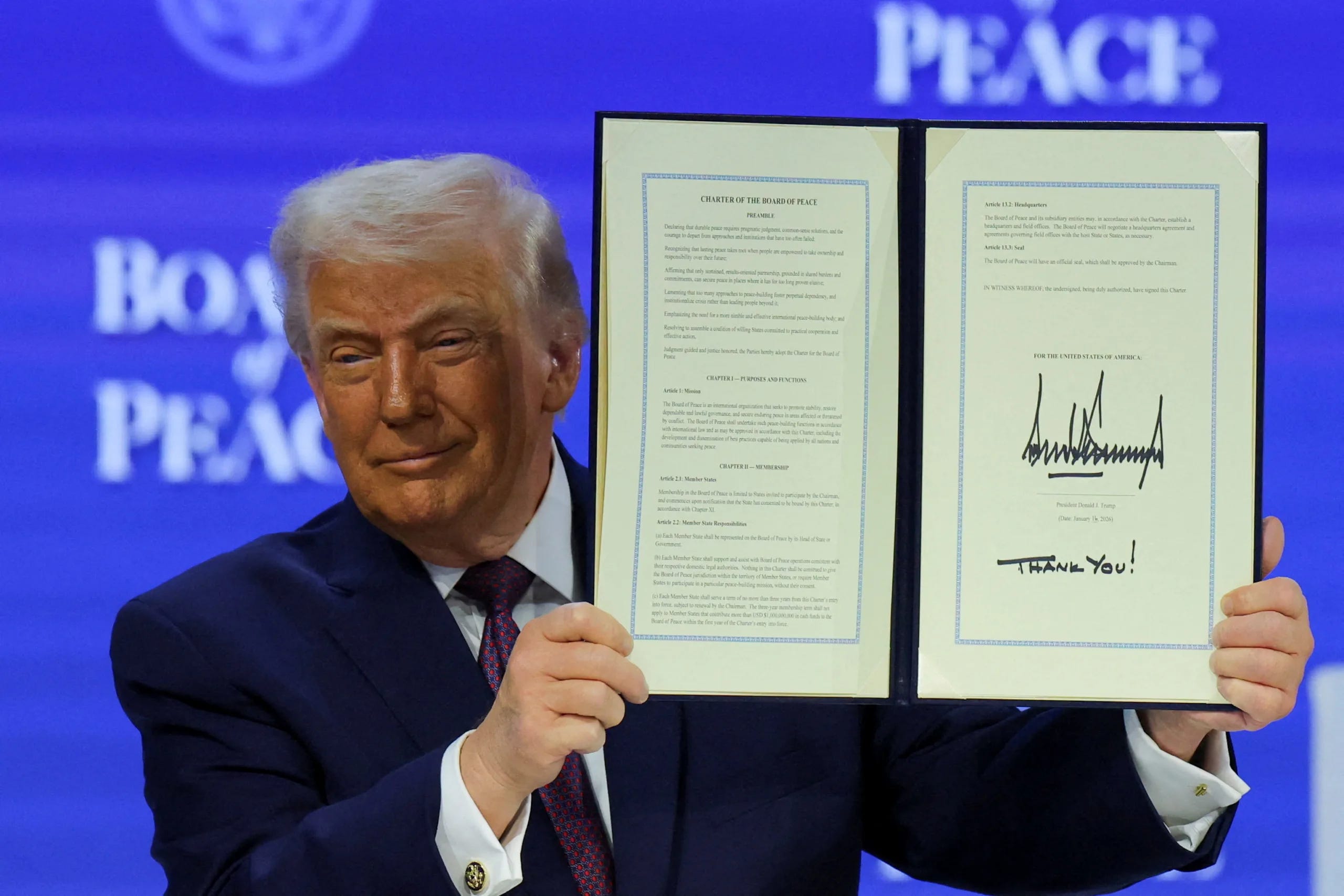
This year’s forum was nothing short of extraordinary, taking place at a geopolitical inflection point triggered by what many are calling a political “bombshell” from U.S. President Donald Trump. His sweeping changes to American foreign policy affecting allies and adversaries alike have jolted the international system.
From Gaza to Iran, from Venezuela to Greenland, Trump adopted an uncompromising tone that rekindled fears of a collapse in the global trade system and the unraveling of rules that have stood for decades.
Amid this heightened tension, pressing questions emerged over the future of U.S. relations with its traditional allies especially after Trump threatened to impose new tariffs on European countries in retaliation for their rejection of his controversial Greenland annexation proposal. European leaders feared becoming pawns in what they saw as a campaign of American coercion.
What was once a forum primarily focused on economics energy, food security, and the clean transition morphed into a stage for direct political confrontation between Washington and Brussels. Both sides came to Davos bracing for confrontation, poised to defend their interests. The forum became exceptional not just in its agenda, but in the simmering geopolitical anxiety and growing volatility shaping the global economic map.
Trump Rewrites the Rules of Global Trade
For decades, the economic relationship between the United States and Europe stood as a pillar of global stability a model of interdependence that buffered against disruption. But Trump’s policy shifts have shaken that foundation. What once seemed a robust and stable system now appears fragile, vulnerable to erosion and collapse.
European leaders arrived in Davos burdened with growing doubts about the future of transatlantic trade. A sense of unease loomed large: the rules that governed economic ties for years were now in question.
Trump carried two clear messages to Davos. First, that economics is now a tool of sovereign power. Tariffs are no longer just about trade regulation or protecting industries; they’ve become political weapons wielded for strategic gain even at the expense of international legal norms.
Second, traditional alliances, particularly the U.S.–EU partnership, are no longer sacred. Their future is no longer guaranteed. This seismic shift turned the forum from a venue for economic cooperation into a high-stakes political chess match.
The Death of the Old Global Order
In a rare and candid moment that cut through the usual diplomatic decorum, Canadian Prime Minister Mark Carney declared the death of the old, rules-based global order. He warned that middle powers who cling to outdated paradigms would find themselves outmaneuvered by the ambitions of great powers.
Abandoning the cautious tone typical of such summits, Carney delivered a blunt verdict: the rules-based system is crumbling. The powerful do what they want; the weak suffer the consequences.
He insisted the world is not merely facing a “rough patch,” but undergoing a definitive rupture. The era when economic integration ensured peace is over. In its place is a “brutal reality” where interdependence is weaponized through tariffs, financial coercion, and manipulation of supply chains.
Carney introduced a new strategic doctrine for Canada: “Values-Based Realism.” He called for a fundamental rewrite of Western foreign policy narratives—an end to the illusion of impartial global governance while great powers exempt themselves from the rules.
In a striking metaphor, perhaps the boldest by any Western leader at Davos, Carney warned that middle powers though lacking the dominance of the U.S. or China possess collective weight. If they’re not “at the table,” he warned, “they’ll be on the menu.” He urged them to abandon bilateral negotiations from a position of weakness and instead form a “third path” through collective initiatives such as buyers’ clubs for critical minerals or trans-Pacific alliances with the EU.
His remarks signaled a paradigm shift not just crisis management, but a wholesale redrawing of the rules of the global economy. This was a departure from Western rhetoric as we’ve known it.
Europe Seeks a Way Out
Despite internal divisions and economic uncertainty, European leaders sought to present a united front against Trump’s threats. His proposal to impose tariffs on eight European nations over their opposition to the Greenland annexation was widely seen as a litmus test for the European Union’s resilience.
French President Emmanuel Macron articulated Europe’s position clearly: the EU must not yield to the rule of the strong, nor succumb to bullying or intimidation. Even considering trade retaliation against the United States, he said, underscores the gravity of the current moment.
European Commission President Ursula von der Leyen echoed this sentiment, calling for swift, decisive responses to global upheavals. The scale of the seismic changes underway, she argued, necessitates a push toward full European independence. “The time has come to build a new, autonomous Europe,” she said.
Belgian Prime Minister Bart De Wever emphasized the need for cohesion within the bloc, criticizing earlier attempts to appease Trump for his support in Ukraine. The EU, he said, must choose: stand together or remain fractured.
Sweden’s Deputy Prime Minister Ebba Busch added that pandering to Trump was futile. She urged the EU to harden its stance and keep trade retaliation tools ready as a deterrent.
China Offers Itself as a “Reliable Partner”
As the rift between the United States and Europe widened, China seized the moment to present itself as a stable alternative an open, cooperative partner embracing inclusivity over division, collaboration over unilateralism.
Amid the fading trust in global institutions, Beijing pitched itself as a dependable ally capable of weathering the chaos of American policy shifts.
Chinese Vice Premier He Lifeng didn’t mention the U.S. by name but condemned “unilateral actions and trade agreements” that undermine WTO principles and damage global commerce clearly referencing American tactics.
He emphasized that China is not an adversary but a trading partner to all. Its growth, he said, should be seen as an opportunity, not a threat. Beijing is prepared to further open its vast market and expand imports. It no longer aspires solely to be the “world’s factory,” but also, with growing ambition, “the world’s market.”
His remarks were an open invitation for Europe to recalibrate its partnerships away from Washington, toward the East. In a world where the U.S. may be retreating, China offered appealing incentives and the promise of stability. The subtext: Europe has options and the U.S. would be wise not to forget that.
Trump Steps Back
Faced with a firm European response and growing anxiety over escalating tensions, Trump appeared to back down. On the evening of Wednesday, January 21, following a meeting with NATO Secretary General Mark Rutte, the U.S. president announced he would delay the planned February 1 tariffs on select European nations.
This came on the heels of remarks by Treasury Secretary Scott Besant, who expressed optimism that the crisis would pass. “Why jump to worst-case scenarios?” he asked. “Calm the hysteria. Take a deep breath.”
Besant partially blamed the media—specifically referencing the Financial Times—for exaggerating the crisis. But the more critical message was clear: Trump was wary of letting the rift with Europe spiral beyond repair. The decision seemed aimed at de-escalating tensions and signaling temporary relief, amid fears that the trade dispute might ignite a broader conflict.
Trump appeared to be testing boundaries leveraging crisis for gain, while still mindful not to push Europe beyond the breaking point.
What About the Middle East?
The Davos deliberations laid bare the ferocity of global polarization. The escalating rivalries among major powers be it between Washington and Brussels or Beijing and Washington are dismantling the very foundations of the old economic order.
In this new environment, tariffs, sanctions, and trade influence have become weapons of political leverage. The consequences for developing nations especially in the Middle East—are potentially dire.
Arab economies are bracing for heightened volatility in commodity prices, particularly oil, gas, and food supplies. Inflationary pressures may rise, threatening stability. Politically, countries in the region are being forced to navigate an increasingly binary world, with growing pressure to choose sides jeopardizing their sovereignty and policy independence.
The moment calls for Middle Eastern nations to adopt the “Values-Based Realism” advocated by Prime Minister Carney: joining new regional and international coalitions and capitalizing on emerging strategic partnerships from Europe’s overtures to China and Qatar, to its negotiations with India and ASEAN.
Ultimately, Davos 2026 delivered a clear warning: countries that lack a seat at the major powers’ table risk ending up as prey in a global contest for dominance and resources. The message is urgent: will the region finally heed it?
