

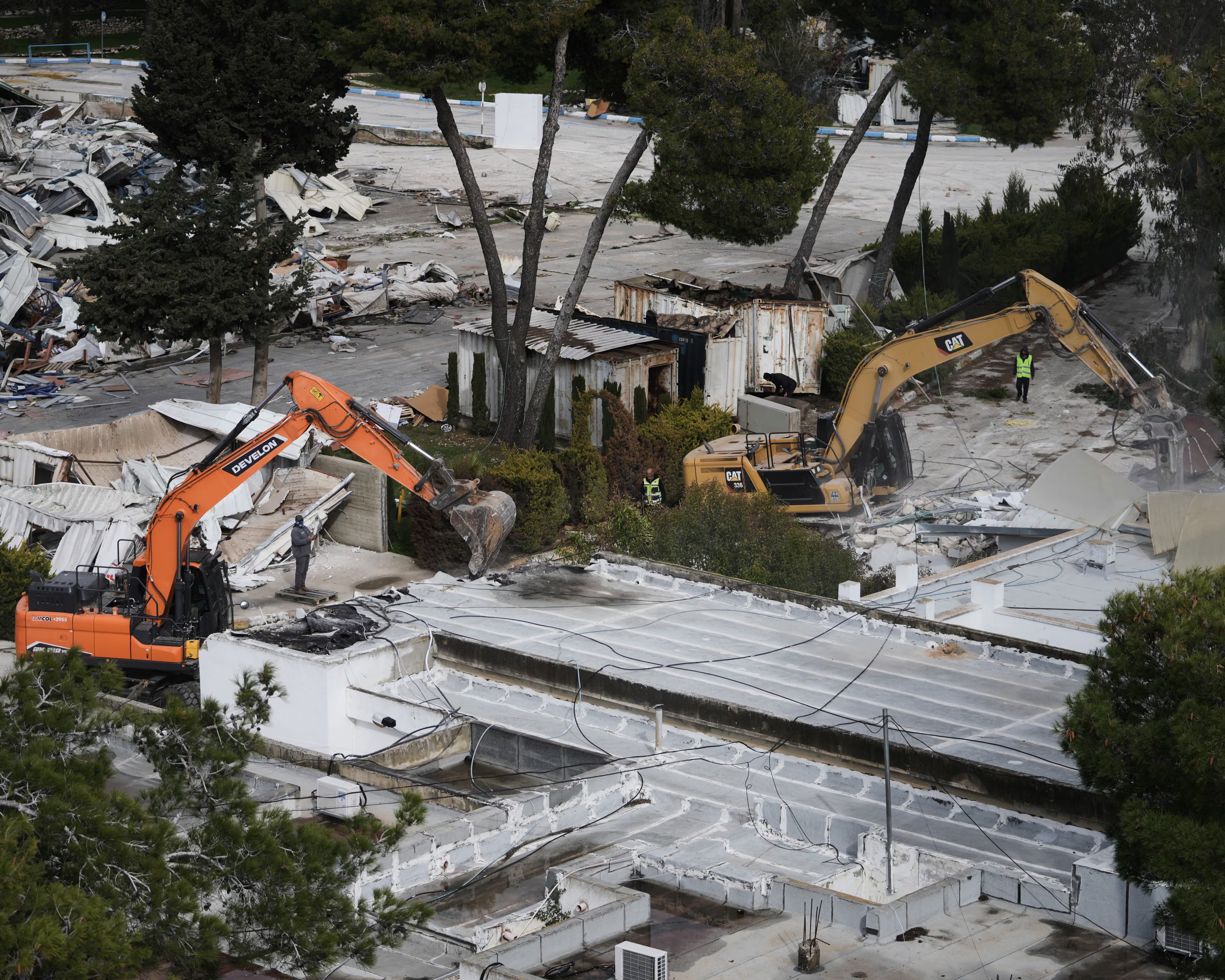
In an unprecedented move and a direct challenge to international law, Israeli occupation forces stormed the headquarters of the United Nations Relief and Works Agency for Palestine Refugees (UNRWA) in the Sheikh Jarrah neighborhood of East Jerusalem, forcibly evacuating it before Israeli bulldozers began demolishing its facilities.
Israeli soldiers hoisted the Israeli flag over the UN building after removing the United Nations banner, while far-right Israeli ministers celebrated the scene, calling it a “historic day.”
This development marks a culmination of escalating measures against the agency, including the passage of legislation banning its operations in Jerusalem and pursuing its employees raising serious questions about the immunity of UN sites and ushering in a new chapter that threatens the future of UNRWA’s services to Palestinian refugees.
What Was Demolished?
The targeted UNRWA headquarters was located in the Ammunition Hill area of northern Jerusalem. Heavy machinery flattened several large buildings and smaller facilities within the compound, which the agency had used for storing aid and managing operations.
Video footage revealed the scale of destruction at the UN compound, with piles of rubble and remains of buildings that once housed offices for dozens of staff.
UNRWA officials confirmed that the destroyed facilities included warehouses used to prepare aid for the West Bank and Gaza Strip, as well as administrative buildings that served as the heart of the agency’s operations in Jerusalem.
The site had not been in active use for about a year, as the agency was forced to vacate it in January 2025 after receiving Israeli orders to cease all operations in the city.
Despite this, Israeli authorities claimed ownership of the property, asserting that the complex lacked immunity an assertion UNRWA firmly rejected, stating the site was legally leased from Palestinian owners under formal agreements.
Israeli National Security Minister Itamar Ben-Gvir personally accompanied the bulldozers during the demolition and released a video from the ruins celebrating what he called a “festive day… with the expulsion of terror supporters,” in his words.
This marked the second raid on the compound in less than a month; the first occurred on December 23, 2025, and also involved Israeli forces raising their flag, drawing sharp condemnation from the UN agency.
Immunity Under Scrutiny
The demolition of a UNRWA facility presumed to be protected as a UN site sparked an international outcry and legal questions surrounding the diplomatic immunity of United Nations premises.
According to the 1946 Convention on the Privileges and Immunities of the United Nations, member states are obligated to respect and protect the inviolability of UN buildings.
International law experts view the storming and demolition of the UNRWA facility as a flagrant breach of these commitments, emphasizing that the convention clearly prohibits unauthorized entry into or interference with UN premises.
UN Secretary-General António Guterres denounced the Israeli action as “completely unacceptable” and a violation of Israel’s clear obligations under international law and the UN Charter. He called on Israeli authorities to halt the demolition immediately and return all confiscated property to the organization without delay.
Days before the demolition, Guterres sent an official letter to Israeli Prime Minister Benjamin Netanyahu, warning of legal action at the International Court of Justice (ICJ) unless Israel reversed its laws and measures targeting UNRWA and restored the seized UN sites.
In October 2025, the ICJ issued an advisory opinion affirming that obstructing the operations of UN institutions in occupied territories is illegal.
Conversely, the Israeli government attempted to justify its actions based on domestic legislation passed by the Knesset in late 2024 banning UNRWA activities within areas it claims as under its “sovereignty.”
In response, UNRWA warned that undermining the United Nations’ immunity in Jerusalem sets a dangerous precedent that could be replicated against other diplomatic missions and international organizations if not deterred.
Direct Impact on Services
For decades, UNRWA has operated schools and clinics in East Jerusalem and the refugee camps of Shu’fat and Qalandiya. The demolition of its headquarters and forced expulsion from the city has had immediate consequences for thousands of Palestinians.
1. Education
UNRWA oversaw seven independent curriculum schools in Jerusalem, serving approximately 1,800 refugee students.
However, in May 2025, under pressure from the new Israeli law, police raided UNRWA-run schools and shut down six of them in Shu’fat Camp and other neighborhoods, leaving around 550 students without classrooms.
Police also issued notices banning any educational activity under UNRWA’s auspices in Jerusalem and arrested at least one educational staff member.
This closure deprived hundreds of children of their right to education, forcing families to seek scarce alternatives.
Most Palestinian public schools (run by the Ministry of Awqaf) in Jerusalem are already overcrowded. Many families had no choice but to enroll their children in Israeli municipal schools that teach the Israeli curriculum.
Parents fear these schools will strip their children of their national identity, expose them to discrimination, and pose logistical hardships due to their distance from refugee communities.
2. Health and Social Services
UNRWA operates essential healthcare clinics relied upon by refugees, including a central clinic in the Old City and another in Shu’fat Camp, offering general medicine, maternal care, and vaccinations to large numbers of patients.
According to agency data, its health program serves thousands of Palestinian refugees in Jerusalem annually, many of whom cannot afford private care or are not covered by Israeli health insurance.
UNRWA also manages a vocational training center in Qalandiya, which provides annual technical and trade training for over 300 young men and women, helping them enter the job market.
This center was also targeted during the raid on the headquarters: Israeli forces stormed the facility and fired tear gas to disperse students, claiming to be searching for UNRWA staff. Several students suffered from tear gas inhalation, and a 15-year-old boy was shot in the eye with a rubber bullet.
UNRWA warned that continued Israeli pressure may force the Qalandiya center to close, depriving hundreds of youth of essential livelihood skills.
In total, about 110,000 Palestinian refugees are registered with UNRWA in Jerusalem and surrounding areas, living across various parts of the city and its camps.
Shu’fat and Qalandiya camps alone are home to over 32,000 Palestinians (approximately 16,500 in each), many of whom depend heavily on the agency’s services in education, health, and relief.
Weakening or eliminating UNRWA’s presence in Jerusalem would thus have profound humanitarian repercussions for this vulnerable population.
What’s Next?
Observers believe the demolition of UNRWA’s headquarters and its expulsion from Jerusalem may mark the beginning of the end for the agency’s role in Palestine or at the very least, a final warning to the international community.
Across the West Bank and Gaza, UNRWA has long provided essential services to millions of refugees, but Israel’s latest actions cast doubt on the future of these operations.
In the West Bank, the Israeli ban does not apply directly, as the territory remains, at least in theory, outside Israeli legal sovereignty. Nonetheless, recent months have seen growing Israeli obstacles to UNRWA’s work, including camp raids, staff harassment, and permit revocations.
In Gaza, while Israel has no direct presence in UNRWA’s areas of operation, it employs other means of obstruction, such as restricting the entry of supplies and targeting the agency’s facilities during the ongoing war.
Since the war on Gaza began in 2023, 382 UNRWA staff members have been killed in the line of duty the agency’s highest-ever death toll. Dozens of schools and facilities have also been destroyed, further crippling its ability to provide aid and exacerbating displacement.
In light of this reality, UNRWA is exploring emergency contingency plans to continue delivering core services. In Jerusalem, it is attempting to relocate operations to nearby West Bank areas, such as Ramallah or Jericho, to manage the files of Jerusalem’s refugees from afar.
However, this approach faces logistical and political challenges, particularly the difficulty of Palestinian refugees in Jerusalem accessing these offices due to Israeli checkpoints.
Palestinian officials and UNRWA fear the ultimate goal is to erase the refugee issue by dismantling the sole institution that safeguards their legal status. Commissioner-General Philippe Lazzarini said the latest demolition follows Israeli efforts “to erase the identity of Palestine refugees.”
At the international level, the outlook remains bleak—but not yet irreversible. UNRWA’s mandate continues to be renewed by the United Nations, and the agency still receives significant funding from the European Union, Arab, and Asian countries to offset the shortfall caused by the cessation of U.S. funding in 2018 and again in 2024.
The UN has reiterated its commitment to Palestinian refugees in Jerusalem despite mounting obstacles, calling for legal mechanisms to uphold UNRWA’s protected status.
The demolition of the UNRWA headquarters in Jerusalem stands as a critical test of UN immunity in occupied Palestinian territory. The coming phase could bring either Israeli retreat under international pressure or further escalation, with dire humanitarian and political consequences.