

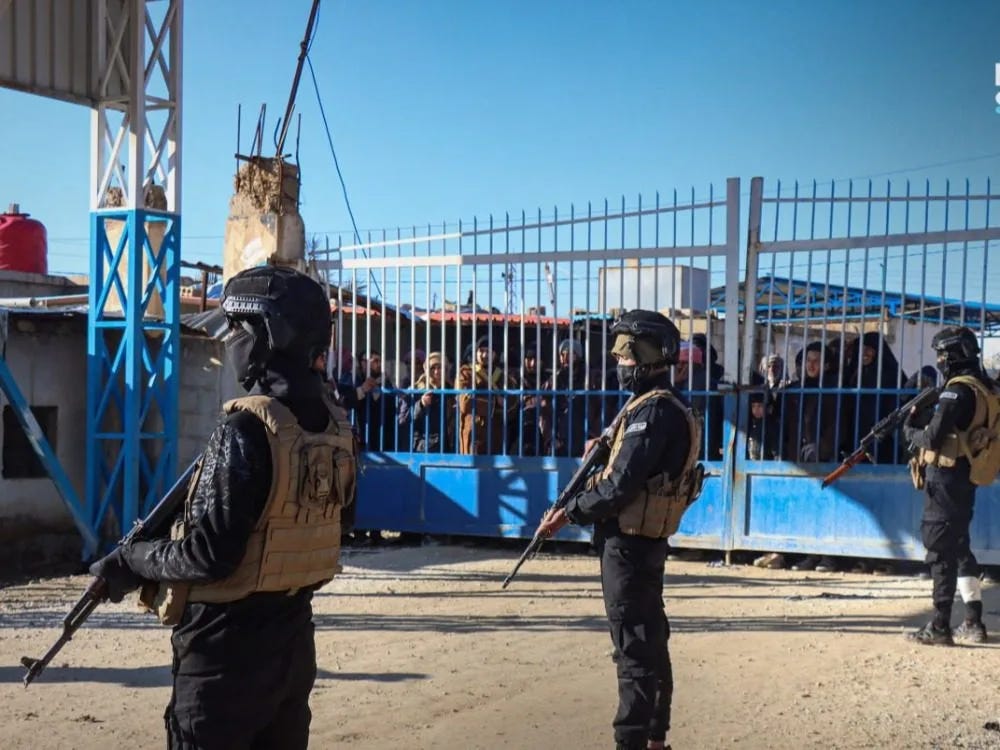
The US Central Command has announced the launch of a new operation in Syria aimed at transferring ISIS detainees from the country’s northeast to Iraq a move that has sparked questions over whether it is a necessary security measure or merely the relocation of a ticking time bomb.
According to a statement issued on January 21, 2026, 150 ISIS fighters held at a detention facility in the Syrian city of Hasakah were transferred to a “secure” holding site in Iraq. The US added that up to 7,000 detainees could eventually be moved from Syria to facilities under Iraqi government control.
The move comes amid major military and political developments in Syria, particularly the rapid collapse of control by the US-backed Syrian Democratic Forces (SDF) in parts of the northeast following recent clashes with the Syrian government forces in Damascus.
While Washington insists that the transfer is intended to ensure detainees remain in secure facilities and to prevent any immediate security threat to the region or the US, observers question whether this approach truly resolves the underlying issue or simply shifts the danger to another country.
A Network of Prisons and Camps
In the years following ISIS’s territorial defeat in 2019, the SDF established a sprawling network of prisons and camps across its areas of control to detain ISIS fighters and their families.
According to media sources, the SDF was holding approximately 9,000 ISIS militants in over a dozen detention centers across northern and eastern Syria, including hundreds of foreign fighters whose home countries refused to repatriate them.
The largest of these facilities is Ghuwayran Prison in Hasakah, housing around 4,500 detainees. Parallel to that, the notorious al-Hol camp has hosted tens of thousands of ISIS fighters’ family members—mostly women and children—living in dire conditions.
Al-Hol currently shelters about 24,000 people, mostly Syrians and Iraqis, but also around 6,500 nationals from more than 40 countries considered hardline ISIS loyalists, who are housed in a high-security section of the camp.
These prisons and camps have often been described as ticking time bombs, posing both security and humanitarian risks. They have witnessed repeated violence, including murders within the camps, in addition to extreme overcrowding and catastrophic living conditions circumstances that risk turning these sites into breeding grounds for future extremism if no sustainable solution is found.
Transferring thousands of detainees to Iraq was not possible without intricate political and security arrangements between Baghdad and Washington, given the sensitivity and implications of such a move. On the Iraqi side, the official stance has cautiously supported the transfer following a reassessment of the evolving situation in Syria.
Iraq’s National Security Council announced its approval to receive “terrorist detainees holding Iraqi and other nationalities who were previously held in SDF-run prisons.”
Spokesperson for the Iraqi Armed Forces, Sabah al-Numan, confirmed that the detainees—both Iraqi and foreign nationals who were “involved in spilling the blood of innocent Iraqis,” would be placed in official government-run correctional facilities.
Iraq’s Supreme Judicial Council emphasized that all transferred individuals would fall under the jurisdiction of the Iraqi judiciary, stating: “We will take legal action against them.”
This cooperation marks a significant shift in Baghdad-Washington relations. For years, Iraq resisted accepting such large numbers of ISIS affiliates and even demanded billions of dollars in financial compensation to shoulder the responsibility.
The Burden of Security and Detention Costs
Managing and securing these facilities has placed a heavy burden on the SDF and its backers. The Kurdish-led Autonomous Administration has relied heavily on international coalition support—particularly from the US for funding, training, and logistical assistance.
Washington has repeatedly stressed it cannot continue financing these operations indefinitely. In a January 2025 UN Security Council session, Acting US Ambassador to the UN Dorothy Shea remarked: “The United States has borne this burden for far too long... Ultimately, these camps cannot remain a direct financial responsibility of the US,” referencing al-Hol and Roj camps.
Shea urged countries to take responsibility by repatriating their nationals detained in those facilities.
Iraq has been among the most responsive, repatriating over 10,000 of its citizens from al-Hol and Roj in recent years as part of a gradual rehabilitation and reintegration program.
Still, tens of thousands of foreign detainees remain stuck in Syria, with most Western governments unwilling to bring them back and prosecute them on home soil.
In light of this, the cost—both financial and security-related—of continuing to detain these individuals has continued to rise, prompting the US to view the deportation agreement with Iraq as an urgent necessity.
The Fate of the Camps After SDF Withdrawal
Recent developments on the ground in Syria have radically altered the future of camps previously controlled by the SDF especially al-Hol.
Following two weeks of clashes between Syrian government forces and the SDF in Aleppo and Hasakah provinces, both parties reached a temporary ceasefire in late January 2026, brokered by Washington.
As part of the agreement, the SDF withdrew from al-Hol and handed over control to the Syrian government. On January 21, Damascus announced the deployment of military and security units into the camp, assuming full responsibility.
This move ended years of Kurdish administration of the camp, supported by the international community, and transferred the issue to Syrian state control, which vowed to restore order and prevent chaos inside the camp.
Syrian officials described al-Hol as having been a “pressure card” used by the SDF, accusing the Kurdish forces of exploiting the presence of ISIS families for political leverage.
Nonetheless, Damascus now faces the immense challenge of managing the sprawling camp, which experts consider one of the region’s most dangerous security concerns due to recurring murders and disappearances inside.
UN reports point to extremely poor humanitarian conditions in al-Hol, including a lack of services, healthcare, and education for children making it a potential breeding ground for a new generation of extremists if left unaddressed.
And al-Hol is not the only concern: smaller camps like Roj still house hundreds of foreign families and around 2,400 to 2,600 fighters. Damascus is expected to coordinate with concerned countries to either repatriate their nationals or integrate them locally.
As for ISIS prisons still inside Syria, most remain under SDF control for now, based on a temporary arrangement to keep the detainees in Kurdish custody until they are either transferred to Iraq or handed over to the Syrian military in future deals.
Escape Attempts and the Resurgence Threat
In recent years, ISIS detainees have launched several coordinated prison breaks, reinforcing concerns that keeping them in minimally secure facilities poses a significant regional and global threat.
The most notorious of these occurred in January 2022, when ISIS staged a massive, coordinated attack on Ghuwayran Prison in Hasakah the group’s largest operation since its territorial collapse.
The assault began with a car bomb and an internal prison riot, sparking fierce battles that raged for ten days between ISIS fighters and prison guards, backed by SDF forces with US air and ground support.
The fighting killed at least 500 people, including ISIS fighters, guards, and civilians. Amid the chaos, hundreds of detainees managed to escape.
Although most escapees were later recaptured with American support, the incident raised serious alarms about the group’s ability to exploit weaknesses in detention infrastructure.
Similar concerns reemerged during recent clashes between the Syrian army and the SDF in early 2026. US sources reported that about 200 ISIS fighters escaped from al-Shaddadi prison amid the turmoil, though many were later apprehended by Syrian government forces.
These developments have heightened fears that any security collapse in detention zones could allow ISIS remnants to free thousands of comrades—just as occurred in Iraq in 2012–2013, when the group stormed Abu Ghraib and Taji prisons and released hundreds of extremists, sparking a renewed insurgency.
In this context, the new head of US Central Command, Admiral Brad Cooper, stated that the orderly and secure transfer of ISIS detainees is “crucial to preventing a mass prison break that could directly threaten the US and regional security.”
But the question remains: will deporting ISIS detainees to Iraq truly enhance regional stability and eliminate the group’s lingering threat or will it simply relocate the crisis to a new arena, delaying the inevitable explosion?