

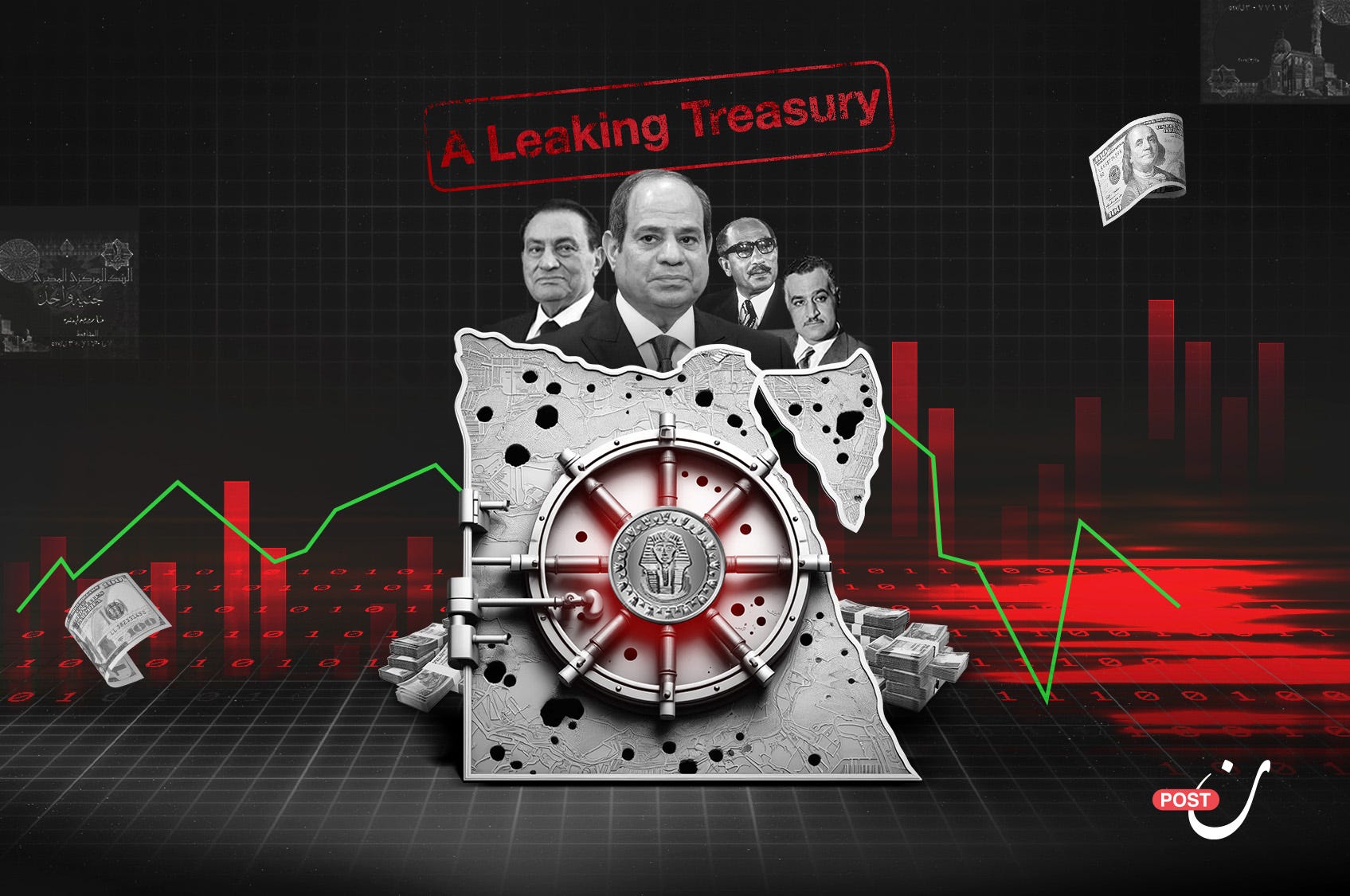
From the era of the late President Gamal Abdel Nasser to that of current President Abdel Fattah el-Sisi, one constant has endured across Egypt’s successive regimes: an unwavering reliance on foreign assistance and loans.
Throughout decades, Egypt has remained tethered to external lifelines grants, aid packages, and international borrowing driven by a chronic expectation of salvation from abroad and an entrenched tendency toward indebtedness.
Successive governments of the republic have consistently failed to generate sufficient domestic revenues or to cut spending to match deteriorating public finances. As a result, the country has frequently found itself mired in debt crises with far-reaching impacts on the national economy and the Egyptian pound.
Despite differing fiscal approaches and varying narratives to justify borrowing, each administration found reasons to look outward for solutions. In this series, “A Leaking Treasury,” we examine the core structural problems in Egypt’s economy and the ruling regimes’ attempts to patch them often to cover up corruption and policy failure.
This installment traces the evolution of Egypt’s debt dependency, from Nasser to Sisi, and unpacks the rationale that has driven the nation to depend on foreign financial support.
One Hand to America, the Other to the Soviets
In The Strong Regime and the Weak State, economist Samer Soliman argues that while Nasser’s regime achieved political stability, it required a constant flow of financial resources to maintain that control.
After nationalizing the assets of foreign capitalists, the regime exhausted that pool and turned to foreign loans and aid a defining feature of the political system that continued under Sadat and Mubarak.
Ironically, the act of nationalizing foreign assets became a key reason for Egypt’s borrowing, as the government needed to compensate British shareholders of the Suez Canal Company and other foreign nationals whose assets had been seized.
According to economist Galal Amin in The Story of the Egyptian Economy from Mohamed Ali to Mubarak, Egypt secured various loans in the 1950s and 1960s amounting to approximately 800 million Egyptian pounds 300 million from the United States and 500 million from the Soviet Union.
These loans funded the High Dam, industrial development, infrastructure expansion, public subsidies, and military efforts in Yemen.
By the end of Nasser’s rule in 1970, Egypt’s external debt had reached $1.8 billion about 21% of its GDP, estimated at $8.3 billion. Amin contends that Nasser’s borrowing was largely productive, aimed at capacity-building rather than consumption.
Unlike later periods, Nasser avoided high-interest borrowing, relying instead on grants or soft loans from the Eastern bloc, even if this slowed development.
Sadat’s Debt: Pivoting from East to West
Under Anwar Sadat, Egypt’s debt skyrocketed. In just five years, foreign civil debt jumped 350%, from $1.8 billion to $6.3 billion. While external conditions played a role, Galal Amin attributes much of the crisis to poor economic management especially the unrestrained import of luxury consumer goods after the 1973 war, which drained foreign currency reserves amid declining exports.
To cover the growing trade deficit, the regime turned to expensive short-term loans. Sadat dismissed internal objections to these policies, deeming them “higher political matters.” Amin compares the pressure Sadat faced to that endured by Khedive Ismail in the 19th century from intermediaries and financiers.
Though Egypt received far more Arab aid under Sadat than under Nasser, nearly half of the country’s foreign currency deficit during Sadat’s early years was covered by grants from Gulf states. Nevertheless, regional donors began to express skepticism over Egypt’s ability to use the aid effectively, citing mismanagement and corruption.
According to Soliman, Egypt’s dire financial state compelled Sadat to make historic political concessions including his visit to Israel under pressure to secure international support. The westward pivot, often interpreted as admiration for the West, was more a desperate attempt to avoid regime collapse.
This strategic shift temporarily revived Egypt’s economy between 1977 and 1981, driven by increased oil exports and worker remittances. Yet, instead of reducing debt, Egypt borrowed even more foreign civil debt surged from $4.8 billion in 1975 to $22 billion in 1981.
Amin argues that the resulting investments were misallocated to low-productivity sectors, leaving Egypt saddled with debt but without the productive capacity to service it.
While the postwar reconstruction of the Suez Canal region and restocking of essential goods offered limited gains, the 1973 war itself had been largely funded by Arab grants, undermining its use as a justification for spiraling debt.
A Heavy Legacy and a Pivotal Reprieve
Hosni Mubarak inherited a staggering debt load from Sadat $30 billion, or 141% of GDP at the time. In his first year, servicing just the civil portion of that debt cost $2.9 billion.
Declining revenues from oil, the Suez Canal, and remittances forced Mubarak’s regime to continue borrowing. By 1987, Egypt’s debt had ballooned to $44.15 billion, according to World Bank figures.
Facing an economic crisis by the late 1980s, Egypt teetered on the brink of insolvency. In Egypt Under Mubarak (1989), political analyst Robert Springborg outlined three scenarios: authoritarian rule via military-capitalist alliance; a pact with Islamists to legitimize the regime; or a strategy of waiting for foreign resources to reappear.
It was the third scenario that materialized. Iraq’s 1990 invasion of Kuwait opened a new geopolitical opportunity. In return for joining the US-led coalition against Saddam Hussein, Egypt received a $13.7 billion debt write-off and $4.7 billion in new aid. This extraordinary turn of events helped the country avert collapse.
The 2008 global financial crisis, however, reversed some of the progress, as FDI and exports fell. The government responded with more borrowing, and by the time of the 2011 revolution, Egypt faced renewed economic strain marked by rising debt, inflation, and unemployment.
Sisi’s Debt: Teetering on the Brink
Today, Egypt is grappling with an unprecedented debt crisis. While the government no longer publishes domestic debt figures, estimates suggest public debt may exceed GDP. According to the Central Bank, Egypt is due to repay at least $42.3 billion in 2025, including $32.8 billion in medium- and long-term debt and $9.5 billion in short-term obligations. Total external debt stands at around $170 billion.
Under President Abdel Fattah el-Sisi, Egypt initially benefited from a historic inflow of Gulf aid estimated at $100 billion between 2011 and 2015. Simultaneously, the administration embarked on massive infrastructure projects, starting with the expedited Suez Canal expansion in 2015, which drained foreign reserves and contributed to a dollar crisis.
As Gulf countries grew reluctant to offer further grants, citing Egypt’s failure to build a self-sustaining economy, Cairo turned back to the IMF after a 26-year hiatus. The 2016 deal involved a $12 billion loan tied to austerity conditions: subsidy cuts, spending reductions, currency devaluation, and tax hikes.
The IMF’s endorsement enabled Egypt to tap global debt markets, issuing high-yield bonds and attracting short-term speculative capital. But while this provided liquidity, it also multiplied Egypt’s debt burden, which quadrupled over Sisi’s tenure.
The Russian invasion of Ukraine in 2022 exposed Egypt’s fragility: $25 billion in “hot money” exited the country, deepening the crisis. Egypt responded the only way it knew—seeking aid and taking on more debt. It issued $71.6 billion in short-term debt instruments in early 2024 alone, offering interest rates exceeding 30%.
Despite the warnings, the borrowing spree continues. Egypt must secure 2.8 trillion Egyptian pounds in financing in the next fiscal year, mostly through more foreign loans and debt issuances.
Then came the miracle. Amid escalating tensions following the Hamas-led Al-Aqsa Flood operation in October 2023, Egypt emerged as a key player in regional diplomacy, owing to its geography and strategic relevance. The West moved quickly to stabilize its most crucial partner.
A $35 billion deal with the UAE to acquire Ras El Hekma and an $8 billion EU aid package arrived just in time echoes of the Gulf War reprieve under Mubarak.
Debt has been a central force shaping Egypt’s modern history. Under Nasser, loans were used for industrialization and infrastructure. Under Sadat, they fed consumer imports and unproductive investments. Mubarak borrowed to service existing debts and preserve regime stability.
Under Sisi, borrowing fueled vanity megaprojects, exacerbated economic fragility, and led to record inflation, currency devaluation, and declining living standards.
Egypt’s financial policies have evolved from state-led development to survival through speculation, as each crisis deepens the country’s dependency on external rescue. Once again, a geopolitical twist has granted Egypt temporary relief but unless the structural flaws are addressed, the cycle of debt will only continue.