

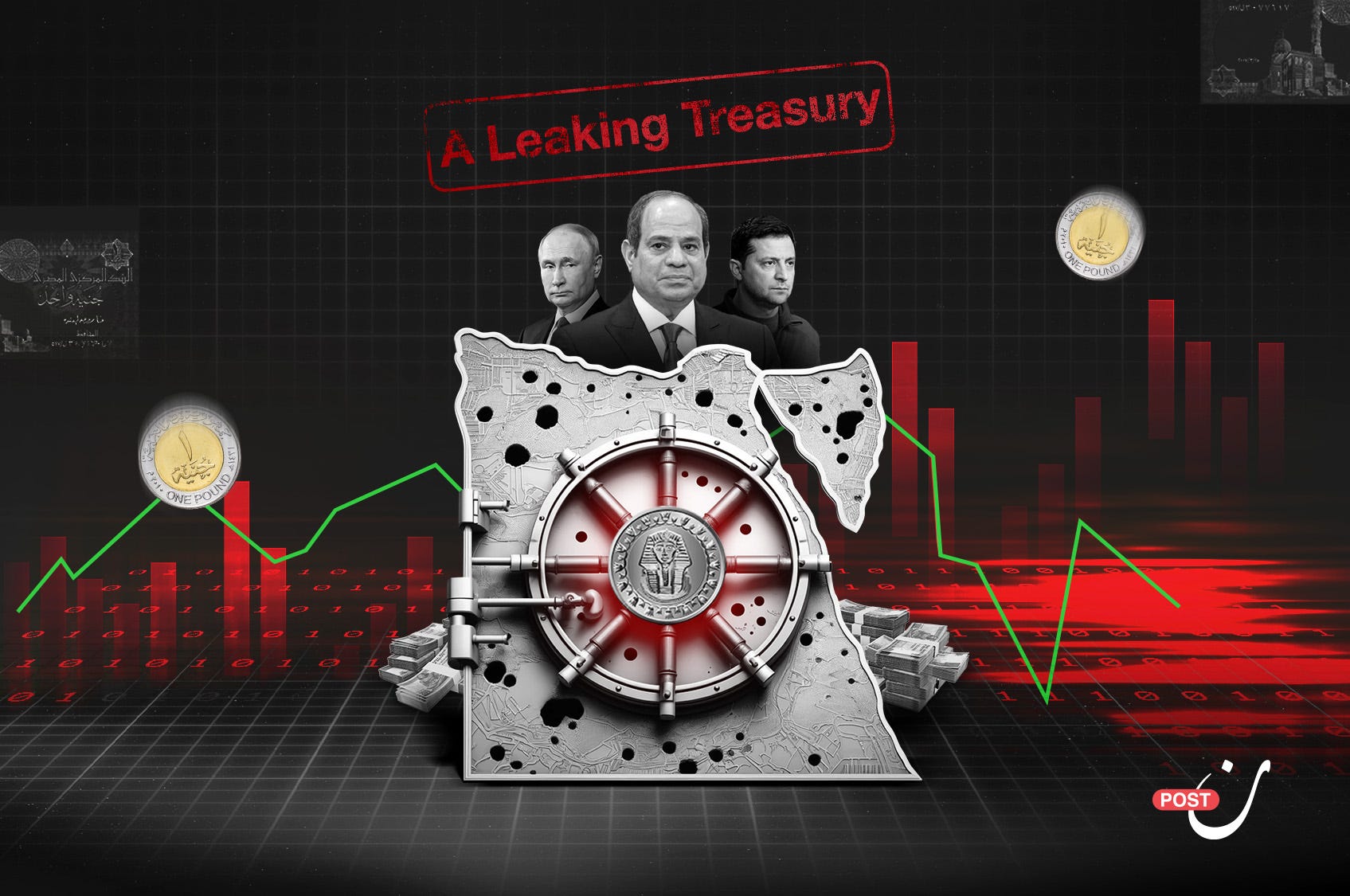
Billions of dollars in foreign investment in Egypt’s sovereign debt instruments fled the country following the outbreak of the Russia-Ukraine war in early 2022. This exodus drained the Central Bank’s foreign currency reserves, plunging the Egyptian government into an unprecedented crisis.
The government scrambled to implement a sweeping series of emergency measures most notably a sharp devaluation of the Egyptian pound and a fresh agreement with the International Monetary Fund.
These decisions ignited one of the most severe economic crises Egypt has experienced in decades an ordeal still unfolding more than two years later, with citizens continuing to endure its painful consequences.
From the very onset, Egypt’s ruling authorities clung to a consistent narrative: the crisis was global, not domestic. This messaging blaming COVID-19 and the Russia-Ukraine war was echoed by President Abdel Fattah el-Sisi, senior officials, and amplified by both state and pro-government media. It served as a ready-made justification for an increasingly disillusioned public.
In a speech last year, President Sisi asserted, “Had it not been for the state’s prior preparations to contain the negative fallout of the global economic crisis, the effects would have been doubly severe.” He also insisted the government had successfully managed the crisis.
Before debating the true roots of Egypt’s economic collapse whether domestic missteps or external shocks it is essential to examine the outcomes. These alone underscore how deeply the Egyptian economy is tethered to external forces, highlighting its inability to weather global shocks.
How the Russian War Sparked the Meltdown
Like many developing economies, Egypt’s financial system is embedded within the global dollar-based order. Events have repeatedly shown that this framework is ill-equipped to shield developing countries from crises originating in wealthier states, particularly the United States.
The US Federal Reserve’s repeated interest rate hikes triggered a global scramble to protect local currencies against the soaring dollar. Unsurprisingly, weaker currencies buckled among them, the Egyptian pound, which became one of the world’s worst-performing currencies after the Russian invasion.
Even before that, Egypt had already begun to align itself closely with the IMF. In 2016, Cairo signed a $12 billion loan deal that saw the pound devalued from 8.8 to nearly 20 per dollar. Alongside painful austerity measures including sweeping subsidy cuts living standards plummeted.
These steps impoverished millions, particularly from the middle class. Still, the government remained optimistic, defending its policies as necessary sacrifices for future economic gains.
Egypt did record impressive growth figures in the years that followed, buoyed by foreign currency inflows mostly from external borrowing and a surge in “hot money” attracted by high interest rates. The government interpreted the ease of acquiring foreign loans as a sign of success and even cited IMF praise for its commitment to reform. Stability, it seemed, was within reach.
Then came the Russian war. According to Egypt’s Prime Minister, roughly $25 billion in foreign investment in government debt fled in under a month funds the country relied on to cover imports and external debt.
Simultaneously, the cost of imports soared especially energy and wheat—just as Egypt, the world’s largest wheat importer, faced oil prices nearing $100 a barrel. Inflation skyrocketed to 40%, the pound nosedived, and purchasing power eroded. Incomes collapsed in real terms, and the cost of living soared.
While the Russian invasion triggered the crisis, it merely exposed the underlying fragilities of Egypt’s economic model.
Unsustainable Policies and Growing Dependency
Egypt’s crisis has deep roots, stretching back decades. Structural weaknesses have worsened under the current administration, with economic indicators deteriorating year after year.
One major issue is the persistent budget deficit the shortfall between government spending and revenues—forcing Egypt to finance itself through borrowing. In the 2024–2025 fiscal year, debt servicing alone consumes 62.1% of the national budget.
The foreign currency shortage is equally alarming, driven by the massive gap between imports and meager exports. In the first nine months of fiscal year 2023–2024, Egypt’s current account deficit ballooned by 225% year-on-year to $17.1 billion.
This has led to a widening financing gap. According to the latest IMF reports, Egypt needs $28.5 billion in foreign currency despite already accounting for inflows from the Ras El Hekma deal and IMF loans.
Over the past decade, Egypt has pursued an unsustainable economic model centered on capital-intensive infrastructure projects with little or no return. President Sisi once stated that the state had spent 10 trillion Egyptian pounds on such “national projects”—equivalent to $300 billion today or $600 billion based on previous exchange rates.
This path has made the government increasingly reliant on external borrowing—from financial institutions, foreign banks, and high-interest foreign capital. It also issued bonds in various currencies to plug fiscal holes.
Despite all this, excessive borrowing has not translated into sustainable growth or boosted production. It has failed to address the chronic balance of payments deficit or diversify exports. Egypt remains dependent on debt to fund everything from wheat to fuel.
In 2014, Egypt imported $60 billion in goods. By 2021, that number had grown to $89.2 billion. Exports, meanwhile, rose from $24.1 billion in 2014 to just $43.6 billion in 2021. These figures show that Egypt has grown more dependent on external markets and less capable of generating the revenues it needs to sustain itself.
In 2025 alone, Egypt must repay $36.3 billion in debt. According to the Central Bank, medium- and long-term external debt servicing obligations total $191.5 billion through 2071, including $58.5 billion in interest.
The government has also marginalized the private sector in recent years, competing with it directly and constraining its access to credit. Banks now primarily finance government deficits at high interest rates, crowding out private investment.
As economist Amr Adly notes in his essay “How the State Devoured Private Sector Opportunities,” this trend has stunted private-sector growth. International institutions have repeatedly called for structural reforms chief among them, boosting private-sector participation in the economy.
State dominance and a fixation on mega infrastructure projects have failed to address deep-seated challenges: stagnant productivity, sluggish investment, and lackluster export diversification. Neoliberal market-driven policies haven’t delivered the promised growth.
Are External Factors Solely to Blame?
While the government continues to point fingers at global events, it’s critical to assess its own crisis-management response. The food sector provides a revealing case study.
In February 2022, following the hot money exodus, Egypt imposed sweeping import restrictions. It required importers to secure letters of credit and pay in full upfront a move that quickly choked supply chains.
Banks struggled to provide hard currency, leading to months-long backlogs at ports. Industries couldn’t access raw materials, and production costs surged. Food shortages spread rapidly, driving prices skyward.
According to the investigative platform Matsadaqsh, the animal protein sector 90% dependent on imported feed was devastated. Feed prices soared by 300% in 2022, crippling poultry, livestock, and fish producers. Nearly 40% of poultry farmers exited the market that year. Egg production fell from 14 billion to 9 billion annually. Chicken numbers dropped from 1.4 billion to 1 billion in 2023.
Mada Masr reported a 60% decline in Egypt’s cattle production capacity in 2022. Dairy prices rose 70% the following year. Fish farming, which supplies 75% of national demand, also suffered as feed costs surged by up to 90%.
By 2023, Egypt’s Central Agency for Public Mobilization and Statistics recorded staggering food price hikes: meat and poultry up 93%, fish up 83%. That July through September, the World Bank ranked Egypt first globally in food inflation.
These figures barely scratch the surface. A 2022 government study found 74% of Egyptian households reduced food consumption due to rising prices. Ninety percent cut back on meat, poultry, and fish. Over two-thirds reduced egg and vegetable intake.
This was in the first year of the crisis. With inflation still soaring, the nutritional situation has likely deteriorated further. Families are now resorting to cheaper, lower-quality foods raising the specter of widespread food insecurity and malnutrition.
Egypt’s failure to manage the food crisis is not an isolated case it is emblematic of deeper policy failures and a broader inability to respond effectively to global shocks.
Conclusion
No economy is immune to disruption. The 20th and 21st centuries have seen pandemics, wars, financial crashes, and technological upheaval. Egypt has experienced its share of turmoil alongside these global shifts.
Yet, one truth is indisputable: no economy enjoys perpetual stability. On the contrary, volatility is the rule, not the exception. Therefore, blaming external events can’t serve as an enduring excuse for poor governance.
Resilient economies are those that adapt, withstand shocks, and recalibrate. As geopolitical tensions rise, especially in Egypt’s immediate neighborhood, the country can ill afford an economic model that cracks under pressure. Without meaningful reform, the next global crisis could prove even more catastrophic.