

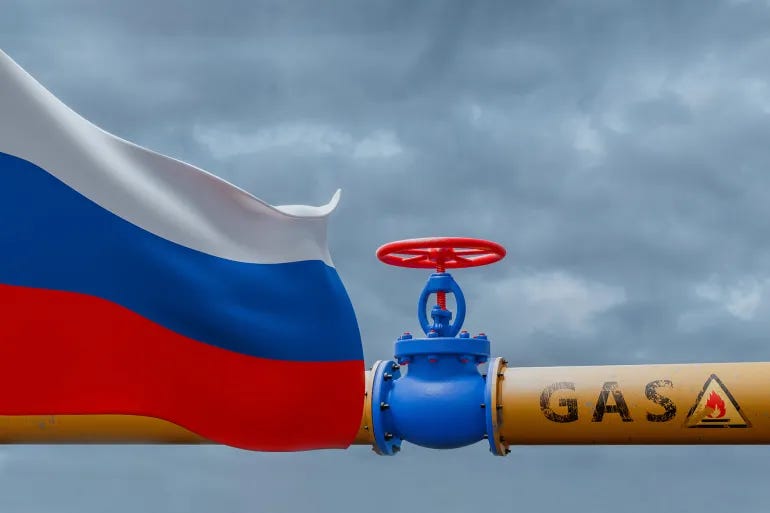
In a decisive development at the start of 2026, the European Union passed legislation mandating a phased ban on Russian gas imports through the end of 2027, turning its commitment to sever energy ties with Moscow—once its top supplier—into legally binding action.
The move comes nearly four years after the war in Ukraine erupted and continues a broader effort to reduce dependency on Russian gas, which plummeted from over 40% of Europe’s energy consumption before 2022 to just around 13% by 2025.
The EU’s ban aims to redraw the global gas market map, replacing Russian supplies with “low-risk” alternatives chief among them Qatar and Algeria while safeguarding energy security and avoiding new overreliance on a single source.
This report offers an in-depth look at the ban’s timeline, its underlying motivations, the significance of Qatar and Algeria’s designation as trusted suppliers, and the winners and losers in long-term gas contracts. It also explores how these changes are reshaping regional energy dynamics and their geopolitical consequences.
Phased European Ban: Mechanisms and Enforcement
The EU legislation stipulates:
A full halt to liquefied natural gas (LNG) imports from Russia by the end of 2026, and a cessation of pipeline gas imports by September 30, 2027.
A potential extension for pipeline deliveries to November 1, 2027, if a member state faces difficulty securing alternatives or filling reserves.
An immediate ban on signing new contracts with Moscow, with existing contracts to be terminated within specified deadlines.
LNG spot contracts signed before June 17, 2025, will be banned as of April 25, 2026. For pipeline gas, the cutoff is June 17, 2026. All long-term contracts must end by late 2027.
To ensure compliance, companies breaching the law face fines of up to 3.5% of their global annual revenue—highlighting Brussels’ resolve.
Despite objections from Russia-dependent nations like Hungary and Slovakia, which voted against the measure, the ban was passed through a qualified majority that overrides individual vetoes.
Budapest announced plans to challenge the law before the European Court of Justice, but its implementation remains assured, as it now forms part of the EU’s binding legal framework.
To enforce the embargo, the EU introduced a “pre-authorization” mechanism to track gas imports from third countries and prevent circumvention. This system requires importing companies to submit proof of a shipment’s origin to EU customs five days prior to arrival at European ports.
However, this bureaucratic step will not apply to nations labeled “low-risk,” which are currently major suppliers and unlikely to serve as conduits for Russian gas.
According to the draft regulation, major exporters such as the United States, Norway, Qatar, the United Kingdom, Algeria, and Nigeria are exempt from the pre-clearance rule. This classification is based on criteria including whether the country itself has banned Russian gas or lacks infrastructure capable of importing it.
Through this measure, Brussels aims to block Russian gas from re-entering EU markets via third parties while signaling trust in new cornerstone suppliers of European energy security.
Qatar and Algeria: Trusted Energy Partners
The EU’s decision to classify Qatar and Algeria as “low-risk” partners is no coincidence. Both countries rank among the world’s leading gas exporters and are self-sufficient, making them largely immune to reliance on Russian supplies.
Qatar, for instance, is implementing a massive expansion plan to boost LNG production from 77 million tons per year before the Ukraine crisis to 126 million tons by 2027—a 60% increase. Known as the North Field Expansion, this project will solidify Qatar’s status as the world’s top LNG supplier, enabling it to meet Europe’s growing demand.
Algeria, which possesses vast reserves and pipeline links to Europe via the Mediterranean, quickly moved to capitalize on increased demand by ramping up deliveries to Italy and Spain and signing new export agreements.
Algerian authorities stated their intention to seize the opportunity created by Europe’s pivot away from Russian gas. They also reassured European partners, particularly Spain, that diplomatic tensions over Western Sahara would not affect contractual commitments, emphasizing a clear separation between political disputes and energy supply.
The EU’s preferential treatment of Qatar and Algeria effectively establishes both as strategic pillars in the post-Russia gas landscape.
As of 2025, Norway became the EU’s top gas supplier, delivering roughly 89 billion cubic meters annually, followed by the US (81 billion). Russia, once dominant, fell dramatically in the rankings.
Alongside Norway and the US, Qatar and Algeria have emerged as capable alternatives able to fill a large portion of the void left by Moscow’s exit.
The EU’s growing trust in these Arab states is reflected in a string of long-term supply deals signed in recent years:
Germany, traditionally hesitant about long-term energy contracts, signed its first deal with Qatar for 2 million tons of LNG annually over 15 years, starting in 2026.
Italy’s Eni signed a 27-year agreement with Qatar to supply up to 1 million tons per year, stretching to around 2050.
Algeria reached deals with European firms like Eni and Naturgy in 2022 to revise prices and extend contracts, increasing gas deliveries to Italy by 9 billion cubic meters across 2023–2024 to help offset Russian shortfalls.
Winners and Losers in the Long-Term Gas Race
The evolving energy landscape has clearly revealed a divide between winners and losers in the global gas market.
Biggest loser: Russia, which now faces long-term exclusion from its most lucrative market.
Europe has been forced to overhaul its supply strategy.
The United States quickly emerged as a key transatlantic supplier.
Egypt saw a surge in LNG export revenues in 2022.
Qatar and Algeria stand out as medium-term winners.
Libya secured a gas field development deal with Eni to supply Europe.
The infographic below illustrates the new energy winners and losers in the post-Ukraine war era.
Gas and Oil for Influence
The implications of these changes extend far beyond economics. Europe’s frantic search for alternatives has redrawn the geopolitical map and redefined key alliances.
This was evident in a wave of high-level diplomatic visits and energy summits involving Gulf and North African states.
European officials have made repeated trips to Algeria and Qatar since 2022 to secure energy deals, while leaders from those nations were welcomed in European capitals as part of a broader strategic dialogue.
In return for gas, these countries have gained political capital. Qatar, for instance, has reenergized its ties with the West and is increasingly seen as a reliable energy partner, strengthening its soft power across Europe.
Algeria, long seen through the lens of its colonial past and ties to France, has gained renewed weight as a strategic supplier. EU nations are now more cautious in handling Algeria’s regional sensitivities especially around the Western Sahara issue out of concern for potential energy disruptions.
Indeed, Spain’s decision in 2022 to shift its long-standing stance on Western Sahara triggered a diplomatic crisis with Algeria, which threatened to review gas agreements before a diplomatic push defused the tension and ensured continuity.
In short, the EU’s Russian gas ban is not merely an economic or punitive action within the context of the Ukraine war it marks a strategic turning point with far-reaching consequences.
In the short term, it has ushered in a “golden season” for Arab and American gas exporters to expand market share and reap financial rewards. But it has also tested Europe’s ability to forge new energy partnerships without compromising its geopolitical interests.