

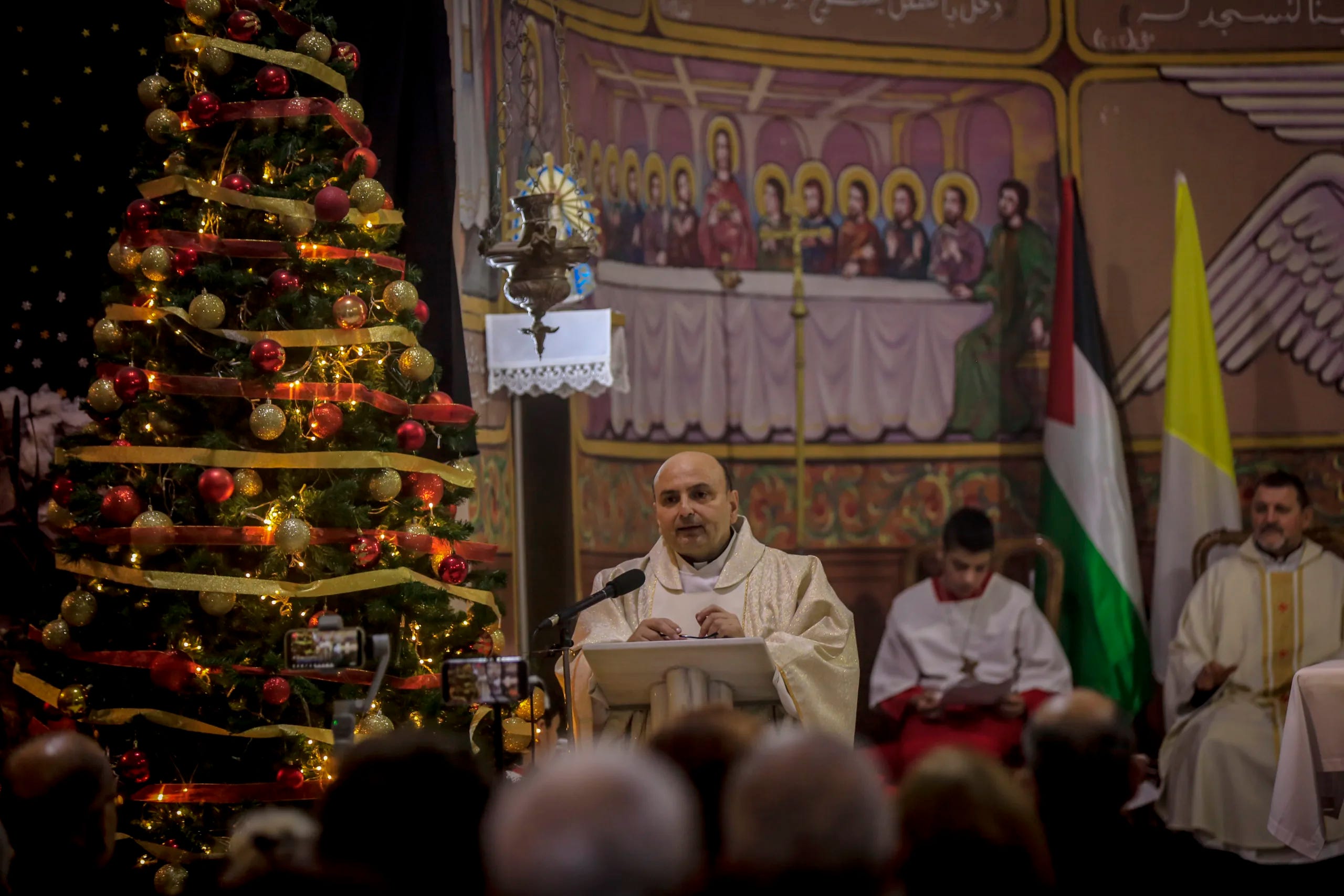
Two years after Israel’s latest assault, Gaza’s Christian community is marking Christmas in somber silence absent the relentless sound of bombardment, yet under the shadow of a fragile ceasefire that has held for over two months.
Across the West Bank in Bethlehem, Christmas lights once again illuminate Manger Square outside the Church of the Nativity, after two years of forced darkness in solidarity with Gaza.
But what are the Christmas celebrations like this year? What is the reality for Palestinian Christians today and what is the state of their churches, amid war in Gaza and escalating restrictions and violence in the West Bank?
Cautious Joy Returns
In Gaza, the Holy Family Church—the only Catholic church in the Strip—has been modestly adorned with a simple Christmas tree and dim lights, despite damage sustained during the war.
Throughout the conflict, the church became a shelter for hundreds of displaced people, and it now stands as a symbol of the Christian community’s resilience. Around 400 people remain housed in its buildings after losing their homes.
Pierbattista Pizzaballa, the Latin Patriarch of Jerusalem, led his first Mass in Gaza since the ceasefire, held in the same church. He called it the beginning of a new chapter, even as living conditions remain catastrophic.
In Bethlehem, marching scout bands filled the streets to mark the return of Christmas celebrations two years after the Israeli assault on Gaza had extinguished festive spirit in the birthplace of Jesus, according to Christian tradition.
Drums and bagpipes echoed with familiar carols as worshippers gathered in Manger Square.
Bethlehem, a historic city in the southern West Bank, holds profound religious significance due to the Church of the Nativity, built over the cave where Mary is believed to have given birth to Jesus.
Life for Christians and Churches in Gaza
The war has taken a devastating toll on Gaza’s already small Christian community, both in lives lost and physical destruction.
A Shrinking Population
Before the war, Gaza’s Christian population was estimated at around 1,000. Today, only 500 to 600 remain.
Twenty-three Christians were killed directly in Israeli attacks, while others died from lack of food and medicine—bringing the total Christian death toll to 44.
Nearly half the Christian population fled during the war, many using rare openings at border crossings into Egypt.
Christians now make up just 0.05% of Gaza’s population of over 2 million.
Churches Under Fire
Gaza is home to three churches: St. Porphyrius, Holy Family (Latin Church), and the Baptist Church all of which have been targeted.
St. Porphyrius, an Orthodox church dating back to the 5th century, was hit by an Israeli strike, causing part of the structure to collapse and killing 20 civilians who had taken shelter there.
Holy Family Church sustained major damage. An airstrike on November 4, 2023, destroyed part of its affiliated school, and in July 2025, an Israeli tank shell struck its compound, killing three and injuring others.
The Baptist Church is tied to one of the war’s worst massacres. On October 17, 2023, an Israeli strike hit the courtyard of the hospital associated with the church, killing around 500 Palestinians many of them patients and displaced civilians.
The Israeli military also struck the Orthodox Cultural Center in Gaza City’s southern Rimal neighborhood.
Displacement and Travel Restrictions
Despite the ceasefire, most Christians remain displaced from their original neighborhoods. Estimates suggest 75% of their homes have been damaged or destroyed.
With their homes in ruins and Israeli forces still occupying parts of Gaza, many Christians are left living in church shelters or with relatives, awaiting reconstruction.
For the third consecutive year, Gaza’s Christians were barred from making their traditional Christmas pilgrimage to Bethlehem and Jerusalem. Before the war, they were occasionally granted special Israeli permits to attend midnight Mass at the Church of the Nativity or visit the Church of the Holy Sepulchre.
Christians in the West Bank: A Parallel Struggle
While the suffering differs in nature, West Bank Christians have also endured immense hardship particularly during the Gaza war, which coincided with a surge in settler violence and intensified Israeli restrictions.
Settler Attacks
Under the protection of Israeli forces, settlers exploited the war to launch widespread land grabs and terror campaigns. By August 2025, there had been over 1,000 settler attacks on Palestinians the highest ever recorded.
Even predominantly Christian towns were not spared. Taybeh, near Ramallah—the last all-Christian village in the West Bank suffered multiple violent attacks by settlers over the past year.
In July 2025, settlers set fire to the historic St. George’s Church at the edge of Taybeh, damaging the building, torching vehicles, and destroying property. These night-time raids prompted residents to begin self-patrolling to protect their families and places of worship.
Other Christian areas were also targeted. In Beit Sahour, east of Bethlehem, settlers established a new outpost on a historic hill in November. Attacks have also plagued the Armenian monastery and church cemetery in occupied Jerusalem.
Movement Restrictions
The escalation following the Gaza war led to unprecedented restrictions on Palestinian movement across the West Bank, affecting Christians as well.
In Bethlehem, roadblocks, concrete barriers, and iron gates have closed key access routes for months.
Some villages have become effectively sealed off behind electronic gates controlled by the Israeli military, severely limiting Christians’ ability to travel or worship.
Travel from towns like Beit Jala and Beit Sahour to Jerusalem now requires complex permits when they are even issued. At times, total closure is imposed.
Bethlehem and its surroundings have been choked by walls and checkpoints, cutting the city off from Jerusalem and stunting its urban development.
Over decades of occupation, Bethlehem has lost around 80% of its land to settlements and the separation wall, shrinking from 37 square kilometers to just 7 today.
Economic Decline
Christian towns in the West Bank have seen their tourism and pilgrimage industries collapse almost entirely during the war devastating incomes for both Muslims and Christians.
Bethlehem, where roughly 80% of residents rely on tourism, has been paralyzed since foreign pilgrims stopped arriving in late 2023.
The Bethlehem municipality described tourism as the city’s economic lifeline. Its absence has driven unemployment from 14% to 65% in just one year. Poverty has spiked, and hundreds of shops and hotels have shut down.
A local shop owner told Reuters, “The last two years were hell... The economy collapsed, and Israeli restrictions got worse in every way.”
The Quiet Exodus Gathers Pace
Palestinian Christians one of the oldest Christian communities in the world—have seen their numbers decline drastically due to war, displacement, and economic hardship.
Before the Nakba in 1948, Christians made up around 12.5% of the population in historic Palestine.
Today, they represent only about 1.2% of Palestinians in historic Palestine, and around 1% in the territories occupied since 1967.
In the West Bank, there are an estimated 45,000 to 50,000 Christians out of nearly 3 million residents about 1.5%.
Most live in Bethlehem (22,000–25,000), Ramallah (10,000), and East Jerusalem (8,000–10,000).
In Bethlehem, the Christian population has dropped from 85% in 1947 to around 10% today.
Due to worsening conditions, local officials estimate that 4,000 people left Bethlehem in the past year in search of work abroad.
In Gaza, the Christian population declined from about 3,000 in the early 2000s to 1,000 before the 2023 war and now stands at just a few hundred.
During the Gaza war and the rise in settler violence, the deputy mayor of Taybeh warned: “We are facing an existential assault… If we don’t receive urgent political and economic support, we will go extinct.”
Pastor Munther Isaac of the Evangelical Lutheran Church in Bethlehem and Beit Sahour echoed that warning, saying Christians in Gaza and the West Bank risk extinction due to Israeli war crimes and systematic restrictions.
Church leaders in Palestine argue that this steady exodus threatens the very existence of Christianity in its birthplace. Patriarchs and clergy have repeatedly warned that Palestine—the land of Christ—could lose its Christian population within decades if current trends continue.
In the end, the 2025 Christmas scene in Palestine between Gaza tending its wounds and Bethlehem rekindling its light underscores the unshakable resilience of Palestinian Christians and their determination to hold on to their land and their faith, even in a time when so many of the lights have gone out.