

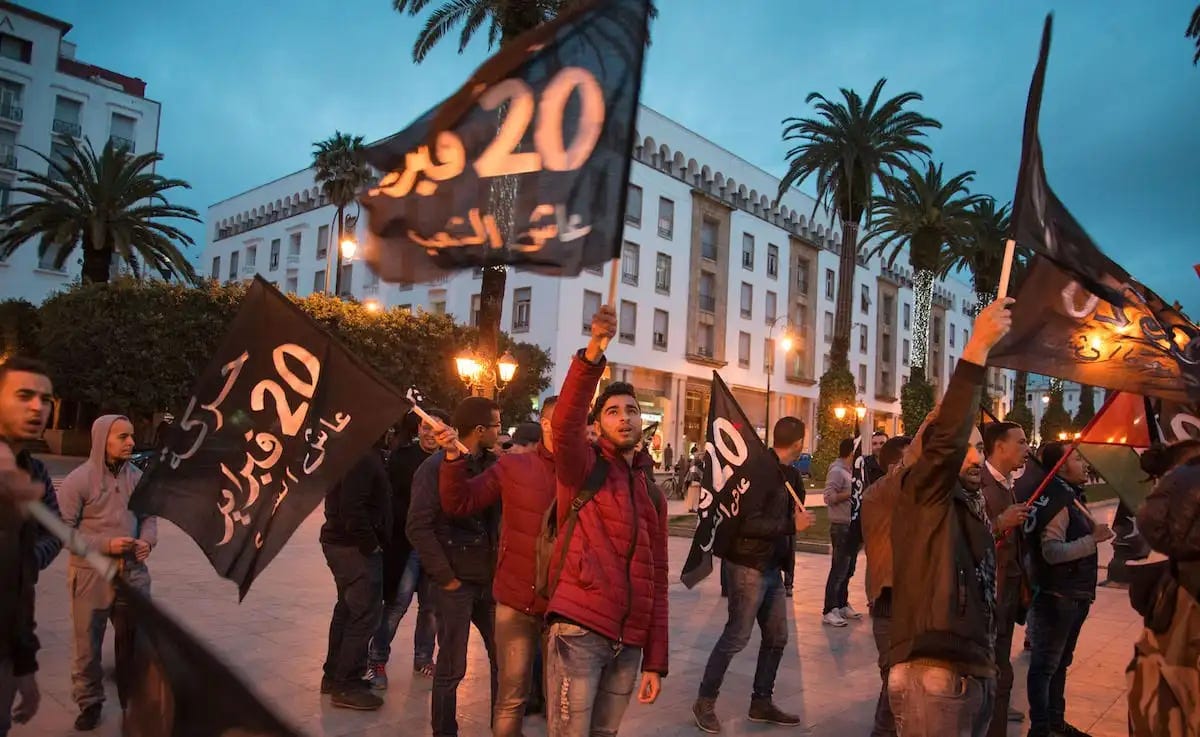
The February 20 Movement, which embodied Morocco’s version of the Arab Spring in 2011, did more than usher in a new constitution and early elections. It served as the spark for a sustained cycle of protest and public dissent, widening the arena of contention to include not only the streets but also digital platforms and football stadiums.
Yet the movement soon lost momentum and its ability to mobilize supporters, undermined by internal rifts and organizational disagreements most notably the withdrawal of Al-Adl wal-Ihsan (Justice and Spirituality). A swift response from the authorities, including King Mohammed VI’s March 9, 2011 speech delivered under street pressure, addressed part of the protesters’ demands. But the embers of protest did not fade. In 2016, the Hirak Rif movement erupted, followed by successive waves of anger in the cities of Zagora and Jerada.
In 2018, Morocco witnessed an unprecedented boycott campaign targeting three well-known consumer products. The movement began on social media before translating into tangible action on the ground.
Around the same time, Moroccan football crowds pioneered a new form of protest through politically charged chants most notably “F’Bladi Dalmouni” (“In My Country, They Wronged Me”), thundered by supporters of Raja Casablanca.
What Did the Movement Change in Protest Culture?
In his book Protest Movements in Morocco and the Dynamics of Change within Continuity, researcher Habib Astaty Zine El Abidine argues that while Morocco has advanced through several stages of political and constitutional reform, political liberalization—though it reduced electoral engagement—has paradoxically expanded the protest arena and strengthened more autonomous coordination capacities.
The Hirak Rif movement emerged as the most visible and consequential protest wave after February 20. It began in October 2016 and lasted until the summer of 2017, culminating in 2018 with a 20-year prison sentence handed to its leader, Nasser Zefzafi. Central demands focused on ending the marginalization of the Rif region and investing in its infrastructure.
The connection between the Rif protests and the broader Arab Spring remains an open question. Political researcher Sharifa Lamouer contends that these protest waves form an interconnected whole, united by their socio-political character.
Yet, in comments to Noon Post, Lamouer notes that what distinguished February 20 was the political maturity of its youth, who articulated clear constitutional and political demands—something largely absent in subsequent movements. Even so, she adds, later protests reflect renewed forms of activism inspired by the spirit of 2011.
Protest did not stop at the Rif. In 2017, residents of Zagora mobilized against chronic water shortages, while Jerada erupted in anger after miners died in makeshift coal shafts. Locals argue that the city was left without economic alternatives after its official mine was shut down.
Stadiums and the Digital Sphere: A Product of the Movement?
Following these waves, protest in Morocco expanded beyond traditional street demonstrations. In 2018, a sweeping boycott campaign targeted companies operating in fuel, dairy, and bottled water sectors. Originating online, it inflicted substantial financial losses.
The following year, protest songs echoed through football stadiums. Among them were Raja Casablanca’s “F’Bladi Dalmouni” and Wydad Athletic Club’s “Qalb Hazin” (“A Sad Heart”). Their lyrics denounced corruption, youth marginalization, and unemployment, spreading widely across social media and even resonating at demonstrations such as those staged by medical and pharmacy students.
Khalid El Bekkari, a university professor and Moroccan human rights activist, cautions against viewing digital activism and stadium protests as direct gains of February 20. These forms, he notes, predated or coincided with the movement, and several of its prominent figures emerged from ultra fan groups and blogging communities.
However, El Bekkari argues that the persistence of critical online commentary and politically charged stadium chants even as street protests receded following the harsh repression of the Rif movement reflects heightened security control and the state’s reassertion of dominance over public space. Most post-Rif protests, he says, have been sectoral or intermittent, swiftly contained before they could expand geographically or numerically.
Abdelrahim Bourkia, a researcher in sports sociology, shares this assessment. He notes that ultra groups did not officially participate in February 20 demonstrations; on the contrary, supporters of Raja and Wydad were at times mobilized to praise the reign of King Mohammed VI.
Generation Z Protests: A Qualitative Shift?
The “Generation Z 212” movement surfaced in mid-September 2025, when discussions began on Discord over the deteriorating state of healthcare and education, triggered by the shocking death of eight pregnant women at Hassan II Hospital in Agadir. Discord’s anonymity offered participants a layer of protection.
By September 27, protests had spilled into the streets of several major Moroccan cities, demanding reform in health and education and an end to corruption. Within days, thousands had joined the online platform.
Hakim Sikkouk, head of the Rabat branch of the Moroccan Association for Human Rights and a leading figure in February 20, describes Generation Z as a twin movement, sharing social and political demands and emerging from the digital sphere.
But he highlights a structural divergence: February 20 mobilized overt political backing, with many activists affiliated with leftist currents and decisions made in open assemblies. Generation Z, by contrast, operates through anonymous digital debates and online voting, with its members’ identities still concealed.
El Bekkari sees continuity in their shared youth character and their trajectory from virtual space to street mobilization around anti-corruption and rights-based slogans. Yet he underscores Generation Z’s deep mistrust of political parties and its organizational fragility reliance on anonymity has limited its geographic reach and left it vulnerable to arrest waves even more extensive than those of 2011.
Fifteen Years On: Gains and Setbacks
Frédéric Vairel, a scholar of social movements in Morocco, observes that the post-2011 period saw a relative widening of the space for expression. But he warns against reading this as a structural gain; it remains conditional on not threatening the power structure and contracts once unwritten red lines are crossed as demonstrated by the Rif experience.
Vairel argues that February 20 generated a profound cultural shift in Moroccans’ relationship with politics perhaps deeper than any constitutional reform. The Moroccan regime may have contained the movement, but it could not erase its imprint on collective consciousness.
El Bekkari insists that the protest trajectory of the past 15 years yielded tangible gains, including the regionally advanced 2011 Constitution, progress on employment and wages, the repeal of restrictive laws, and the preservation of social peace by serving as a countervailing force against state overreach.
Still, he acknowledges a central weakness: the absence of organized political representation capable of sustaining dialogue with the state. Weak unions and opposition parties leave protest demands contingent on shifting power balances, often confining them to sectoral frameworks rather than embedding them in a broader democratic transition.
Hakim Sikkouk, however, paints a darker picture. Fifteen years after February 20, he argues, many rights gains have receded, and authorities have expanded their repression of protest and calls for meaningful change.
Sharifa Lamouer concludes that while Morocco has long portrayed itself as an exceptional model in its regional environment even in its handling of dissent—this exceptionalism remains incomplete unless it translates into genuine respect for peaceful protest and serious engagement with legitimate social demands.
Fifteen years on, the spirit of February 20 still lingers in Morocco’s streets, a reminder that meaningful change is achieved not through repression, but through openness and trust between state and society.