

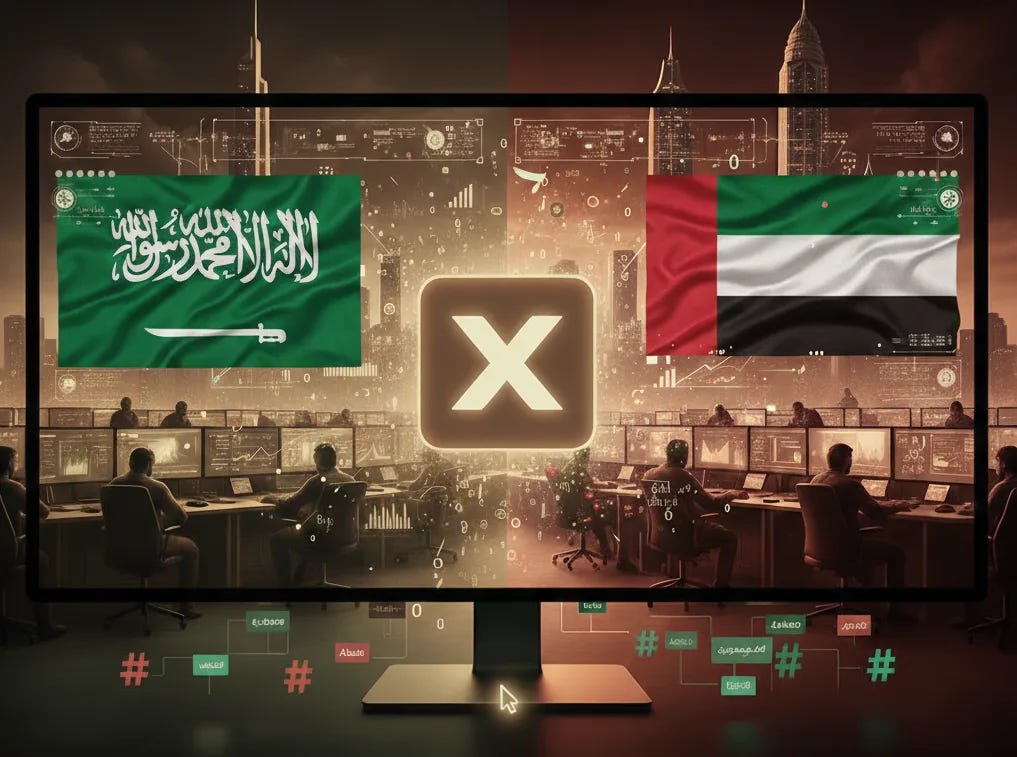
In recent days, X (formerly Twitter) has been a battlefield for hashtags calling for a boycott of the UAE’s goods and tourism sector. What sets this campaign apart is not its nature but its origin: it was launched from inside Saudi Arabia. In a peculiar twist, the luxury perfume brand “Dukhoon Al Emarat,” which is Saudi-owned despite its name, announced an upcoming rebrand that omits any reference to the Emirates.
In the context of recurring sibling rivalries among Gulf states, it’s become increasingly clear that digital armies and bot accounts are integral to regional political disputes domestically and abroad. Yet what is more noteworthy than the usual squabbles on X is the tone emerging from official Saudi media.
It has reached such a pitch that many are beginning to wonder whether the once-solid Saudi-UAE alliance is entering a new phase one reminiscent of the Gulf crisis with Qatar in 2017.
Such speculation is tempting, particularly as the fragmentation of the Saudi-Emirati alliance an outcome more damaging to the UAE than to Saudi Arabia would benefit many causes and actors across the Middle East. But are the recent Saudi media campaigns against the UAE sufficient to justify this forecast?
From “Violations” to “Human Rights”: The Language of Condemnation
Observers of UAE-aligned digital campaigns on X will find them largely focused on deflecting accusations of human rights abuses particularly relating to the country’s alleged role in fueling genocides and famines in Sudan, as previously reported by Noon Post.
The irony of the current brotherly feud lies in who’s leading the charge against Abu Dhabi: not NGOs or rights organizations, but Saudi Arabia itself via its official media channels. In recent days, Saudi state media has escalated its rhetoric to a level that resembles a legal dossier fit for The Hague.
Take, for example, a week’s worth of programming on Al Ekhbariya, a Saudi state-run news channel. On January 18, 2026, the channel aired a report portraying the UAE no longer as a mischievous sibling but as a destabilizing force in Yemen. The report accused Abu Dhabi of backing Southern Transitional Council leader Aiderous al-Zubaidi and his faction, going as far as to label the UAE a national security threat to the Kingdom.
Within just 48 hours, the tone grew even harsher. A new investigative segment titled “UAE Prisons in Hadhramaut Reveal Abu Dhabi’s Dark Face” aired on January 20, opening with terms like “terrifying prison” and “lack of basic human rights.” The report included footage of bare, cramped cells where detainees were unable to sit or lie down. It relied on official testimonies and left little to interpretation.
That same day, another Al Ekhbariya segment titled “Al-Zubaidi’s Gang: Crimes with Emirati Cover” revisited older human rights reports linking the UAE to the torture and murder of a Hadhrami citizen allegations dating back seven years, during a period when the UAE was still a coalition partner in Yemen and such accusations were unthinkable on Saudi airwaves.
The shift is stark: Saudi media’s current onslaught not only highlights UAE misconduct, but also raises questions about Saudi Arabia’s own complicity whether through active partnership or silent endorsement.
On January 21, Al Ekhbariya humanized the narrative further, airing interviews with Yemeni victims of Emirati torture in Hadhramaut. In a 15-minute exposé, survivors shared harrowing stories of abuse, marking the campaign’s most explicit turn yet.
By January 25, the network continued its blitz with a report on the “disappeared,” alleging 300 victims of UAE-run detention centers. The Saudi coverage has now grown into a scandalous archive of UAE violations not just in Yemen but in Libya and the Horn of Africa, where Abu Dhabi is accused of supporting militias and sowing chaos.
Absorbing the Blows: Strategic Silence or Strategic Weakness?
American historian Daniel Chirot advises us to take political leaders’ statements seriously. In “You Say You Want a Revolution?” he writes: “We should pay close attention to what political leaders say and write... any endorsement of violence should be viewed as a prediction of future policy, not mere posturing.”
While Chirot was addressing revolutionary ideologies, his advice offers a useful lens to understand the UAE’s response to Saudi Arabia’s media onslaught not through media proxies, but from the leadership itself.
At the 2026 Billion Followers Summit, Abdullah bin Mohammed bin Butti Al Hamed, head of the UAE’s National Media Office, declared that Abu Dhabi had no intention of engaging in social media squabbles over Yemen. He described this approach as a “studied and systematic method to avoid futile conflicts” a strategy of strategic silence.
“UAE media does not follow political whims or emotional reactions,” Al Hamed said. “Strategic silence is not absence it is a deliberate presence that chooses when, how, and why to speak, or not to speak.” He blamed the Muslim Brotherhood for spreading discord between the two countries and emphasized the role of content creators as digital ambassadors of the UAE’s constructive vision.
In practice, his words ring true. Major UAE outlets like Sky News Arabia have not mirrored the aggressive tone of Saudi coverage. Instead, they have adopted a defensive posture, focusing on rebutting accusations rather than launching counterattacks.
This reflects a recognition that Saudi Arabia is still the “elder sibling” in the Gulf, and direct escalation may jeopardize the UAE’s numerous regional projects and ongoing diplomatic frameworks.
Even in the UAE’s digital ecosystem previously described as a hub of “electronic flies” we now see a restrained narrative. Influencers praised the UAE’s restraint using Islamic parables, like a viral clip referencing Saad ibn Abi Waqqas as a model for piety in times of fitna (discord).
The video, ending with the line, “The best you can do is to avoid lighting the fire,” was widely shared by pro-UAE voices like Mira Zayed and Majed Al Saadi.
In the same vein, influencer “Bojasim” posted a 4.5-minute video on January 21 touting the UAE’s constructive role in Yemen just a day after Al Ekhbariya labeled the country Yemen’s primary destabilizer. Other lesser-known Emirati accounts have tried flipping the script, tying Saudi Arabia to Israel employing the same scare tactic Saudi media has used against Abu Dhabi in recent days.
Al Hamed dismissed these fringe voices as Brotherhood-linked agitators unaffiliated with the official Emirati position. However, the mixed messaging is most evident in figures like Amjad Taha. One moment, he praises Saudi-Emirati brotherhood and posts celebratory tributes to the UAE military on Saudi channels; the next, he shares reports accusing Saudi Arabia and Turkey of funding jihadist groups committing war crimes in Sudan.
These reports, particularly a Daily Mail article alleging Saudi-Turkish involvement in Sudanese atrocities, were amplified in English by Emirati influencers like Taha and Khamis Al-Hosani perhaps to better reach a Western audience.
Notes and Red Lines
As this media feud grows more intense, several observations stand out:
Saudi Arabia appears stronger, bolder, and more assertive both in media and geopolitics. Yet its messaging is erratic, reflecting the undefined “red lines” in this fraught bilateral relationship. Will tensions boil over into open rupture, or is this merely a passing storm?
Take, for instance, the now-deleted article by Saudi journalist Al-Tuwaijri, published in Al Jazirah newspaper. It accused the UAE of “falling into Israel’s lap,” likening it to a Zionist Trojan horse driven by an inferiority complex toward Saudi Arabia. The article went as far as addressing the Emirati people rather than their leadership a break from the traditional respect afforded to Gulf monarchs. It credited Saudi King Faisal with the very creation of the UAE and accused Abu Dhabi of playing a destructive role in the war on Gaza.
The article was initially removed after backlash from both Israeli media and Emirati influencers, who decried it as antisemitic. It was later republished, likely as an effort to reaffirm Saudi Arabia’s stance after appearing to have crossed a line.
Meanwhile, the UAE’s media response remains more cautious tinged with fear of crossing those same lines. Its digital operatives oscillate between veiled insinuations, lofty appeals for calm, and even expressions of admiration for Saudi nationalism.
Ultimately, Al Hamed’s claim that “strategic silence” is more beneficial than confrontation seems plausible not out of noble intent, but due to Abu Dhabi’s limited leverage. The UAE has long feared being seen as a geographical appendage an upstart state vulnerable to the dominance of its larger, older sibling.
Most Western observers, including Gulf security analyst Anna Jacobs, tend to downplay the current tensions, viewing them as minor irritants in a relationship bound by deep economic and strategic ties. But in today’s volatile world, the only certainty is uncertainty. The fate of Saudi-UAE relations may well rest in the hands of time.
“The days will reveal what you once did not know.”