

After more than three weeks of escalation, the U.S.–Iran confrontation appears to be approaching a different diplomatic inflection point. The political, economic, and security costs have surpassed earlier expectations, amid mounting warnings of a slide into a broader regional—perhaps even global—conflict with unpredictable consequences.
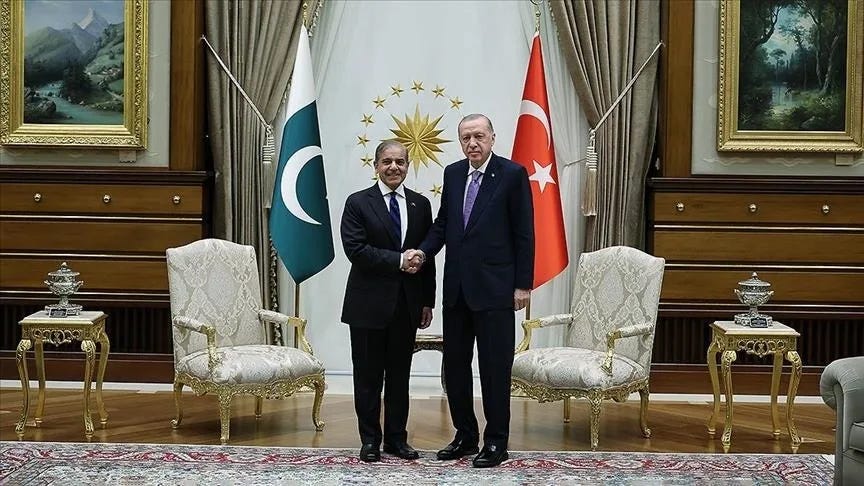
In this context, Western media reports have revealed a diplomatic push led by Egypt, Turkey, and Pakistan to mediate between Tehran and Washington and defuse the crisis. According to the Associated Press, Iran has received—through this trio—a 15-point U.S. proposal aimed at halting the war.
Meanwhile, The Wall Street Journal reported that the three countries are working to arrange a meeting between U.S. and Iranian officials within the next 48 hours. This comes despite a still-wide gap between the two sides, even as Iran signals cautious openness to the track while continuing to deny it officially.
This mediation gains additional significance as it comes at the expense of more traditional channels that have dominated recent efforts, most notably Oman, Qatar, and several European capitals.
This shift raises legitimate questions about the motivations behind this new Islamic diplomatic push, the retreat of traditional mediators, and whether the Egyptian-Turkish-Pakistani initiative can break the deadlock and calm tensions given the leverage and influence it may possess.
Why Have Traditional Mediators Fallen Short?
It appears that traditional mediators have chosen, this time, to step back and allow space for a new trilateral effort. This was clearly reflected in remarks by Qatar’s Foreign Ministry spokesperson, Majed Al-Ansari, who stated publicly that there is no direct Qatari mediation between the United States and Iran, while emphasizing Doha’s support for all formal and informal diplomatic channels aimed at ending the war.
More importantly, Al-Ansari explicitly named Egypt, Pakistan, and Turkey as the countries currently engaged in mediation efforts, describing them as the parties officially working to de-escalate the U.S.-Israeli war on Iran a conflict whose repercussions are no longer confined to its immediate theater but have extended to global energy supplies and maritime security.
This raises a fundamental question: why has the mediator changed in this round? The answer lies, above all, in the transformation of the crisis itself. This is no longer a contained military confrontation that can be managed through conventional messaging channels. Nor are its costs limited to the two primary actors. Instead, its impact now spans energy markets, gas prices, maritime routes, supply chains, and the global economy as a whole.
As a result, reliance on traditional channels which have failed in recent months to achieve any meaningful negotiating breakthrough has appeared increasingly ineffective. Moreover, some of these mediations have faced questions regarding their perceived bias: Qatar and Oman are viewed in some circles as closer to Tehran, while certain European actors are seen as more aligned with Washington, thereby undermining confidence in their ability to produce a balanced settlement.
In a conflict of this scale and complexity, it is no longer sufficient for a mediator to simply relay messages between parties. Washington requires intermediaries with political weight and regional influence capable of exerting real pressure on Tehran. Iran, for its part, is not merely seeking a communication channel to the U.S. administration, but a party capable of providing guarantees for a ceasefire, preventing circumvention of negotiations, and offering broader regional legitimacy to any potential agreement.
A Trilateral Alliance: What Common Ground?
The selection of Egypt, Turkey, and Pakistan to lead this mediation effort was neither incidental nor arbitrary. It likely reflects a convergence of shared interests and approaches that have prompted these countries despite differing positions and calculations to act at this critical juncture.
Foremost among these motivations is the desire to prevent a large-scale regional explosion and widespread instability that would threaten not only the parties to the conflict but also the broader interests of the Middle East and the global community, including disruptions to energy, the economy, supply chains, and food security, as well as the potential for wider political and security upheaval.
At the same time, this trio is guided by a clear pragmatic compass. The current escalation, the closure of the Strait of Hormuz, threats to the Bab el-Mandeb, and attacks on regional energy infrastructure have pushed these countries beyond the political dimension of mediation toward the direct defense of their economic security and vital interests.
There is also another crucial dimension: the success of this mediation could grant Egypt, Turkey, and Pakistan broader regional influence and a more substantial international presence. It may reposition Islamic countries as key actors in managing major crises, rather than passive observers on the sidelines. In this sense, the mediation represents an attempt to seize a pivotal global moment and reassert Islamic influence on the regional and international stage.
What Leverage Does the New Mediator Hold?
The three countries possess significant assets that qualify them for this role. Egypt, as a representative of central Arab weight and legitimacy, maintains considerable relations with the parties involved, particularly the U.S. administration, which in turn provides it with channels of communication extending to Tel Aviv and Prime Minister Benjamin Netanyahu’s government even if these relations have experienced recent strain.
At the same time, Cairo maintains relatively good ties with Tehran and enjoys a level of credibility that makes it less provocative than some Gulf capitals and less ideologically confrontational than certain Western powers.
Egypt also has a clear and direct interest in the success of this effort, given the severe crisis facing the Suez Canal one of the country’s most vital economic arteries—as well as the security, economic, and logistical challenges posed by threats in the Red Sea.
Turkey, meanwhile, brings broader maneuverability across competing camps. As a NATO member, it maintains important ties with Washington while also preserving functional relations with Tehran, alongside accumulated political experience in managing complex rivalries.
Pakistan is similarly positioned, with close geopolitical ties to Iran, strong connections with Gulf states, and growing relations with the United States making Islamabad one of the most likely capitals to play this role, especially amid reports that it could host upcoming rounds of negotiations.
Together, these capabilities allow the trio to move beyond the “postman” role associated with traditional mediation toward a more influential role in shaping a political framework capable of preventing escalation into open war.
They may also provide guarantees and apply pressure sufficient to act as guarantors of any potential understanding between Tehran and Washington. In this sense, the mediation is not merely a channel for communication, but an attempt to craft a new balance between interests, risks, and challenges.
Obstacles and Challenges
On the other hand, despite the tools and leverage available to this new Islamic mediator, its mission is far from easy even with the apparent, albeit limited, openness of both parties to negotiation. A long list of challenges makes the success of this mediation highly complex.
At the forefront is Iran’s own approach. Tehran appears increasingly firm in its conditions, even raising its demands in recent days, bolstered by what it perceives as success in inflicting losses on U.S. and Israeli interests enhancing its confidence and negotiating posture.
Its conditions are therefore substantial and explicit: a formal end to the war, guarantees against renewed attacks, demands for compensation, and a firm refusal to accept any significant curbs on its missile program. These demands clash sharply with the parameters within which the U.S. administration is operating.
The complexity is further compounded by the reality that decision-making in Tehran is now more closely tied to the Islamic Revolutionary Guard Corps and hardline security institutions, making additional flexibility a political luxury that is difficult to envision at this stage.
Conversely, Washington continues to approach negotiations from what it sees as a position of strength, seeking to impose its full set of conditions on an adversary expected to come to the table in submission a reading that does not fully align with the realities on the ground or the evolving cost calculus.
The Israeli position must also be taken into account, particularly the role Prime Minister Benjamin Netanyahu’s government could play in escalating tensions and complicating the landscape if it perceives that any agreement falls short of its objectives.
Nevertheless, some continue to bet on the role of energy factors gas prices, freedom of navigation, and maritime security as pressure points that could push both sides toward stepping back and showing greater flexibility. Yet this remains contingent on the behavior of Tehran and Washington in the coming days, amid unprecedented U.S. military mobilization, entrenched positions on both sides, and growing doubts about former President Donald Trump’s seriousness in pursuing a genuine settlement, as opposed to buying time for a more escalatory strategy.
In conclusion, based on current indicators and an increasingly volatile and complex landscape, the entire region stands on the edge of a volcano that could erupt at any moment. The question remains open: can this Islamic mediation defuse the crisis before it explodes completely?
