

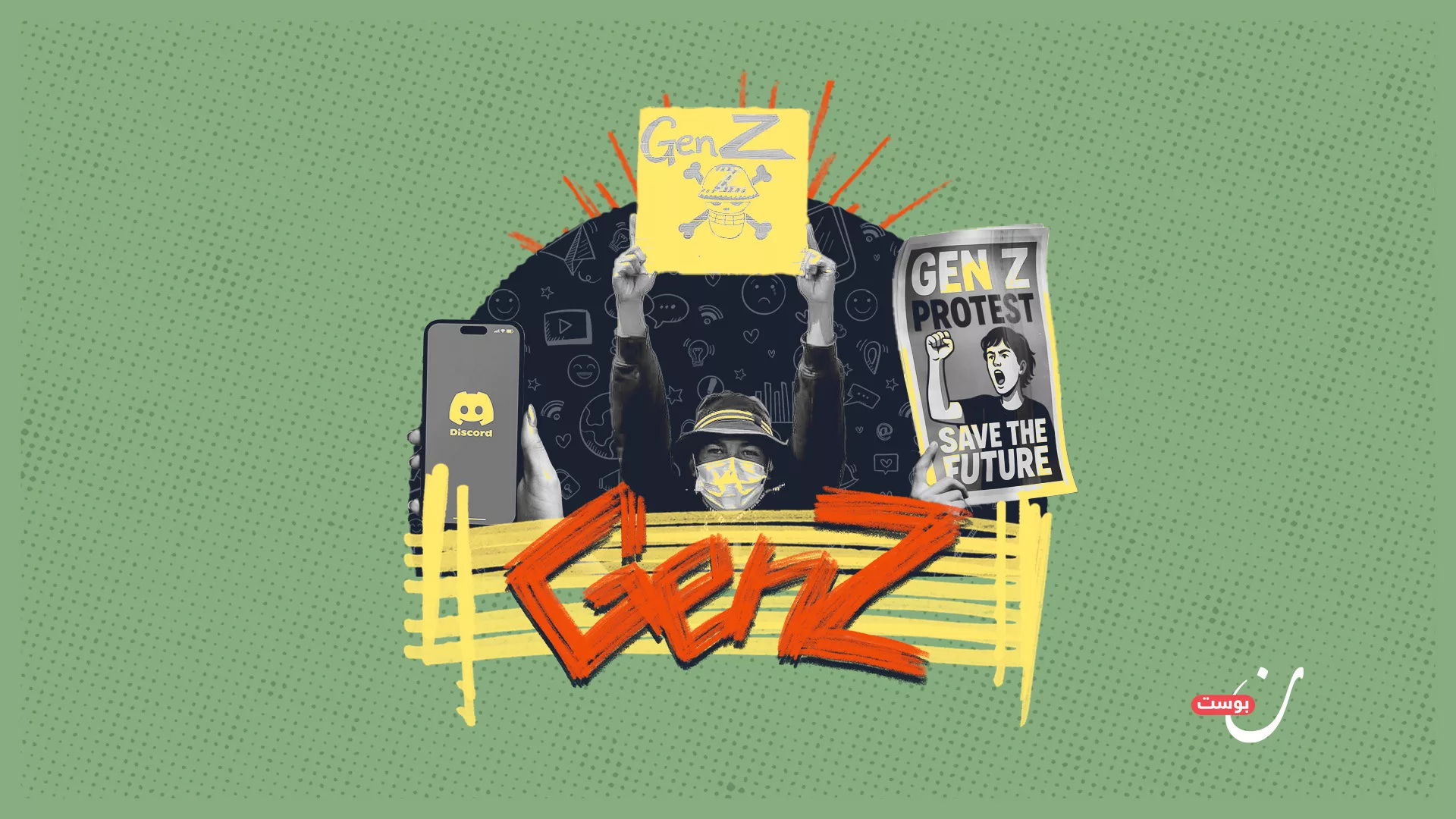
The latest wave of global protests, led by Generation Z those born between the mid-1990s and early 2010s signals the return of youth as a driving force challenging a crumbling world order. This is not merely a passing demographic shift.
These young people are confronting deep structural exclusion: they are inheriting the costs of crises they did not cause like debt and climate change while the economic systems they live in no longer need their labor.
Yet, much media coverage and political analysis falls into the trap of reducing these uprisings to a simplistic “Gen Z protest” label conflating the medium (digital tools) with the message (structural crisis).
What’s driving this generation isn’t a “generational mood,” but rather the politics of necessity born of blocked social and economic prospects. This is embodied in their persistent demands for social justice, dignity, and lost opportunities, seen in movements such as “Gen Z 212” in Morocco or youth protests in Nepal against corruption and the excessive wealth of political elites.
This article explores how modern digital tools are reshaping the relationship between younger generations and politics. We ask whether these tools are creating a truly new and radical political awareness or merely repackaging old patterns of participation into fleeting, algorithm-driven formats.
We also compare Gen Z with earlier generations in terms of their approach to power and capacity to produce genuine political alternatives.
Particular focus is given to how Gen Z leverages digital space to turn virtual anger into concrete political action, the limits of that action in the face of repression, and whether it can evolve into a sustainable form of political pressure.
Shifting Political Priorities Compared to Older Generations
Gen Z, particularly in Western countries, is more politically engaged and consistently active than some previous generations. Around 32% of Gen Z regularly participate in activism or social justice work, compared to 24% of Millennials.
When compared with older generations, Gen Z places greater emphasis on issues like healthcare (72%), climate change (64%), and income and opportunity inequality (56%)—in contrast to older cohorts like Baby Boomers and Gen X, who focus more on topics like taxes and government spending (40%).
This growing alignment with social justice ideologies positions Gen Z as a major force in shaping the future of social and criminal justice structures. This shift feeds into a broadly progressive worldview: 43% of Gen Z adults identify as liberal, a notably higher percentage than older age groups.
Coupled with the belief that generational change is essential for solving complex national challenges, this ideological current makes Gen Z a decisive force in future electoral dynamics.
However, when it comes to political engagement, Gen Z and Millennials are less convinced that voting is the most effective way to bring about change.
Only 58% of Gen Z adults see voting as the best means of enacting change, compared to 70% of Gen X revealing a stronger tendency toward direct, grassroots or digital action outside traditional democratic frameworks.
Digital Tools and the Limits of Repression
Digital platforms form the backbone of Gen Z’s activism. Roughly 66% of their political activity takes place online via fundraising, awareness campaigns, and event coordination. These platforms are not merely communication channels; they define the decentralized nature of these movements.
The rise of platforms like TikTok and Instagram, which prioritize short, algorithmically amplified content over personal follower networks, has transformed mobilization mechanisms.
Viral videos and memes become cultural weapons that challenge official narratives, amplify transnational dissent, and act as instruments of soft power pushing for reform.
New tools like Discord servers have enabled rapid logistical coordination beyond traditional party structures. However, decentralization has also given rise to so-called “leaderless” movements.
While this allows for flexible, spontaneous mobilization such as the “Be Like Water” tactic in Thailand, which used Telegram to shift protest locations and evade surveillance it also leaves movements without leadership capable of long-term strategy or detailed political programming.
This structural challenge means algorithmic mobilization may ignite trending moments, but doesn’t necessarily translate into institutional continuity flaring up fast, and fading just as quickly, as seen in the recent protests in Morocco.
Meanwhile, authoritarian regimes across the Arab world no longer view technology as a liberating force, but as a tool for repression. “Digital authoritarianism” has taken hold, encompassing surveillance, intimidation, manipulation, propaganda, and legal persecution.
In extreme cases, it includes arrest and torture routinely practiced in Egypt, Jordan, and Saudi Arabia under vague legal pretexts such as “undermining national security” or “spreading false news.”
Even countries like Bangladesh have used digital security laws to detain dissenters, cut off the internet, and use live ammunition against protesters. Sophisticated spyware has been deployed in several states to monitor, intimidate, or expose activists.
Yet paradoxically, these very tactics can backfire. When state violence is documented and broadcast online, it can generate even greater mobilization. In Bangladesh in 2024, the killing of over 1,400 protesters turned into a unifying symbol after the image of slain student Abu Saeed became a martyrdom icon that rallied the opposition and drew middle-class support.
Similarly, when Nepal’s government banned social media, protests intensified and eventually led to the Prime Minister’s resignation. Even in Egypt, the 2011 revolution was sparked by a series of leaked torture videos from police stations shared one after another online.
The Challenge of Sustainability
Gen Z’s greatest challenge is moving from spontaneous mobilization to the creation of sustained political pressure. Digital enthusiasm, while accelerating mobilization, can also be a weakness if it lacks the organizational depth required for continuity.
Digital activism risks becoming symbolic hashtags and petitions without follow-through failing to generate tangible, lasting policy changes. Real transformation requires strategic, sustained effort in offline spaces: universities, political parties, and diverse cultural venues, both locally and abroad.
In the case of “Gen Z 212” in Morocco, the movement sparked widespread debate about corruption and even prompted the monarchy to announce social reforms. But now it stands at a crossroads: remain an external pressure group outside traditional parties, or transform into a structured political force ready to compete in elections. Without this evolution, it may suffer the same fate as previous movements like February 20, losing its strategic momentum.
A deeper analysis reveals that Gen Z movements lean toward two types of demands. In some contexts, such as Morocco, demands were modest and echoed existing opposition party platforms without offering radical alternatives indicating a reformist tendency within the existing system.
In contrast, protests in Nepal and Bangladesh took a revolutionary form, toppling corrupt governments and demanding accountability from elites who had amassed vast wealth demonstrating the possibility of dismantling entrenched systems of corruption.
To achieve radical political transformation, structural anger must be converted into clear political and economic alternatives. Recent global experiences offer lessons: the election of Zohran Mamdani as mayor of New York City driven by Gen Z mobilization is a model of offering radical alternatives within a democratic framework.
His campaign went beyond criticism, presenting a clear, funded agenda to “Make New York Affordable Again.”
His proposals included structural economic alternatives: freezing rents for stabilized units, raising the minimum wage to $30 per hour by 2030, and providing universal childcare. Crucially, his campaign tackled the issue of funding head-on, proposing direct tax increases on corporations and individuals earning over $1 million annually.
This explicit link between the demands of working- and middle-class youth and structural funding mechanisms (like wealth taxes) distinguished his platform from traditional reform agendas.
His slogan “Abolish the Billionaires” reflected a commitment to systemic redistribution of wealth. It is an inspiring model for how opposition can evolve into an organized, radical alternative perhaps one worth adapting in some Arab countries.
In conclusion, this isn’t just a repackaging of old “forums” with new tools. Gen Z’s digital activism, despite its lack of institutional structure, carries a genuine radical horizon: it has the power to topple corrupt regimes, propose viable economic alternatives (as seen in Mamdani’s case), and confront the structural crises of neoliberal capitalism.
What’s underway is not just generational succession but a pivot toward a politics of necessity calling for deep structural change, using every available digital and physical means to forge a new, sustainable emancipatory reality.
 | A guest post by
|