

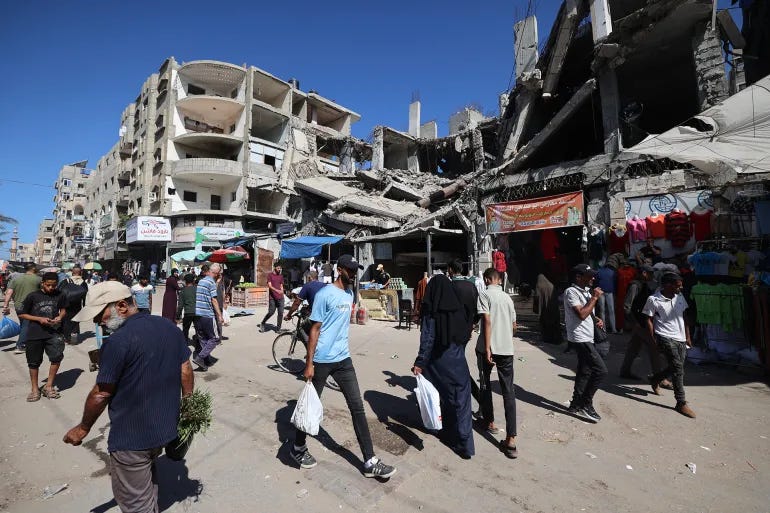
For years, the Gaza Strip has endured a suffocating blockade and repeated closures of its crossings by Israeli authorities conditions that have profoundly strained the economy and driven up poverty and unemployment among young people. Despite scarce opportunities and an unstable labor market, many graduates have sought a foothold through short-term contracts or part-time work, while a small minority secured more stable positions though these remained limited.
But the war that erupted on October 7, 2023, pushed an already fragile economy into a far harsher phase. Widespread destruction of productive sectors and the loss of income for thousands of workers have drastically reduced opportunities. The question is no longer how young people can find suitable employment, but how they can secure any source of income that guarantees the bare minimum for survival in an economy staggering under the weight of war.
A Fragile Labor Market Before the War… Total Collapse After
Mahmoud Mansour (26), a computer engineering graduate from the Islamic University, was displaced with his family from Jabalia refugee camp to the Al-Nasr neighborhood after their home was destroyed. Describing the labor market before the war, he says: “Finding work in Gaza was already difficult and complicated but with the onset of the war, the problem multiplied many times over.”
Speaking to Noon Post, Mahmoud continues: “As a computer engineering graduate, I once envisioned my professional future working as an engineer in a government office or a major company. But the scarcity of opportunities forced me early on to work outside my field. I became a sports media presenter at a radio station and for Namaa Sports Club.”
When the war began, everything Mahmoud had built collapsed at once. “The club and the radio station were destroyed in the early months of the war, and their owners were killed,” he says, explaining that his professional life came to a complete halt not only because he lost his job, but also because of the overwhelming sense that death had become more imminent than any plans for the future.
As the war dragged on and the illusion of it being short-lived faded, Mahmoud’s perception of reality shifted dramatically. He no longer asks himself what he wants to become, but how he can endure. “We now face life not to achieve our dreams,” he says with sorrow, “but to secure a livelihood that preserves our dignity and spares us from asking for help.”
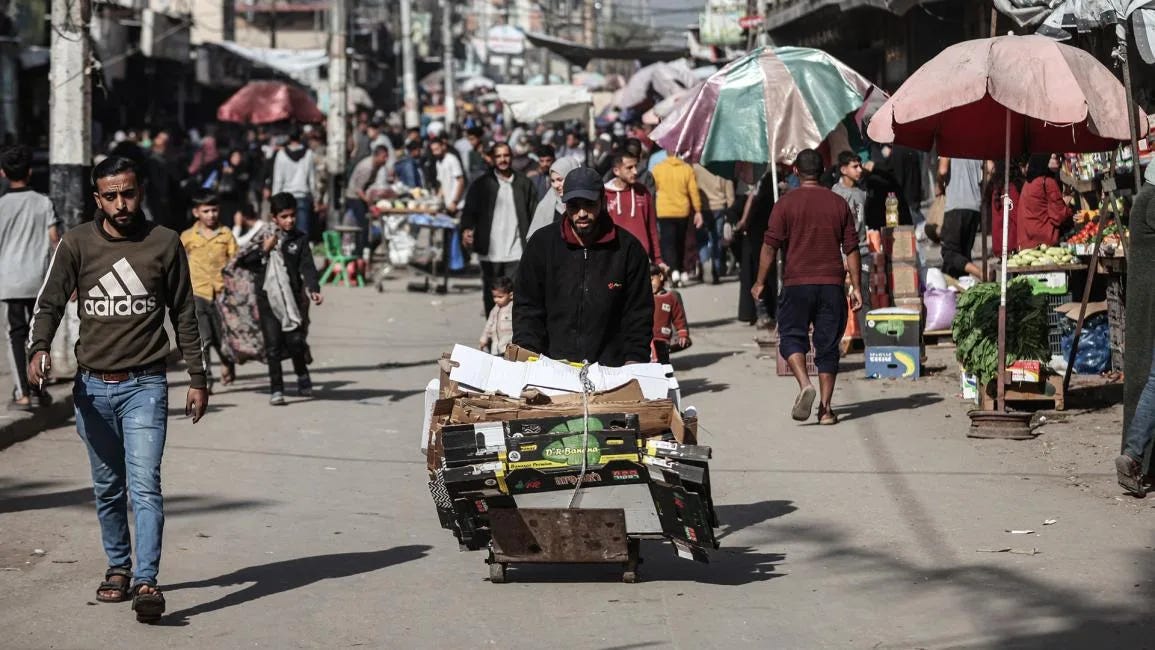
Mahmoud was eventually forced to take on a range of different jobs working on filming reports and documentaries capturing the devastating reality in Gaza, and participating in a water desalination project. But that work abruptly ended due to a lack of funding, leaving him unemployed once again. He later found a job in accounting at a newly opened cafe despite having never studied accounting.
He concludes bitterly: “We live in a state of job insecurity. We could lose our work at any moment, and the income barely covers basic needs.” Between exhausting labor and meager returns, Mahmoud sees temporary work no longer as an option, but as the norm in Gaza while waiting for a reality that may one day offer stability.
Chasing Stability in a Volatile Labor Market
Suha Sukkar (28), a media graduate from Al-Azhar University, shares a similar story. Displaced with her family from Shuja’iyya to the Saraya area, she had worked on temporary contracts within her field. Her most recent nine-month contract with a local media organization had offered a rare opportunity for relative stability until the war upended everything.
The shutdown of most institutions after the war broke out placed Suha, like many others, in an even more difficult professional reality, pushing her to search for any available job. “I’ve been forced to work in any field I can find to avoid being unemployed,” she tells Noon Post.
She describes her journey in search of job stability since graduation as arduous akin to “chasing a mirage.” With limited opportunities, many young people find themselves compelled to accept temporary work or jobs far removed from their ambitions, simply to maintain an income that allows them to continue living.
Along the way, Suha has moved between various roles, leveraging her media background in digital storytelling while also working outside her specialization facilitating psychosocial support sessions and participating in relief efforts.
Working under wartime conditions, however, has been anything but easy. Daily challenges, she says, begin with the basics of life: “Every day brought a new obstacle whether it was transportation difficulties or power and internet outages at home, which forced me to search for places with connectivity to submit my work, in addition to the dangers of moving around.”
Suha admits to feeling exhausted due to a lack of recognition. “I put in a great deal of effort but don’t receive adequate moral or financial appreciation,” she says, noting that some of her work has gone unpaid. Still, she refuses to give up, hoping that the days ahead may offer the stability she—and many of Gaza’s youth—have long awaited.
Psychological Pressures Beyond Endurance
Aya Al-Muqayyad, a psychology specialist, explains that constant job changes create a sense of disorientation and loss, increasing psychological pressure in the absence of professional stability. Many are pushed into jobs they neither enjoy nor identify with, leading to a profound sense of lost professional identity.
She notes that this disconnect can manifest as internal psychological conflict, particularly when individuals are forced to accept jobs that do not match their abilities simply to meet basic needs. The ongoing absence of job security also affects family relationships, heightening tension and irritability while reinforcing feelings of helplessness at a time when people most need stability and reassurance.
Al-Muqayyad also links this reality to what she describes as “engineered starvation” caused by Israel during the war. The middle class has shrunk, while the gap has widened between a small minority with resources and a majority increasingly dependent on aid a dynamic that continues to cast a long shadow.
She adds that these transformations have reshaped young people’s awareness and aspirations. Some have turned toward temporary initiatives or quick-income opportunities instead of investing in skill development or building sustainable projects contributing to a decline in productivity and a rise in consumerist tendencies, driven by fear of losing any new venture.
Al-Muqayyad emphasizes the importance of supporting youth both psychologically and professionally by providing safe spaces for expression, counseling programs, and training to help them develop skills and realign their ambitions toward realistic paths, enabling them to adapt without losing their professional identity.
A War Economy Reshaping the Labor Market
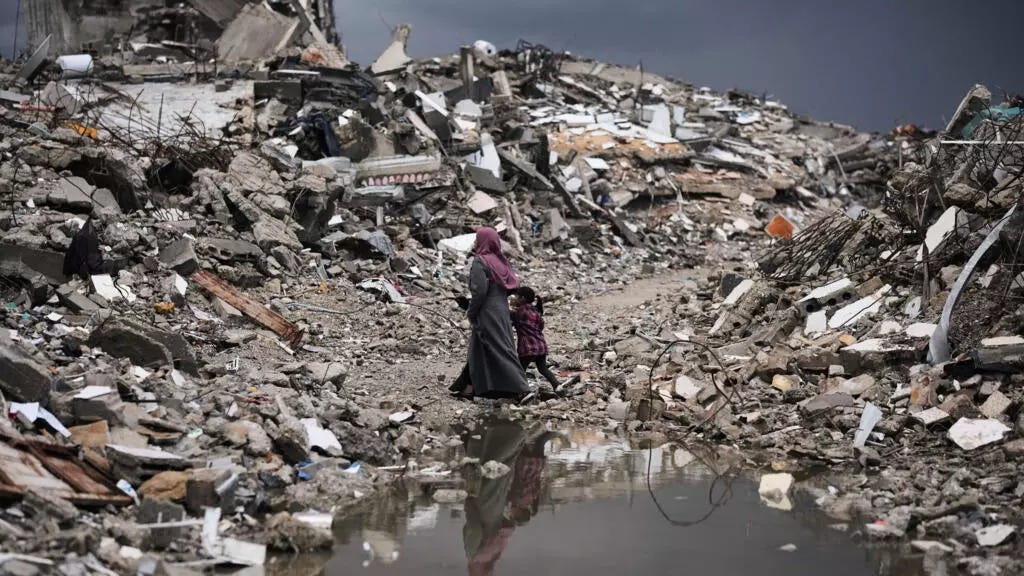
In the same context, economist Ahmed Abu Al-Qamar, a board member of the Gaza Economists Syndicate, says the war has triggered deep structural changes in the labor market following widespread destruction across economic sectors. According to the Palestinian Central Bureau of Statistics, the industrial sector has lost more than 80% of its facilities, while approximately 95% of agricultural land has been destroyed leading to widespread paralysis in productive sectors.
Abu Al-Qamar adds that remote work once a viable option under blockade has been severely disrupted by electricity and internet outages. Although some workers have attempted to gradually resume their jobs, recovery remains difficult amid job losses and worsening conditions.
He notes that unemployment has exceeded 80%, according to UNCTAD, while 95% of the population now relies on aid, according to UNRWA statistics reflecting a shift toward a survival economy imposed by war. He adds that the war has created new professions, some temporary and others likely to persist, such as electronic payment services, while others—like selling firewood—are tied to the crisis and may disappear once conditions improve.
Abu Al-Qamar explains that the collapse of productive sectors has pushed the economy from a structured system into a survival economy. This pattern, he suggests, could recede with the reopening of crossings and the entry of raw materials allowing factories to resume operations, reviving agriculture and livestock farming, and stimulating service sectors.
He concludes that stabilizing the labor market requires a stable political environment, the full reopening of crossings, enabling exports, strengthening vocational education to match market needs, and expanding remote work opportunities measures that could help reduce unemployment and mitigate the effects of the blockade.
Caught between economic analyses and mounting psychological pressures, Gaza’s youth remain trapped between a reality that forces them into a daily struggle for survival and deferred dreams of stable employment that might one day restore a measure of long-awaited security.