

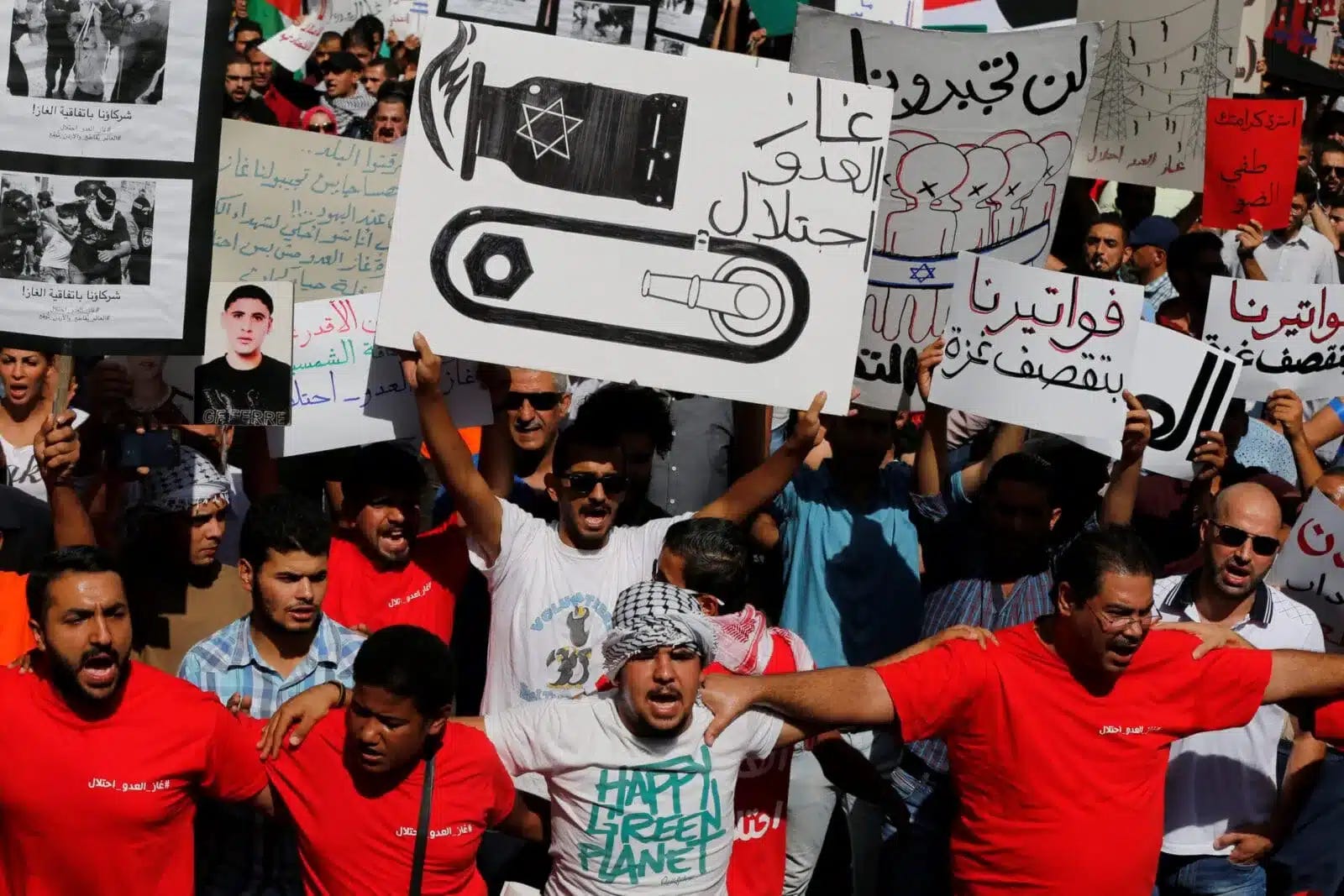
Young Jordanians gathered in Al-Rabiah, near the Israeli embassy in Amman, in front of the U.S. embassy in Abdoun, across downtown streets, and throughout the country’s governorates, chanting a slogan whose echo has not faded for more than twelve years: “From the south to the north, the enemy’s gas is occupation.” What began as a chant has become the defining headline of recurring protests present in the streets, yet absent from the ears of successive governments.
This has remained the case even after Israel cut gas supplies to Jordan for the second time in less than a year, following the U.S.-Israeli assault on Iran earlier this month.
In 2014, Amman signed a letter of intent to import gas from Israel, followed by a formal agreement in 2016. Gas began flowing in 2020. Today, Israeli gas covers more than 50% of Jordan’s needs, with reports indicating that the supplied volumes continue to rise.
Annual imports have reached approximately 3 billion cubic meters in recent years marking a profound economic shift for a country whose consumption was virtually nonexistent before 2019.
Historically, Jordan relied on neighboring Arab countries for oil and gas. From the 1960s through the 1980s, supplies primarily came from Saudi Arabia and other Gulf states. After the First Gulf War in 1990, dependence shifted to Iraq until the U.S. invasion in 2003. Jordan then turned to Egypt, but the unrest following the 2011 revolution disrupted supplies.
To compensate, Jordan imported crude oil from global markets at a high cost, leading to significant deficits for the state-owned National Electric Power Company (NEPCO).
In 2016, NEPCO signed the agreement for gas extracted from the Leviathan field in the Mediterranean Sea, operated by the American oil giant Chevron and under Israeli control.
Following the U.S.-Israeli assault on Iran, Israel abruptly cut gas supplies to Jordan without prior notice. Minister of Energy and Mineral Resources Saleh Kharabsheh stated that recent regional developments had disrupted the kingdom’s access to natural gas from Mediterranean fields used in electricity generation.
An emergency plan was activated, shifting to alternative energy sources, including liquefied natural gas via a floating terminal, as well as diesel and heavy fuel oil.
In late February, Israel’s Ministry of Energy announced that natural gas exports had been halted following reduced production amid Iranian missile attacks. A spokesperson explained in press statements that “due to the security situation, operations at some natural gas fields have been temporarily suspended, which has, among other things, led to a temporary halt in exports at this stage.”
Why Has Jordan Not Canceled the Agreement?
The Jordanian National Campaign to Abolish the Gas Agreement with the Zionist Entity—active for over 12 years—issued a statement asserting that the moment is ripe for Jordan to terminate the deal. It cited the supplier’s failure to meet contractual obligations and the suspension of supply during a critical emergency as grounds for immediate cancellation and a shift toward sovereign energy investments.
The statement stressed that no justification remains for maintaining what it described as “catastrophic” agreements with the enemy, calling for their immediate termination.
The government, however, defends its position by noting Jordan’s heavy reliance on natural gas to operate power plants. Around 97% of the country’s energy needs are imported, making any sudden cancellation a risk to national energy security.
Officials also highlight the agreement’s role in reducing electricity production costs, with NEPCO estimates suggesting savings of around $600 million annually compared to diesel and heavy fuel alternatives.
Energy and natural resources consultant Mubarak Al-Tahrawi argues that Israel halted supplies without officially declaring force majeure, potentially constituting a breach of contract if continued without clear legal justification. He estimates that the disruption could cost Jordan roughly $1.5 million per day due to reliance on more expensive alternative fuels.
In comments posted on Facebook, Al-Tahrawi noted that international commercial law offers Jordan several options: demanding specific performance to compel the supplier to resume agreed deliveries, seeking financial compensation for direct damages such as higher fuel costs, and addressing indirect damages like increased deficits at NEPCO.
Another option would be contract termination if a fundamental breach is proven particularly if force majeure was not properly declared. Al-Tahrawi explained that international energy contracts typically include complex provisions regarding force majeure and good faith, potentially allowing Jordan to challenge any selective application of these clauses.
What Options Does Jordan Have?
Jordan is not without alternatives in the event of supply disruptions. It can use the liquefied natural gas terminal in Aqaba to import gas from global markets if pipeline supplies stop. The government has also explored coordination with Gulf states to secure gas in case of prolonged disruptions.
The campaign’s statement pointed to additional alternatives, including investing in sovereign energy sources, redirecting billions toward the Risha gas project, oil shale, renewable energy, and green hydrogen. Until full energy independence is achieved, Jordan can rely on floating regasification vessels and the Aqaba LNG port to secure global supplies.
Jordan may also pursue a more independent path, having discovered new natural gas reserves in late 2024. Given its limited fossil fuel resources, the country has strong potential—abundant sunlight and technical expertise to expand renewable energy production.
Campaign secretary-general Mohammed Al-Absi emphasized that all agreements with the “Zionist entity” are categorically rejected, noting that this is not the first disruption in gas supply. He argued that it is unjust to abandon domestic potential while relying on an adversary for energy security.
Speaking to Noon Post, Al-Absi stressed the need to sever the agreement and avoid linking energy to occupation, arguing that the billions spent could have been invested in sovereign energy projects.
Energy expert Amer Al-Shobaki, however, believes the available options are limited. Importing oil or gas from countries such as Libya or Algeria poses political and logistical challenges. He also warned that an expanded regional conflict could increase global pressure on non-Gulf energy sources, placing Jordan’s energy security under one of its toughest tests in decades.
Abdel Salam Al-Zyoud, spokesperson for the Energy and Minerals Regulatory Commission, stated that sufficient reserves of petroleum products and gas are available, reassuring that incoming shipments are on their way to the kingdom.
What Is the Impact of the Gas Cut on Jordan?
The disruption in gas supplies has immediate implications for Jordan’s energy sector, particularly rising electricity production costs as power plants switch to diesel and heavy fuel both significantly more expensive than natural gas.
If the disruption persists, the government may be forced to borrow to cover the growing cost gap, with potential consequences for consumers and industry through higher electricity prices.
Al-Shobaki described the situation as extremely critical, noting Jordan’s near-total dependence on imports for energy importing all its oil and around 97% of its natural gas.
As gas supplies decline, pressure has shifted to diesel, with demand rising sharply for electricity generation and industrial use by major companies such as the Jordan Phosphate Mines Company and the Arab Potash Company after gas supplies halted.
This surge in demand prompted the Ministry of Energy to issue directives rationing diesel sales at fuel stations an indication, Al-Shobaki said, that the country has entered what he called an “energy crisis tunnel” that may persist as regional tensions continue.
He warned of potential economic repercussions, including unprecedented increases in gasoline and diesel prices in the coming months unless the government intervenes an option that would place additional strain on the public budget.
In the electricity sector, the issue extends beyond cost increases potentially multiplying several times to the risk of outages if oil supplies from the Gulf, particularly Saudi Arabia, are disrupted. While the Attarat oil shale plant supplies about 15% of electricity needs and solar energy contributes during daylight hours, the sector remains vulnerable to regional supply fluctuations.
Chairman of the parliamentary Energy Committee, MP Ayman Abu Hanieh, noted that alternative energy sources are available but still limited. Renewable energy accounts for around 27% of electricity production, while oil shale contributes 17%. The floating LNG terminal in Aqaba supplies gas every 15 days from Egypt.
He stated that the current emergency plan is effective so far, stressing the importance of avoiding power outages. He also noted that the parliamentary committee has recently pushed to accelerate the approval of the 2025 Gas Purchase Law to expand self-reliance and investment in new energy discoveries.
It is worth noting that the Israel Electric Corporation filed an arbitration case before the International Chamber of Commerce in Paris in December 2015 following attacks on the Sinai gas pipeline and the halt of Egyptian gas supplies to Israel in 2011.
The arbitration ruling favored Israel, obliging Egyptian entities the Egyptian General Petroleum Corporation and EGAS to pay $1.76 billion in compensation to the Israel Electric Corporation.
This raises a pressing question: if Israel was able to sue Egypt and pursue compensation in international courts, why has Jordan not taken similar legal action following repeated supply disruptions? And when will Amman heed the voices of its youth and cancel the gas agreement or at least demand compensation for these interruptions?