

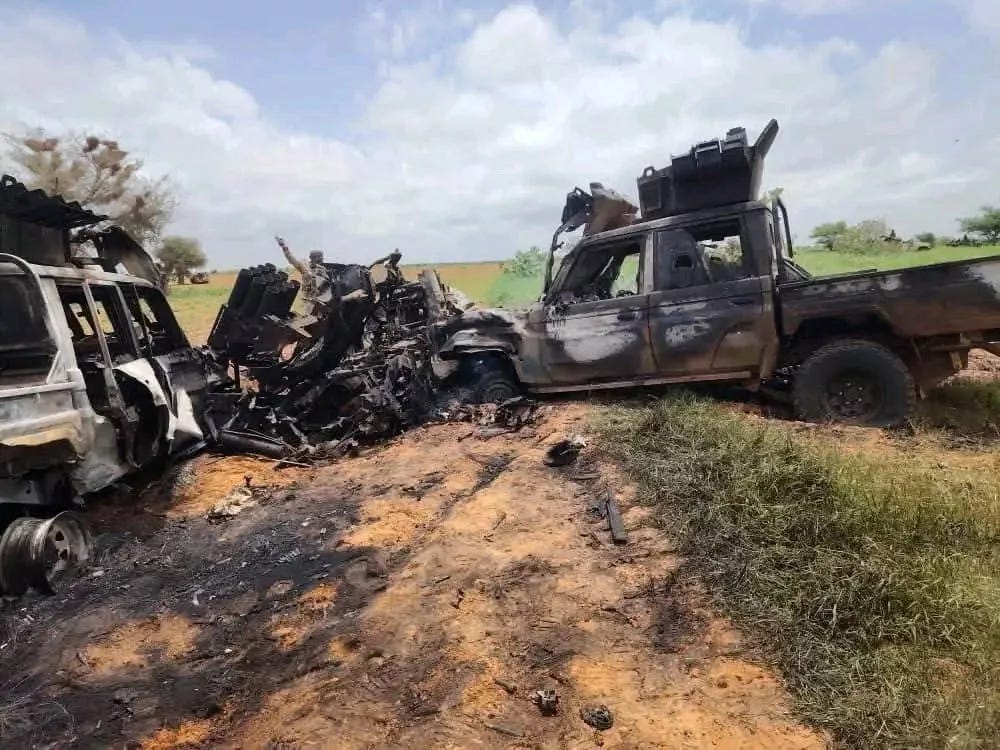
On Wednesday, August 20, forces aligned with the Sudanese army were ambushed in a deadly attack near the town of Umm Qoudd in the vicinity of El-Obeid, the largest city in Greater Kordofan. The following day, army-aligned forces managed to retake the area after fierce clashes.
The back-and-forth control of towns and cities across Kordofan—which comprises North, South, and West Kordofan—has become a defining feature of the war in the region. These battles are not about holding exposed towns but rather about dominating supply routes and resources, winning local community support, and ultimately ensuring complete control by exhausting and disorienting the enemy.
The Rapid Support Forces (RSF), leveraging their mobility and the ability to call for swift reinforcements in open terrains where they enjoy local support, have successfully thwarted recent advances toward eastern and northern Darfur. These attempts had been launched from El-Obeid in North Kordofan and Al-Khuwei in the west. This might have prompted the army to reconsider its strategy.
"The Great Vaza’a"
The new strategy appears to be a temporary shift away from Darfur, focusing instead on opening the 160-kilometer road connecting El-Obeid to Dilling. This route includes several strategic locations such as Al-Hammadi, Al-Dibibat, and Tayba, in addition to dozens of smaller villages. The goal is to disrupt RSF attempts to take over South Kordofan and allow the army to maneuver into areas east of the road.
Earlier this month, the North Kordofan government launched a new campaign called “The Great Vaza’a,” comprising auxiliary forces fighting alongside the army. This new front works in coordination with “Operation Al-Sayyad” to reopen the El-Obeid–Dilling route.
Two days after the operation was launched, Sovereign Council head and army commander Abdel Fattah al-Burhan visited a military site in Kordofan. He was followed a day later by his deputy, Yasser Al-Atta. The army’s official spokesperson was also seen in the region.
Special Forces units—trained in launching highly effective surprise attacks—have begun targeting RSF positions to pave the way for decisive ground battles after identifying militia weaknesses and deployment zones.
Although al-Burhan has decreed that all allied forces operate under the army’s command, many continue to act independently, as was the case in Umm Qoudd. Forces such as the al-Baraa bin Malik Brigade, which lost several field commanders in the clash, the Sudan Shield Forces, and the Joint Armed Movements all continue to carry out missions on their own.
Such independence poses a significant risk, exposing these units to RSF ambushes. The RSF is no longer a cohesive force but rather fragmented militias comprised of men from tribes across Darfur and Kordofan, familiar with the terrain but incapable of withstanding a coordinated offensive.
Obstacles—But Not Insurmountable
The rainy season, peaking in August and September, poses serious logistical challenges. Thick grass and muddy terrain make movement along dirt roads difficult and prevent the deployment of heavy military equipment like tanks and artillery. In response, the army has leaned on its allies, who are better equipped to operate with 4x4 vehicles, while offering them aerial support via drones and warplanes.
This strategy diverges from the urban warfare the army waged in Sennar, Al-Jazira, and Khartoum, where it succeeded by cutting off RSF supply lines and neutralizing their hallmark strategy of rapid, swarm-style offensives. In Kordofan, the objective is attrition.
Achieving that goal requires disregarding time and casualties and focusing instead on breaking the militia’s cohesion by severing it from its support base—locally referred to as “hawadin.” These civilian networks provide vital social cover for the RSF. Undermining this support will trigger the eventual collapse of RSF units, one after the other.
This doesn’t happen through force alone. It requires building trust with tribal leaders, persuading them, and ensuring immunity for their sons fighting with the RSF. The army recognized this early and has toned down its rhetoric, stopped branding RSF sympathizers as traitors, and begun recruiting tribal leaders.
For decades, these leaders have pledged allegiance to whoever controls their areas by force. Their support of the RSF was driven by pragmatism. But if the army gains the upper hand, they’re likely to switch sides just as quickly.
This is why Al-Hammadi—the first major settlement the army encounters on its march from El-Obeid to Dilling—is a key obstacle. The area is home to the Hawazma tribe, known for its loyalty to the RSF. Though the army seized Al-Hammadi on May 13 and advanced as far as Al-Dibibat, it soon had to retreat to El-Obeid.
A Tactical Pivot That Might Work
To secure full control of the El-Obeid–Dilling route, the army must retake Al-Hammadi, Al-Dibibat, and Tayba. Having previously reached the first two towns, Tayba remains the main hurdle. Strategically located, Tayba connects three vital roads linking Al-Dibibat, Dilling, and Abu Zabad.
For the army, Tayba represents a serious challenge: it serves as a supply route for the RSF, either from Abu Zabad or from the Sudan People’s Liberation Movement-North (SPLM–N) in Lagawa. As such, the army has been dropping weapons, equipment, and funds to its Dilling base to facilitate an advance toward Tayba and sever RSF supply lines.
The failure to move from Dilling to Tayba allowed the RSF to recapture Al-Dibibat. The group then began forcibly evacuating the town, which is primarily inhabited by the Kenana tribe a group known to oppose the RSF and lean toward the army.
Why the Army Needs the Road
Securing the El-Obeid–Dilling route would achieve two primary objectives. First, it would reconnect army forces stationed in towns east of the road—such as Dalami, Abu Jubeiha, Abu Kershola, and Rashad—with their main base in El-Obeid. This would ensure consistent supply lines and put pressure on RSF and SPLM–N positions west of the road, including in Abu Zabad, Al-Fula, and other parts of West Kordofan.
Second, it would weaken military coordination between the RSF and SPLM–N in the town of Habila by besieging their forces and cutting off western supply routes—setting the stage for a potential takeover.
If successful, this maneuver would enable the army to push into West Kordofan—especially if its forces in Babanusa can break through—ultimately easing the way toward East Darfur. This would be particularly feasible given that tribal loyalties in West Kordofan, including among the Misseriya tribe, are split between the army and the RSF.
The humanitarian crisis in Dilling and Kadugli, where many residents now survive by foraging wild plants due to food shortages and a collapse of medical services, is directly tied to military movements. Reopening the road would allow critical supplies and medicine to flow in from El-Obeid by land.
SPLM–N is trying to weaken the army’s grip on Dilling and Kadugli by besieging them and cutting off aid, hoping to break army defenses over time. It is likely betting on fatigue and attrition among army ranks before launching a full assault.
The only way the army can thwart that plan is by swiftly securing the El-Obeid–Dilling route. That would allow it to assert control over most of South Kordofan—except for long-standing SPLM–N strongholds like Kauda.
Current indicators suggest the army is capable of reopening the road and reconnecting its forces across North and South Kordofan in preparation for a push westward. But before it can launch an offensive into East Darfur, it must first resolve the complexities of local alliances.