

Nearly a year after the fall of the ousted regime, the return of Syrians to their homes has not become a clear or stable trajectory. Instead, it remains hostage to intertwined humanitarian, economic, and security complexities.
Between displacement camps inside Syria, pressures for forced return, and hesitation that dominates refugees’ decisions in host countries, millions of Syrians live in an open‑ended state of waiting not just answering the question of “return” itself, but also searching for basic safety and the possibility of a dignified life.
This report examines the reality of Syrians trapped between camps inside and outside the country, shedding light on a set of obstacles that prevent return from being a theoretical option or postponed desire into a viable and sustainable reality.
When Displacement Becomes the Less Cruel Option
Thousands of Syrians still suffer from lack of shelter in camps inside Syria. Rather than closing a chapter on displacement, life under tents continues amidst harsh living conditions. Although the fall of the regime theoretically opened the door for residents to return to their towns and villages, this decision clashes with the devastating reality left by years of war destroyed homes, nearly absent infrastructure, widespread landmines and war remnants, alongside rising reconstruction costs and families’ inability to rebuild what they lost.
While some residents have managed to return to their areas, many still prefer to remain in camps that were supposed to be temporary shelters, but have instead become daily realities that reflect the immense challenges associated with return and reconstruction.
In a nearly tattered tent in Salqin Camp in Idlib province, Wasim Ramadan (38) lives with his family of six. Nearly a year after the regime’s fall, he remains unable to return to his village in Al‑Ghab Plain, trapped in a tragic humanitarian reality.
Wasim told Noon Post the reasons he remains in the camp: “The reasons are clear: there are no schools, no water, no electricity, and even the roads are destroyed. My children continue their education here in the camp schools there are just rubble.”
Wasim works in construction. “When it rains, I have no work, and I can’t even buy bread,” he said. He added that organizations that once provided aid have recently stopped, worsening the situation. Wasim earns no more than three dollars a day an amount insufficient to secure basic needs.
With winter approaching, he explained that they resort to burning leftover olive tree trimmings for heat, causing respiratory problems for his wife and children. Despite the harsh life in the camp, Wasim prefers to stay until the contours of a safe return become clearer.
The Same Reality for Tens of Thousands
This is the reality for tens of thousands of displaced people scattered in northern Syria’s camps. They had hoped to return to their villages soon after the regime’s fall, but slow reconstruction efforts, absent infrastructure and essential services, and a near‑complete halt in humanitarian support have turned this return into a deferred dream. They now face a bitter choice: remain in camps or return to devastated towns that fail to provide the minimum requirements for life.
Camps suffer from severe declines in services, stopped aid, and shrinking relief support, even as needs grow and the burden on displaced families intensifies. Ongoing sanitation crises, scarce water, and accumulated garbage persist, with no effective plans to improve the humanitarian situation.
Wael Rustum, director of Al‑Safsafa Camp west of Salqin in rural Idlib, told Noon Post that most of the camp’s residents are originally from Al‑Ghab Plain. The option of returning to their home villages is still stalled due to lack of infrastructure, essential services like water, destroyed schools, and absence of income and job opportunities factors that have prevented many families from returning.
Rustum said the number of families in the camp dropped from 450 after liberation to around 150. However, most of those who left regretted it due to the absence of basic services and medical points nearby, as well as the financial incapacity to rebuild homes or dig water wells.
He added that the nearest hospital is about 20 kilometers from the returned villages, and without transportation, accessing healthcare becomes extremely difficult. Rustum also noted that humanitarian aid to the camp has significantly declined after liberation; previously, multiple organizations provided heating materials, whereas current assistance is limited to just one group still supplying water.
Statistics on Camps and Returnees
According to Ramez Duqsi, the statistics officer at the Directorate of Social Affairs and Labor, speaking to Noon Post, the number of camps after liberation reached 855 camps, housing about 126,200 families, while the number of families who have returned to their original towns reached 118,466 families.
Duqsi noted that families leaving the camps returned to various Syrian governorates, with the largest percentage in rural Idlib, followed by rural Aleppo and rural Hama. Duqsi stressed that destroyed homes, lack of infrastructure, and absence of basic services remain major factors still hindering families’ return.
The Dilemma of Destruction
Given the harsh reality and lack of services, thousands of displaced Syrians have been forced to return to displacement camps for a second time, after finding their homes which the ousted regime had forced them to leave destroyed or uninhabitable. Among them is Umm Ritaj, from the town of Abu Dhour in eastern Idlib countryside. Her sense of helplessness and despair worsens with winter’s approach, as she cannot secure even basic heating needs or change her harsh reality inside Yasmin Camp, where life’s most basic elements are absent.
Umm Ritaj, a mother of three daughters, the oldest of whom is eight years old, told Noon Post about a never‑ending journey of forced displacement. After years in an informal camp, she returned to her town after the regime fell, hoping to regain some stability, only to find her home completely destroyed. She was forced to return to the camp.
Today she lives in a makeshift shelter inside Yasmin Camp with no doors or windows, in a space abandoned by another family. Her husband’s fate remains unknown for about four years he left to work and never returned. Despite repeated attempts to find information about him, she has found none. After the regime fell, she renewed her efforts to discover his fate, but without success.
Umm Ritaj depends on occasional seasonal work harvesting vegetables, but her daughters’ young ages and her fear of leaving them alone limit her ability to work. Often, she and her daughters survive on the simple help neighbors provide. Although her daughters are of school age, extreme poverty prevents them from attending.
The Case of Abdul‑Moneim Mahdi Al‑Jadou’
The situation of Abdul‑Moneim Mahdi Al‑Jadou’ mirrors that of Umm Ritaj. After trying to return to his village of Al‑Tah in southern rural Idlib, he could not settle in a semi‑destroyed house, given the high cost of construction materials. “Although life became harder for us due to displacement, I preferred returning to Yasmin Camp because of the absence of services in the town, piles of rubble, lack of humanitarian support, and schools,” he said.
Today, Abdul‑Moneim lives with his two wives and fourteen children in a single room that lacks basic living necessities no doors, no windows. He added that he used to work during the olive harvest season, but the season is over and he currently has no source of income, amplifying the harsh living conditions he faces.
Their reality reflects that of hundreds of families still caught between destroyed villages that lack basic necessities and camps that fail to provide minimal services amid declining humanitarian support and infrastructure absence making return a complicated and difficult choice for many.
Open‑Ended Waiting and Humanitarian Warnings
In this reality, residents in the camps live in open‑ended waiting between enduring harsh conditions in tents with lacking services, and hoping to rebuild their homes most of which were heavily damaged without actual capacity to repair them even partially. Large towns and villages that were populated before 2019 remain mostly empty, with glaring absence of electricity, schools, health facilities, and bakeries. Available services are limited and insufficient to meet basic life needs.
The Syrian Response Coordinators warned of deteriorating humanitarian conditions in camps in northwest Syria with winter approaching, amid families’ widespread inability to secure heating supplies and severe decline in humanitarian support.
In a statement on October 23, the team said more than 1.5 million civilians still live in camps representing about 75.18% of the total previous number despite reported returns to cities and villages, due to extensive destruction of residential areas and displaced families’ inability to rebuild their homes.
The statement noted that more than 95% of families are unable to secure heating materials for the upcoming winter, and 83% of displaced families did not receive any heating‑related aid during last winter, especially inside camps.
The team pointed out that last winter’s low temperatures led to widespread illnesses among the displaced, as well as fires caused by unsafe primitive heating methods. Storms and snowfall damaged 357 camps, affecting more than 115,000 civilians.
The statement also said that 71% of displaced people plan to cut essential needs especially food in an attempt to secure heating this winter amid major humanitarian support interruptions. Prices of heating materials have risen compared to last year, while monthly income for 88% of families does not exceed $50, making access to fuel or firewood nearly impossible.
The team called on humanitarian organizations and the United Nations to accelerate winter response projects and fill large funding gaps to provide necessary support to more than 1.5 million civilians facing harsh humanitarian conditions in northwest Syrian camps.
UN and Wider Return Context
The UN Resident Coordinator and Humanitarian Coordinator for Syria, Adam Abdel‑Moula, said that about 16.5 million people inside the country need humanitarian aid, in addition to about 2.5 million returnees from internally displaced and refugees returning from abroad, many of whom lost their homes due to the war.
In a press conference before concluding his mission in September, Abdel‑Moula reviewed the UN’s work in Syria and its priorities and future plans to strengthen humanitarian response and support recovery and development. “Syria still suffers from a displacement crisis,” he said, noting that more than 6 million Syrians remain displaced within the country, and more than 6 million are refugees around the world. He explained that about 24% of homes in Syria were damaged or destroyed during previous years, and the UN suffers from a severe funding shortage.
Return Under Pressure Outside Syria
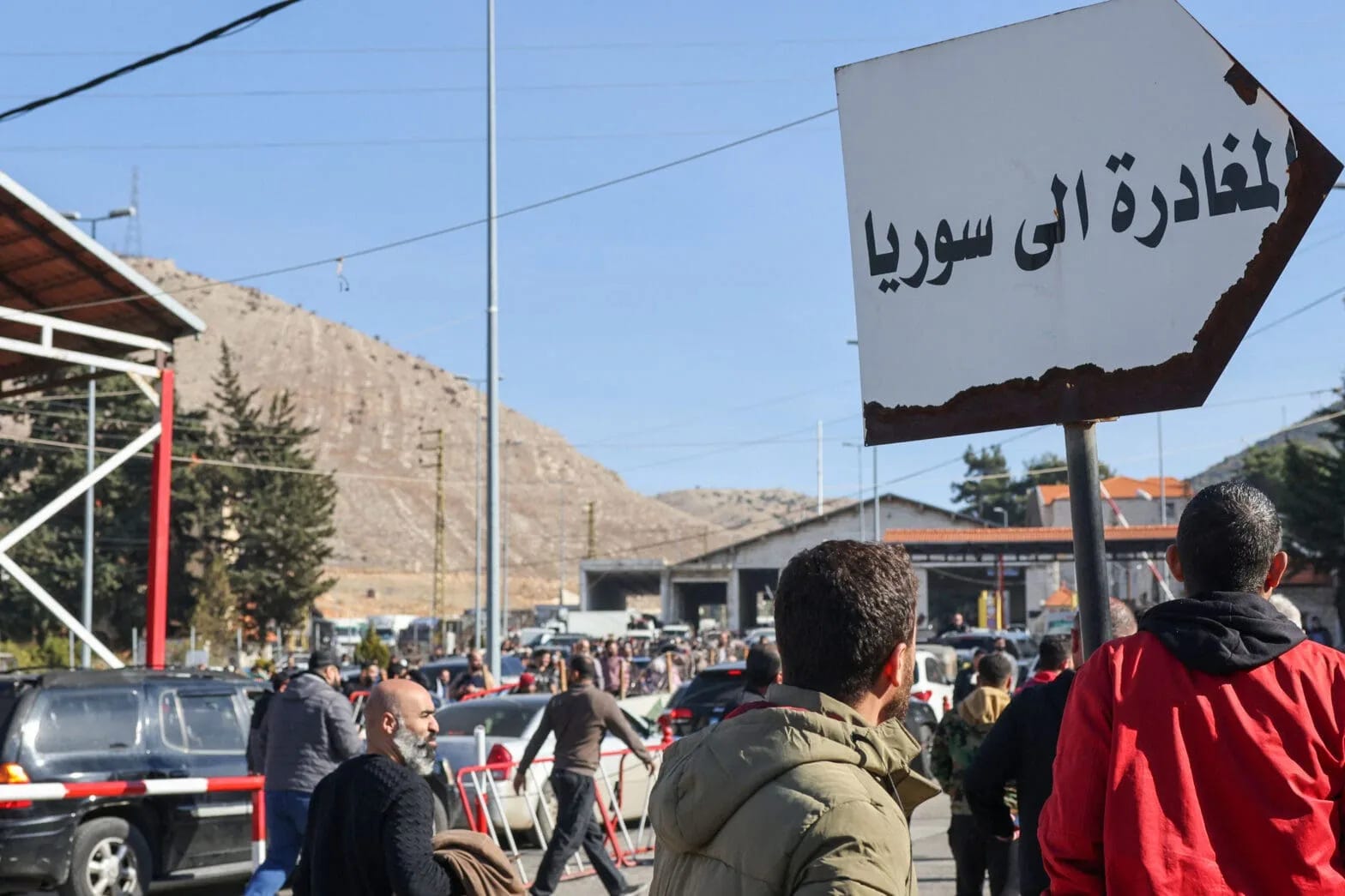
While displaced return inside Syria remains tied to service and humanitarian obstacles that prevent stability, Syrian refugees in Lebanon face a different reality. Some find themselves subjected to forced returns imposed by official decisions without any preparation or guarantees, confronting a harsher reality inside Syria.
Decisions to dismantle some refugee camps in Lebanon forced thousands of families to leave their places of refuge under short deadlines and return to Syria despite lack of shelter and absence of plans to receive them or meet minimum living requirements.
Eman Al‑Hassan (28), from rural Homs, told Noon Post that life for her and her family was turned upside down after Lebanese authorities informed them they must evacuate Zahle Camp within 15 days as part of a decision to dismantle Syrian refugee camps and return them to Syria under the label of “voluntary return.”
Eman described the return decision as sudden and without any prior arrangements, with her family given insufficient time to prepare and no guarantees regarding housing or income sources after return. “We left Syria in 2013, and today we return to an even more painful reality,” she said.
Eman’s family currently lives in rural Damascus with two recently returned families, sharing the rent in a house in an effort to avoid returning to camps again. She noted that the family’s home in rural Homs was heavily damaged during the years of revolution, and they lack the financial means to repair it, making this “return” more akin to a new displacement within Syria than real stability.
Obstacles Delaying Returns from Jordan
In Jordan, the spokesperson for the UN Refugee Agency, Youssef Taha, noted a decline in the number of Syrian refugees returning to Syria in the past three months. He stated that about 19,000 refugees returned in August, dropping to about 15,000 in September, and about 12,000 in October, all returning voluntarily.
Taha explained that this decline is due to several factors, including the start of the school year, the onset of winter, and political and security conditions inside Syria.
A report by the Norwegian Refugee Council (NRC) found that thousands of Syrian refugees in Jordan remain unable to return due to legal, economic, and administrative obstacles, despite recording more than 152,000 returns since December 8, 2024, out of more than 650,000 registered refugees in the country.
The report said that rising living costs, reduced humanitarian aid, and strict documentation policies in both Syria and Jordan make voluntary, safe, and dignified return extremely difficult for many refugees.
According to an NRC survey, initial optimism about return has declined: 40% still hope to return one day, but only 21% express a clear intention to return, while **37% say they do not plan to return at all.
NRC’s country director in Jordan, Amy Schmidt, said Syrian refugees face one of the hardest decisions in over a decade, questioning whether return is even possible amid lack of information, inability to afford travel costs, and fear of being turned back at border crossings.
The council called on the Jordanian government to simplify procedures for registering births and marriages, regularize undocumented families’ status, eliminate fees for work permits, and allow camp residents to take their caravans with them when returning to Syria.
It also urged the Syrian government to remove legal obstacles to property recovery and reactivate the real estate agency mechanism to open transparent paths for status regularization and obtaining official documents.
The report indicated that current policies fall short in five key areas that create an environment unfavorable for return from lack of reliable information to economic and administrative restrictions. It concluded that serious coordination among governments and international actors could turn voluntary return from a theoretical option into a realistic possibility for a broader segment of Syrian refugees.
Although staying in Jordan means facing high living costs, reduced humanitarian aid, and difficulty accessing the labor market, return to Syria for many represents confronting the unknown and lack of security, as well as the overwhelming costs required to start anew.
The report documents that about two‑thirds of Syrian families in Jordan live below the poverty line, and **93% of working Syrians do not have valid work permits.
In this complex landscape, the return of Syrians after the regime’s fall appears far from being purely an individual decision or a wholly voluntary option. With considerations of safety, shelter, the ability to live, and absence of basic services intertwined, millions of Syrians remain trapped in a gray area between displacement and return.