

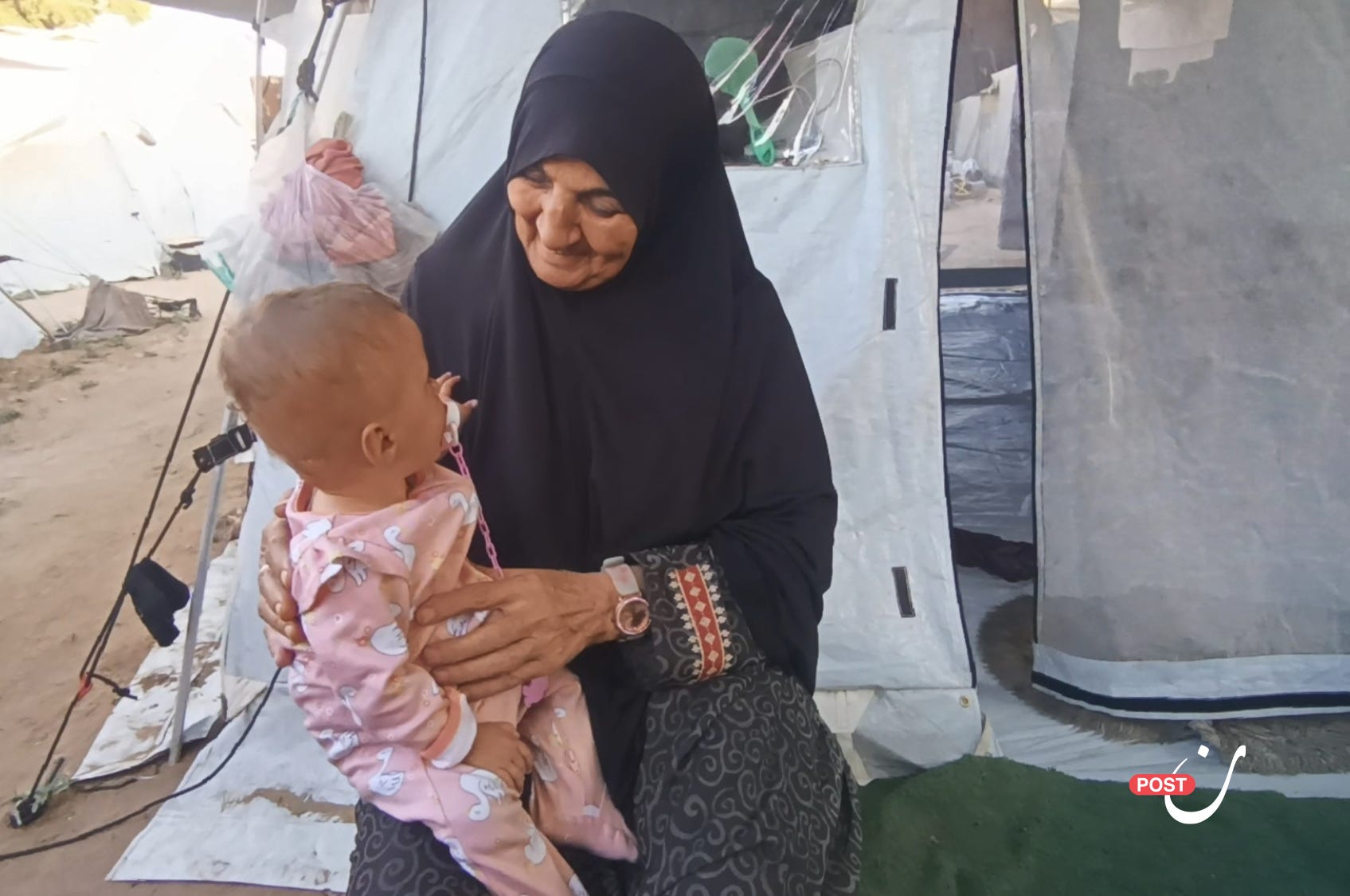
“My wife’s in labor, it’s her first child help us, Umm Saleh!”
It’s one of the many desperate cries that wake 60-year-old midwife Fiza Shreim in the dead of night. With urgency etched into every wrinkle of her hands, she grabs her worn black medical bag, throws on her clothes, and steps out of her white tent.
Guided by the beam of her flashlight, she walks through the rubble-strewn paths and scenes of trauma in Gaza City on her way to deliver life amid death.
Fiza Shreim, a woman known as the “Angel of Birth,” recounts the beginning of her journey. “It was the 1970s, I was just 13. The Israeli occupation had imposed a security lockdown in Gaza. My mother was in labor with my sister Jamila, and there was no one to help her. That’s when I delivered my very first baby.”
That experience led her to pursue formal training in nursing in 1979.
With a warm voice and radiant smile, she continues: “Ten days after I got married, I was accepted into a midwifery program not available in Gaza at the time, but in Sarafand, inside Israeli-occupied territory. I spent a year learning the foundations and practical skills of the craft.”
Shreim went on to give birth to 13 children of her own three of whom were killed in Israel’s war of extermination on Gaza. Today, she is a grandmother to 53 grandchildren many of whom she helped deliver herself.
Looking around the corners of her tent, which lacks the warmth of her former home, she says:
“I worked at Al-Shifa Hospital the only facility that served women giving birth from Rafah in the south to Beit Hanoun in the north. I practiced midwifery for more than four decades without pause.”
Retirement did nothing to slow her commitment to bringing life into the world. “Even after I retired, I turned a room in my house in Jabalia into a birthing room. I continued helping women give birth, comforting them through labor, and letting them hear the joyous cries of their newborns for free, purely as a humanitarian duty.
I carried on even after being displaced to Deir al-Balah more than two years ago, during Israel’s ongoing genocide in Gaza.”
According to the United Nations Population Fund, “Well-trained midwives could prevent up to 66% of maternal and newborn deaths. Women who receive continuous care from a midwife are 24% less likely to deliver prematurely and 16% less likely to lose their babies.”
Her voice trembles and a tear slips from her eye as she speaks:
“I had long awaited the moment to help my pregnant daughter deliver her baby. She had been counting down the days. But the Israeli occupation killed her, her two daughters, her unborn child, and 23 members of her husband’s family.”
Wiping away the tear, she continues:
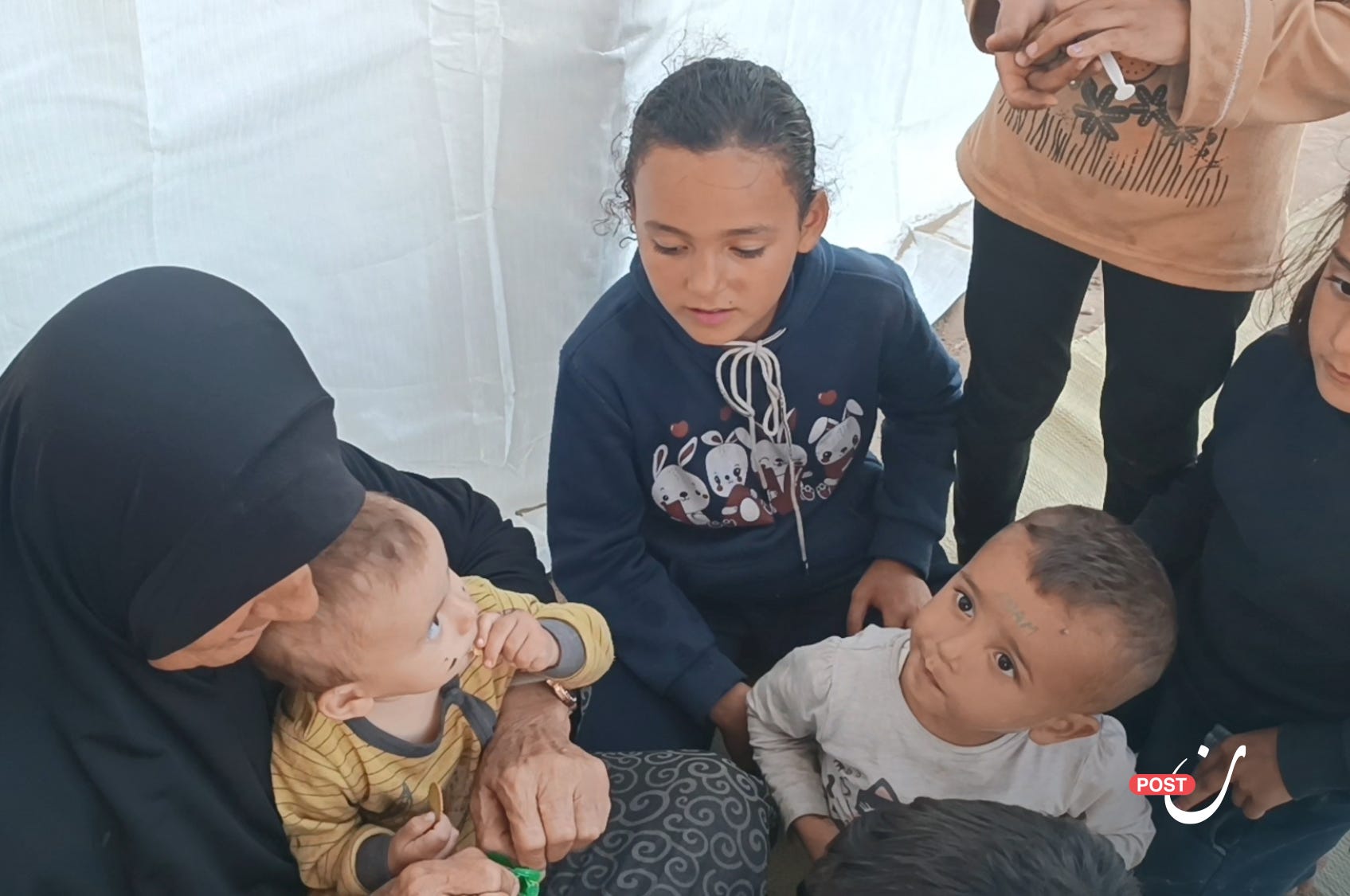
“My eldest daughter lost her husband. She went into labor on the third day of mourning. I helped her through it. I was her mother, her midwife, and the grandmother to her children all at once.”
With many pregnant women unable to reach hospitals because of relentless Israeli bombardment and an airtight blockade, Shreim now helps them give birth in tents and refugee shelters. She uses only the basic tools in her bag, while Gaza’s healthcare system lies in ruins.
Recalling one of the most harrowing births during the war, she says:
“One pitch-black night, lit only by the streaks of airstrikes, a man came running, screaming: ‘My wife is giving birth, please help us, Auntie Umm Saleh. There’s no one else no mother, no support, and no ambulance can reach us.’”
“I didn’t hesitate for a second.
I grabbed my son and said, ‘We’re going to bring life from life.’ We recited the shahada, ‘There is no god but God, and Muhammad is His Messenger,’ expecting to die under the buzzing drones overhead.”
She clasps her gnarled fingers together, takes a breath, and goes on:
“We reached their home. I helped ease the woman’s labor, and the baby emerged with her cries drowning out the sound of Israeli shelling. I delivered the placenta and cleaned the child but then realized I didn’t have any surgical sutures in my bag.
I walked over a kilometer back home on foot to get the threads. I returned and stitched her up under the faint glow of a mobile phone flashlight. I thank God for every life I’ve helped bring into the world, using only the simplest of tools.”
As for what she carries in her medical bag during war, she says:
“I was displaced over 13 times. I kept only the essentials: cotton, gauze, gloves, sutures, and scissors. I had to leave behind my suction equipment and oxygen tanks in my home, which was later destroyed by the Israeli army.”
During this war of annihilation, women have endured double the pain surviving bombardment while fearing for their unborn children. Many have lost their babies because ambulances couldn’t reach them in time, or the roads were too destroyed to travel.
The Israeli military has not hesitated to kill mothers and their unborn children. Yet Auntie Umm Saleh continues to deliver hope—baby by baby—from under the rubble, amidst the explosions, and inside Gaza’s tents. Through it all, she lets the world hear the cries of life from Gaza.
