

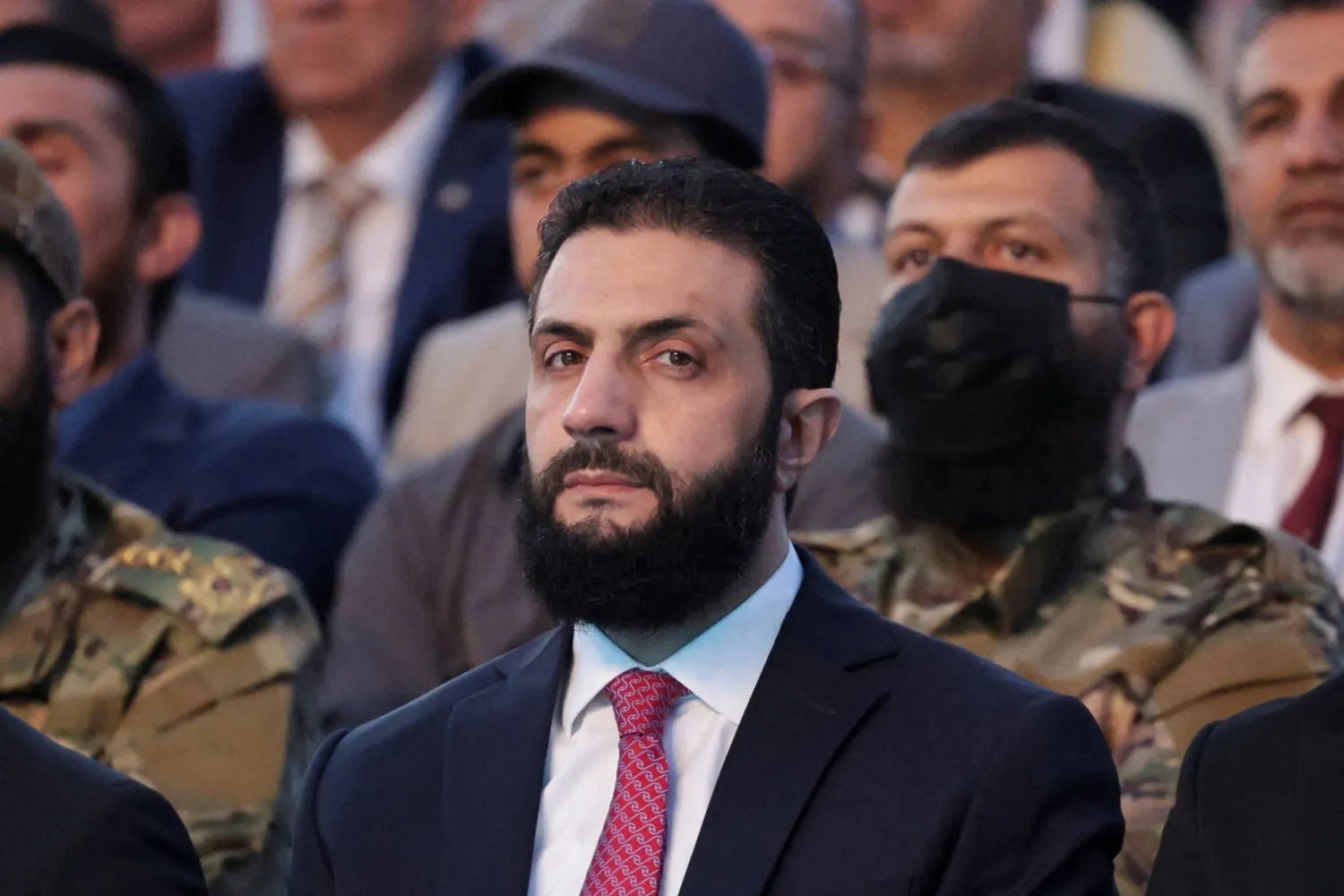
On November 27, 2024, the opposition coalition to the Assad regime, led by Ahmed Al‑Sharʿ, launched the decisive phase of the struggle. They began the “Deter Aggression” campaign with a limited advance from the eastern front toward Idlib but it quickly widened into a major breakthrough that shattered the regime’s defenses in Aleppo and led to the collapse of its front lines within a few days.
With that collapse, Al‑Sharʿ and his allies pushed their forces south through Hama and Homs until they reached the outskirts of Damascus the largest military shift Syria had seen since the revolution began. Less than two weeks after the battle started, the victorious forces entered the capital in the early hours of December 8, 2024, declaring the end of the Assad regime after nearly fourteen years of war.
Assad fled to Moscow. Al‑Sharʿ assumed leadership of the country under his real name. He appointed Asʿad Al‑Shaibani as foreign minister, and Marhaf Abu Qusrah as defense minister. Anas Khattab was made head of intelligence before moving to interior. From the very first days, diplomatic delegations from East and West flocked to the capital to meet the man now ruling a strategically central state in the heart of the region.
Although the “Deter Aggression” victory may have looked sudden, it was the result of a strategic buildup over years. On the social level, Al‑Sharʿ worked steadily to build a cohesive popular base capable of endurance and mobilization. Militarily, he restructured his forces, elevated their discipline and training, developed command-and-control systems, and brought scattered factions under an organized power capable of waging a broad war.
By the end of 2024, Al‑Sharʿ had secured the three vital elements for any major political‑military transformation: a ready social mass, a professional military force, and institutions capable of managing public life and supporting the war effort. So when the “Deter Aggression” battle began, it was the natural climax of a comprehensive preparation process.
Damascus: Gate of Victory and Center of the Narrative
“By God, if we had even a single breath left, I’m certain God will grant us victory, and we will enter Damascus victorious!” Ahmed Al‑Sharʿ, 2020
Following a series of military setbacks for the revolution, Al‑Sharʿ shifted his discourse to restoring internal balance, describing each defeat as a station for reform. He framed failure as an experience that could be turned into practical know‑how.
In his video messages, he linked “the trials of hardship” to “the orders of empowerment,” arguing that every setback exposed a weakness to be addressed on the path to completion.
This shift turned his discourse from justifying retreat to producing a new awareness that treats loss as an opportunity to rebuild and deepen operational and organizational expertise. By blending religious language with pragmatic analysis, he managed to protect his base from psychological collapse, transforming the sense of loss into continuous mobilization energy.
Al‑Sharʿ argued that the battle would not be decided by weapons alone. He sought to craft a narrative convincing society of the continued legitimacy and necessity of confrontation, grounding it in moral and political legitimacy.
His discourse rested on the idea that fighting was a collective duty to defend society from injustice drawing on concepts of justice, dignity, and the defense of the oppressed.
At the same time, he painted a stark picture of the enemy: a Russian occupation striving for imperial glory, an Iranian occupation aiming for demographic change, and the regime itself as a “puppet” between the two. In doing so, Al‑Sharʿ elevated the conflict from an internal civil war to a liberation battle with national and civilizational dimensions.
One of the pillars of his discourse was fostering certainty of victory. Across most of his speeches he repeated that “victory is inevitable,” citing Qur’anic verses and the histories of peoples who prevailed despite limited means. But he presented this certainty not as a mere wish, but as the logical outcome of a cumulative process of organization, arming, administration, and service provision.
In his speeches, Damascus was not just a capital it was a spiritual‑political horizon, a symbol of liberation, dignity, and sovereignty. For Al‑Sharʿ, every act paving a road, opening a school, training a military unit was part of a long journey that ended at its gates.
In reality, he used powerful language to revive morale, invoking past sacrifices and bridging them with the present to assert the community’s ability to endure and persevere. He practiced what can be termed a “discourse of rebalancing,” rejecting the transformation of military defeats into psychological collapse, reinterpreting them as natural steps toward victory.
His addresses carried spiritual and moral weight, offering his soldiers a source of strength beyond their lack of advanced weaponry. Against the enemy’s superiority in tanks and aircraft, Al‑Sharʿ argued his fighters excelled through faith and readiness to sacrifice their lives for God’s cause.
In direct appeals to fighters, he deliberately instilled a heavy moral responsibility, making each soldier feel he was fighting on behalf of thousands. He drew on the experiences of the early companions of the Prophet, giving their sacrifices a meaning that transcended the moment.
It can be said that Al‑Sharʿ’s pre-liberation discourse formed an integrated structure serving mobilization, organization, and psychological endurance: linking defeat as experience, victory as a sure promise, and Damascus as the center of the path and the ultimate goal.
A temporal reading of his speeches reveals a deliberate progression: initially focusing on messages of resilience and steadfastness; then shifting to discourse of preparation and readiness; and finally delivering direct statements about the approach of “Liberation Day.”
Civil and Service Preparation for the Battle of Liberation
“Every institution we build in liberated areas is a step toward Damascus.” Ahmed Al‑Sharʿ
In the years following the ceasefire, Al‑Sharʿ began framing the toppling of the regime not merely as a military operation, but as a project requiring a functioning alternative state capable of managing society. He articulated a vision beyond battles focusing on establishing institutions responsible for governing rebel-held territories.
In May 2021, he explained this logic to a delegation of tribal elders, stressing that “the institution-building phase” was the first condition for achieving final victory. In July 2022, he reiterated that the relative calm after the ceasefire offered an opportunity to qualify cadres and build the necessary expertise for the “complete liberation of Syria.”
Based on this vision, Al‑Sharʿ facilitated the establishment of service administrations acting as a bureaucratic apparatus managing markets, rationing scarce resources, and laying the foundations for “revolutionary governance.”
Over time, features of a quasi‑institutional framework emerged capable of offering relative stability that would not collapse at the first shock of military escalation.
This trajectory traces back to the 2017 civil‑administrative initiative, which led to the formation of a “Salvation Government” to handle administrative governance in Idlib.
This entity included technocrats, academics, and non‑armed Islamists who had been involved in local initiatives since 2011 but felt sidelined by the then-existing provisional government. Al‑Sharʿ’s project offered them a broader, more accommodating space.
As battles waned and COVID‑19 restrictions took hold, daily life in Idlib began to stabilize. From 2021 onward, economic activity picked up in towns like Dana and Sarmada, spurred by investments from local merchants and Aleppo businessmen reinvesting capital in the region.
Within two years, roughly twenty-nine shopping centers were opened, restaurants and cafes thrived again, and leisure facilities zoos, amusement parks, even a stadium in Idlib resumed operation.
Simultaneously, public infrastructure projects advanced. Through a construction company called “Ar-Raqi Construction,” large-scale infrastructure works began: rehabilitating roads, building industrial and commercial zones, improving irrigation networks, and developing new residential neighborhoods.
Al‑Sharʿ frequently attended inaugurations of these projects, presenting each as part of the “liberation effort.” The symbolic opening of the widened road between Bab al-Hawa and Aleppo in January 2022 stood out, as did his presence at irrigation projects and the Idlib Book Fair.
By July 2022, he summarized the essence of his project: “When we liberate large areas and see the end approaching, institutions must be ready to quickly fill the void. People should notice within weeks the difference in security, education, health, agriculture, economy and all aspects of life.”
Through this vision, every service project became a strategic brick, every nascent administration a component of readiness for zero hour. In effect, society became part of the liberation process itself not just a passive backdrop.
Building Social and Political Legitimacy
“The cooperation of our people in the region with the military factions is essential to oppose the regime… the mission is bigger than factions or operations rooms.” Ahmed Al‑Sharʿ, in conversation with elders of Jabal al-Zawiya
Since the early years of his leadership of the “Salvation Government” and allied bodies, Al‑Sharʿ viewed the social environment of northwest Syria as the fundamental base for his political‑military project.
He worked to strengthen ties with tribes and extended families, integrating them into a narrative of shared responsibility. Over time, this helped create a network of social loyalty that could be relied upon in times of tension.
Al‑Sharʿ demonstrated an exceptional ability to address and win over different segments of society, using a flexible discourse sensitive to local context. He was careful to engage various religious and social dynamics in Idlib.
This evolution also manifested in his treatment of minorities. He shifted from a policy of exclusion to one of tension management via direct engagement, reassuring messaging, and rights‑based relations. In June 2022, he visited Druze villages in Jabal al-Samaq; he held meetings with Christian notables; and followed through with practical measures.
These included removing radical elements from minority areas, establishing police stations, strengthening courts, compensating victims, returning properties and religious endowments, and reopening several churches with the church in Idlib placed under the “protection of the Salvation Government” until restoration.
He also established representative councils for minority communities to oversee their affairs.
Concurrently, Al‑Sharʿ worked to expand his political legitimacy within the broader revolutionary space. He embraced a strategy of “embracing the revolution,” gradually scaling commemoration events: from small local gatherings in 2020 to widespread participation from 2022, including raising the revolution’s flag, involving schools, and delivering official speeches.
Externally, he began cultivating relations with Turkey and various NGOs, establishing a political affairs department and an external relations office signaling readiness to engage with the international community.
Socially, he increased meetings with tribes, displaced persons, students, and war‑wounded fighters; he held commemorations and recognition events. In an April 2023 address he emphasized the need to respect local customs and avoid repeating past administrative failures.
As this groundwork solidified, Al‑Sharʿ expanded his media apparatus, gradually shifting toward indirect media via social‑media influencers. This allowed for a more flexible, effective discourse capable of reaching all segments of society. It also increased the capacity to steer public mood.
Despite ongoing criticism of his governance, Al‑Sharʿ strove to build multiple forms of legitimacy. He demonstrated awareness of public sentiment and openness to different social groups, adopting a soft, flexible approach in dealing with them.
These transformations were not mere opportunistic maneuvers: they resulted from continuous evolution shaped by daily field experience.
His political thinking developed through direct interaction with local populations, responding to geographic pressures, balancing geopolitical actors making his reactions to changing circumstances a product of acquired convictions rather than superficial tactics.
Unifying the Forces and Building Military Capacity
Between 2017 and 2018, the conflict passed a critical turning point. Fragmented clashes between armed factions exposed the lack of institutional cohesion and coordination. After the defeat at Saraqib in 2020, the weakness resulting from absence of unified command became evident; frustration peaked following the March 2020 ceasefire under the Russia-Turkey agreement (Sochi agreement).
Al‑Sharʿ responded to this reality by consolidating his position as an organized and disciplined actor capable of imposing change. He eliminated some factions and brought the rest under two tracks: military integration or compliance under a unified organizational umbrella.
He restructured foreign fighters into unified brigades and imposed new regulations to integrate them into a centralized military structure. He struck decisive blows against networks affiliated with ISIS and thwarted attempts to resurrect the branch of Al-Qaeda known as “Huras al‑Din” in 2020.
Simultaneously, he began building a professional military core: the nucleus of the “Deter Aggression” battle. He emphasized training fighters for urban warfare, physical fitness, encirclement and ambush tactics; he created specialized units for precise missions, as well as units for discipline and command.
In December 2021, a military academy was established to train professional officers and fighters. In 2022, he declared that graduates would become the backbone of the “Revolution Army.” The academy played a central role in unifying combat doctrine, developing new tactics, and forming elite units including reconnaissance, assault, special forces, and rapid‑response teams.
He also diversified weapons sources through local workshops that re‑manufactured ammunition and developed arms. These included advanced weaponry such as “Shahin” combat drones, which played a decisive role in targeting and psychological warfare during the “Deter Aggression” battle.
Given the previous lack of coordination among factions, Al‑Sharʿ founded, together with other groups, a unified operations room called “Clear Victory,” which included geographically distributed brigades and central elite units about 40 brigades averaging 600 fighters each, according to data from some affiliated sources. This unified command allowed consolidated decision‑making and execution of operations under a single organizational framework.
Thus, he turned the ceasefire period into a phase of comprehensive preparation — from unifying factions to designing governance structures, and strengthening social cohesion. Parallel to that, he created a central authority responsible for decisions of war and peace and for allocating resources.
By 2024, the opposition had transformed from a collection of disparate factions into a fully integrated central military body, unified operations room, disciplined field structure, locally produced arms, unified fighting doctrine. Al‑Sharʿ considered that transformation the direct cause of the swift victory in “Deter Aggression” — arguing that despite the regime’s superior equipment, it failed to achieve anything comparable.
Reengineering the Religious Sphere
“If authority had adopted the strictest sect and demanded from its people only what their sect requires, it would have the right to grant them their rights but to impose that on all people is not its right.” Ahmed Al‑Sharʿ
The religious reform under Al‑Sharʿ began early, alongside the social and political opening he embraced. As his political role expanded and he engaged more with minority communities, and as his relations with foreign actors grew more flexible, the need emerged for a renewed religious discourse to legitimize that openness before his organizational base.
Starting in 2019, his close associates began formulating religious curricula aligned with his rising political role intended to persuade the base that these changes were not betrayal or opportunism but necessary adaptations.
This process included limiting the influence of global jihadist Salafist symbols, banning their literature in training camps, and restructuring internal education to introduce a “warning against extremism,” shifting instruction toward traditional jurisprudence (fiqh) rather than jihadist literature thereby shielding the organization from internal divisions and preventing future schisms.
Simultaneously, he curtailed the influence of hardline members within the group who were unable to adapt to social realities or unable to accommodate the new orientation. As responsibilities of governance expanded and the need for broader religious legitimacy grew, the movement moved toward adopting the Shafi‘i school of jurisprudence more congruent with the religious environment in northwest Syria.
This marked a practical transition from a global jihadist Salafist model to an institutional Sunni religiosity rooted in local tradition.
Religious curricula were restructured, especially in training camps, to avoid sectarian tension. Texts such as Al-Mithaq: Introduction to the Creed of the Pillars of Faith by Abdul‑Allah Hamad Rukf were adopted offering a concise and flexible doctrinal vision suitable for a broad audience, free from theological complexity.
Meanwhile, the works of Ibn Abd al-Wahhab, once central to Salafist indoctrination, were limited to advanced religious studies within the Sharia faculty at the “University of Idlib.” Appeals to Takfir (excommunication) were banned.
On the institutional level, the group expanded the preexisting educational infrastructure. The “Imam Al‑Nawawi Institute” grew to over fifty branches in opposition-controlled areas playing a central role in producing local imams integrated into their communities.
Also established was a “Preachers’ Training Institute,” under the Sharia faculty at the University of Idlib designed to train field preachers capable of engaging with ordinary people rather than producing isolated doctrinal elites who might later become independent centers of power.
In parallel with religious restructuring, the group reorganized the judicial and mosque systems and the issuing of religious rulings (fatwas), ensuring coherence with the new orientation. They dissolved faction-based Sharia courts and unified the judiciary under more disciplined institutions.
Authority to issue fatwas was centralized under a broad collective body designed to grant political legitimacy without allowing religious authority to evolve into a rival power base.
In March 2019, this vision materialized with the establishment of the “Supreme Council for Iftaʾ” as a unified reference for jurisprudential guidance.
The council grouped scholars from diverse traditions, including Sufis and Ash‘aris, aiming to create a religious umbrella widely accepted by the public thereby preventing influence from radical global preaching networks.
The council maintained a high level of discipline, and its edicts remained scholarly, free from polarization or contestation. Its central role was to prevent fragmentation and ensure that the religious discourse aligned with the social sense of the Sunni majority under opposition control.
Actual executive power remained with advisers close to Al‑Sharʿ to guarantee alignment between the Council’s directives and the strategic path of the movement.
After 2020, the “Salvation Government” tightened control over religious education. It permitted operations only for institutions compatible with the moderate Shafi‘i and Sufi orientation such as the Imam Al‑Nawawi Institute and the Institute of Abd al-Huda al-Sahmi.
Sufism was gradually reintegrated into public religious life through celebrations of the Prophet’s birth, the return of Sufi lessons, and organizing activities for Sufi-inclined institutions. Classic Sufi works were featured at the Idlib Book Fair.
Yet this revival remained within a controlled reform framework intended to ensure a regulated religious environment without provoking social tension. At the same time, the movement refrained from imposing unified sermons or intervening directly in mosque teachings; oversight remained indirect, via the Ministry of Religious Affairs and affiliated institutions.
Through these steps, Al‑Sharʿ redefined the role of religion in public life shifting from wholesale Islamization and top-down religious imposition to a regulated, inclusive, and socially compatible model. As he repeatedly stressed, the priority was a religious policy grounded in widely accepted rulings and designed to maintain social cohesion.
From Cumulative Work to the Moment of Reckoning
“We are not only thinking about liberating Syria from this regime we are thinking about how we will build the future.” Ahmed Al‑Sharʿ
Ahmed Al‑Sharʿ did not base his project solely on military effort; his work between 2017 and 2024 was social, religious, and political in nature. During this period, he pursued a policy of openness and won the “silent majority,” opening channels of wide communication with different social and religious groups, establishing a social environment capable of mobilization and responsive to his directives.
Although he adapted to strategic priorities of Turkey, accepted monitoring points, and agreed to Russia–Turkey ceasefire deals despite some internal resistance he used the relative calm after the 2020 ceasefire to accelerate the building of his institutional framework.
Service bodies matured, local networks gained discipline, and a media apparatus capable of mobilizing the public emerged. Simultaneously, command over military factions was unified under a single leadership.
By the time the “Deter Aggression” battle was announced, this comprehensive framework was virtually complete. There was no longer a need to build new institutions only to activate the existing, well-prepared structure. Service, media, organizational, and military systems had all reached a level of cohesion that made them integral to the war effort.
When the battle began, military action alone wasn’t decisive. Civil and organizational machinery synchronized: the Salvation Government activated the “Emergency Response Committee” (established in 2020), the Development Ministry began preparing new tents for internally displaced persons, contact numbers were distributed across towns and cities, the Emergency Committee accelerated bakery operations, and hospitals were readied in case of escalation.
Thus, the final battle was the culmination of a multi-year process built with patience, transforming what often seemed like competing missions governance, religious reform, social outreach, military unification into components of a single, integrated project.
In return, Al‑Sharʿ’s opponents lacked a serious alternative someone, like Hassan Soufan, admitted joining Al‑Sharʿ only after recognizing there was no other project with comparable vision and coherence.
