

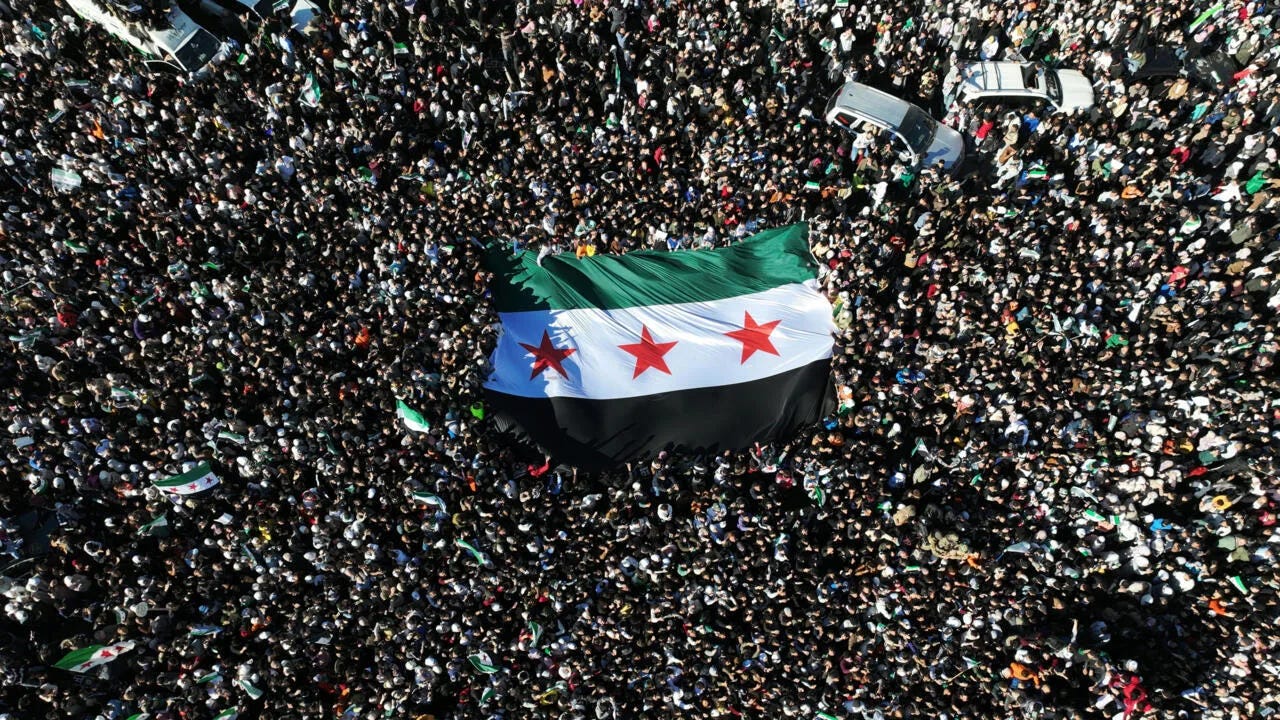
Fifteen years after the outbreak of the Syrian revolution, the country stands at a moment profoundly different from that of the first demonstrations in March 2011. Following years of conflict and the fall of the regime in December 2024, Syria has entered a new phase defined by the rebuilding of the state after decades of authoritarian rule.
This year’s anniversary marks the second since the regime’s collapse a moment prompting many Syrians to reflect on the long trajectory of the revolution: from the early peaceful protests, through years of conflict and fragmentation, to the political transformation that has opened the door to a new transitional phase.
Yet over time, the central question has shifted. It is no longer only about how that phase ended, but what remains of it. Revolutions are not measured solely by the moment regimes fall, but by their ability to leave a lasting imprint on the structure of the state and society.
In the Syrian case, the years of revolution produced deep transformations extending beyond politics into the fabric of society itself: from breaking the barrier of fear, to the rise of new civil actors, to the emergence of a public discourse centered on freedom, dignity, and citizenship.
Today, however, these transformations raise a more pressing question: have the revolution’s gains been translated into the foundations of the new state, or do they remain fragile values at risk of erosion over time?
What Are the “Gains of the Revolution”?
When speaking of the “gains of the revolution,” the term does not refer solely to direct political outcomes such as the fall of a regime or a change in ruling authority. Revolutions often produce deeper shifts that extend to political values, the structure of the public sphere, the nature of civil society, and even the collective memory of a society.
In this sense, the gains of a revolution can be understood as transformations that reshape the relationship between state and society, and between citizens and authority.
In Syria, these transformations began to emerge in the early months of 2011, when demonstrations erupted across multiple cities calling for freedom and dignity after decades of security rule. For many scholars, the mere act of Syrians taking to the streets in open protest marked a transformation in itself, as it shattered the system of fear that had governed political life for decades.
These gains can be understood across four interconnected levels: normative, political, civic, and symbolic.
The Rise of a Discourse of Freedom and Citizenship
One of the most striking shifts accompanying the Syrian revolution was the transformation in political language and the values circulating within society. Before 2011, the political sphere was dominated by official discourse emphasizing regime legitimacy and the necessity of stability, while concepts such as political freedom and public accountability were largely absent from public debate.
With the outbreak of the revolution, new vocabulary entered popular discourse most notably freedom, dignity, and citizenship. The slogans of the early protests reflected this shift clearly, such as “Freedom Forever” and “The Syrian people are one,” carrying a political message that transcended sectarian and regional divisions.
In this sense, the revolution was not merely a protest against political authority, but also an attempt to redefine the relationship between citizen and state one in which political legitimacy is grounded in the will of the people and subject to public accountability.
Breaking the Barrier of Fear and Opening the Public Sphere
This shift in values was directly reflected in the political sphere. During the first months of the revolution, Syria witnessed an unprecedented expansion in public participation, with hundreds of thousands of demonstrators taking to the streets in different cities.
Before 2011, independent political activity was nearly impossible, as the public sphere was tightly controlled by the state, the Baath Party, and the security apparatus. With the revolution, however, new forms of political activity emerged outside traditional frameworks, including local coordination committees, youth networks, and independent political initiatives.
Social media also played a crucial role in organizing protests, disseminating information, and documenting events making the Syrian revolution one of the most closely linked to the digital media sphere in the region.
An Emerging Civil Society
Another major transformation was the emergence of a more independent and organized civil society, particularly in the early years of the uprising.
Under decades of Baath Party rule, civil space was subject to strict state oversight, with unions and professional associations brought under government control, weakening independent civic action.
With the revolution, however, new forms of civic organization began to emerge especially in areas outside regime control and in exile. Relief organizations were established to support internally displaced persons and refugees, alongside alternative educational and health initiatives, as well as independent media platforms dedicated to reporting and documenting violations.
In contrast, civil activity remained constrained in areas that stayed under regime control, where civic work continued to operate under strict licensing requirements and state surveillance.
A New Collective Memory
Alongside political and civic transformations, the Syrian revolution also produced profound symbolic and cultural gains. Over the years of mobilization, a collective memory formed around the events and experiences of the revolution.
This memory found expression in protest songs, slogans, murals, and street art, as well as in literature, personal testimonies, and archival documentation that collected thousands of narratives.
Over time, these experiences contributed to shaping a new national narrative centered on resistance to authoritarianism and the pursuit of freedom a narrative that had not been as clearly present in Syrian political discourse before 2011.
These transformations demonstrate that the gains of the revolution extend beyond immediate political change to encompass values, the public sphere, civil society, and collective memory. Yet such gains remain inherently fragile unless they are translated into enduring institutions capable of protecting them.
This raises the central challenge of the state-building phase: how can these transformations be converted into constitutional and institutional frameworks capable of safeguarding them?
How Have Other Countries Preserved the Gains of Their Revolutions?
Syria is not the first country to face this question after a moment of political transformation. Historical experiences suggest that the real challenge often begins after regimes fall, when societies must find ways to translate revolutionary demands into the rules governing a new state.
One frequently cited example is South Africa following the end of apartheid in the 1990s. At the time, the country faced a dilemma similar to that confronting many post-conflict societies: how to transition from a system based on exclusion and repression to one grounded in rights and citizenship without sliding into renewed conflict.
A key element of that experience was the translation of the values underpinning the anti-apartheid struggle into clear constitutional provisions. The South African Constitution of 1996 is widely regarded as one of the most progressive in the world in its protection of rights and freedoms, explicitly guaranteeing equality before the law, prohibiting discrimination, and safeguarding political and civil liberties.
But the constitution was not the only tool. Independent institutions were established to protect these rights, including a constitutional court and oversight bodies serving as guardians of these principles within the political system.
In addition, the Truth and Reconciliation Commission was launched to uncover violations committed during the apartheid years and provide victims with a space to acknowledge their experiences an effort aimed at preserving collective memory and preventing the past from becoming a permanent source of vengeance.
Although South Africa later faced significant economic and social challenges, its experience demonstrates how revolutions can preserve their gains when core values are institutionalized within constitutional and legal frameworks.
Tunisia’s experience after the 2011 revolution offers a different model. In its early years, the country succeeded in achieving important constitutional gains, most notably the adoption of the 2014 constitution, which enshrined public freedoms and human rights and opened the door to unprecedented political pluralism.
However, these gains later encountered serious political challenges, as divisions between political actors deepened and the consensus that marked the early transition began to erode. These developments revealed that constitutional achievements, however advanced, require a supportive political and social environment to endure.
These examples illustrate that preserving revolutionary gains does not occur automatically with the fall of regimes. Values born in moments of revolution must be translated into institutions, laws, and a new political culture or risk remaining vulnerable to decline over time.
For Syria, now entering a state-rebuilding phase after years of conflict, these experiences provide important insights into the challenges ahead. They also raise a more urgent question: what threatens the gains of the Syrian revolution today?
What Threatens the Gains of the Syrian Revolution Today?
With the fall of the regime in December 2024 and the onset of a new transitional phase, the Syrian revolution has reached one of its most pivotal historical moments. Yet political experience suggests that moments of victory do not mark the end of challenges; rather, they usher in a new phase centered on governing the state and safeguarding revolutionary values.
One of the foremost challenges lies in rebuilding the state after years of fragmentation and conflict. The war that began in 2011 led to the erosion of state institutions and the emergence of multiple local authorities across different regions, making the unification of governance under a single authority a complex and time-consuming process requiring careful political management.
This challenge extends beyond institutional reconstruction to rebuilding trust between state and society an equally critical task after years of violence and division.
Transitional justice also emerges as a sensitive and central issue in the new phase. Over the past year, several committees and bodies have been announced to address transitional justice and investigate violations committed during the conflict, in an effort to establish a legal foundation for addressing the legacy of the past.
However, these processes remain in their early stages. Many victims’ families and human rights organizations have called for clearer and more effective steps to ensure truth, accountability, and justice. Addressing the legacy of violence in a fair and transparent manner is a key condition for building public trust in the new state.
At the same time, Syrian society faces another challenge: the social exhaustion left by years of war. After more than a decade of conflict, displacement, and economic hardship, many Syrians are primarily seeking stability and the rebuilding of their daily lives.
Yet these challenges do not necessarily mean that the revolution’s gains are doomed. A society that has undergone profound transformations in political awareness and that has developed robust civil networks during the revolution also possesses significant capacity to defend those gains and demand their institutionalization.
How Can the Gains of the Revolution Be Consolidated in Practice?
Ultimately, revolutionary gains are not preserved by memory alone, but by their ability to be translated into rules that organize political life and define the relationship between authority and society.
For Syria, this task appears central to the trajectory of political transition. The values embodied by the revolution foremost among them freedom and dignity must find their place within the legal and institutional framework of the new state.
This begins with the constitutional framework that will define the political system, delineate the limits of power, and guarantee citizens’ rights. In countries emerging from major transformations, constitutions are not merely legal documents, but expressions of a new social contract forged after a moment of change.
Yet legal texts alone are insufficient. Entrenching the principles of the revolution also requires institutions capable of protecting them an independent judiciary, effective oversight bodies, and a free space for civil society and media. These institutions ensure that rights and freedoms remain living elements of daily political practice, rather than abstract principles on paper.
Collective memory also plays a crucial role. Historical experience shows that societies that preserve and document their past are better equipped to prevent the recurrence of violations. Documenting the events of the revolution and integrating them into the national narrative and public discourse thus becomes part of the broader process of state-building.
At the same time, the economic and social dimensions remain essential to the stability of any political transition. Consolidating the values of freedom and dignity also requires policies that rebuild the economy and reduce the social inequalities exacerbated by years of war.
Today, Syria enters a new phase after fifteen years of revolution and prolonged conflict. The fall of the regime marked a pivotal moment, opening the door to rebuilding the state on foundations different from those Syrians had known for decades.
Yet, as discussed, historical experience suggests that revolutions are not measured solely by moments of victory, but by their ability to transform their values into the rules that govern the future.
In Syria, this task is inherently long and complex. The new state inherits a country burdened by years of repression, war, and division, making reconstruction a process that will require significant time and sustained political and social effort.
Nevertheless, the transformations produced by the revolution in the political consciousness of Syrians and in their relationship to public life constitute a vital foundation for this process. The values for which people took to the streets in March 2011 are no longer fleeting slogans; they have become part of the lived political experience of an entire generation.
The challenge today is to translate these values into institutions and laws capable of protecting them so that the gains of the revolution do not remain a historical memory, but instead form the foundation of the state that Syrians aspire to build.