

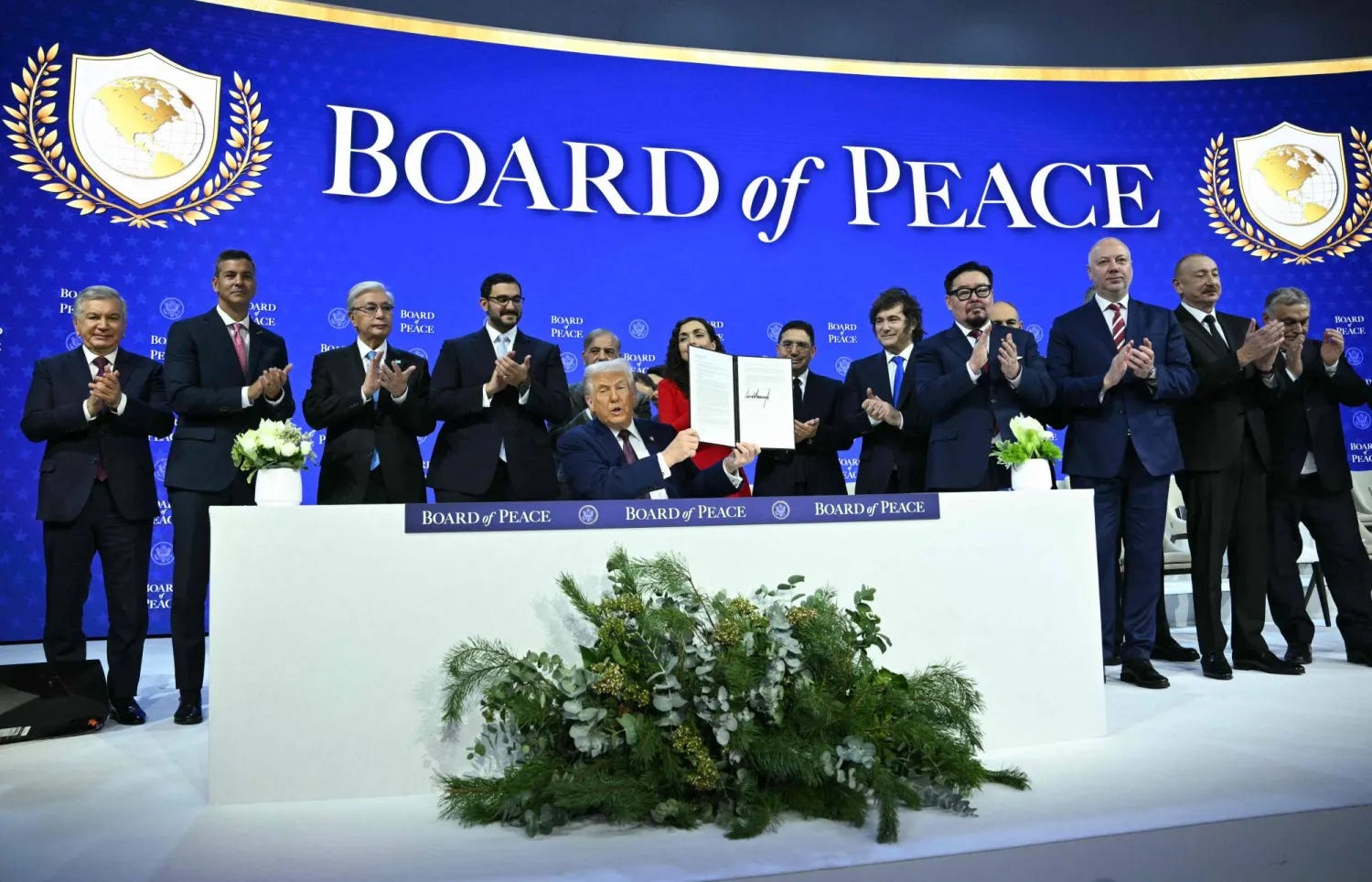
At its inception, the “Global Peace Council” appeared to be an ambitious project aimed at administering Gaza and its aftermath within a new international framework one promoted as more effective than the United Nations, backed by costly membership fees and sweeping powers granted to the U.S. president.
Yet the initiative quickly lost momentum, hampered by faltering funding, institutional disarray, and a declining ability to deliver on its promises. The outbreak of war with Iran further pushed it to the margins, transforming it into a struggling entity facing serious questions about its viability and future.
This report traces the trajectory of its rise and faltering, unpacking how its financial and political crises became entangled with the war and whether it remains salvageable.
The Peace Council: 4 Stages of Rapid Decline
1. Launch and Legitimacy (January 22, 2026)
U.S. President Donald Trump launched the council in Davos in the presence of several world leaders, positioning it as the spearhead of his plan to end the Israeli assault on Gaza.
The council’s charter stipulated that any country seeking a permanent seat must pay $1 billion, while standard membership would be granted for three years.
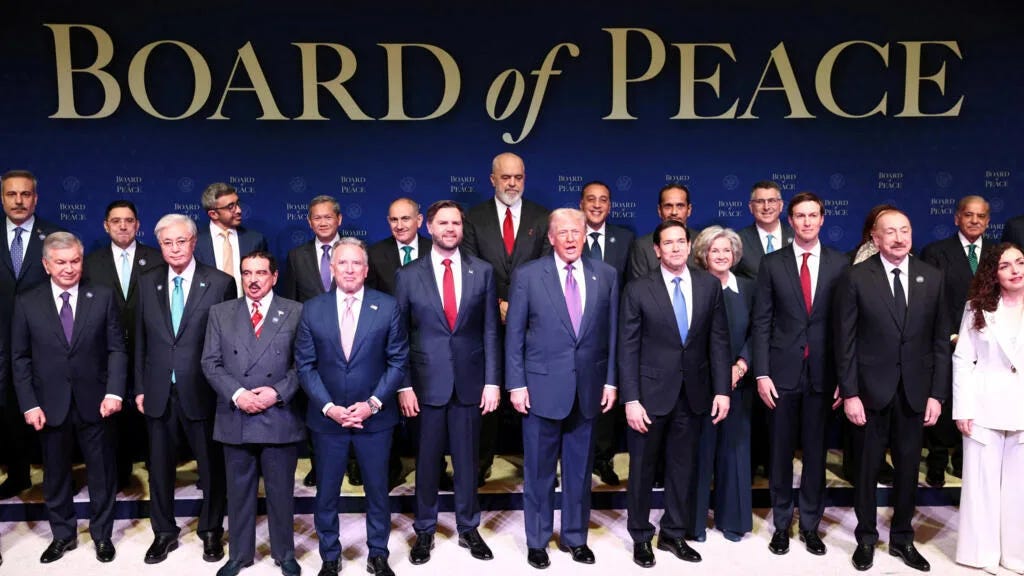
Its founding members included Arab countries such as Saudi Arabia, Qatar, Egypt, the UAE, and Morocco, alongside Turkey and Israel, as well as states from Central Asia and Latin America.
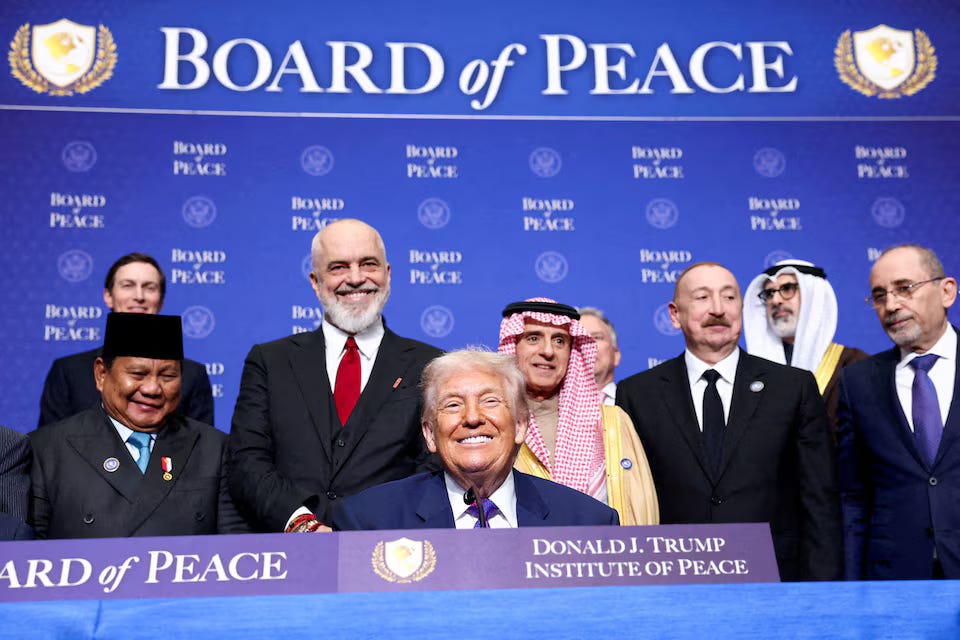
In contrast, major Western powers including the United Kingdom, France, Germany, and Canada declined to join, while China and Russia also abstained.
Critics argued that the council granted Trump unprecedented authority, with the charter empowering him to appoint permanent members, amend bylaws, and select the commander of the international stabilization force.
Although the UN Security Council adopted a resolution in November 2025 recognizing the council as a transitional administration for Gaza until 2027 and authorizing the deployment of an international stabilization force, the mandate imposed restrictions, requiring the council to submit reports every six months raising questions about its legitimacy.
Some critics went further, describing the council as a “colonial” construct, arguing that its leadership both sets policy and funds it, while Palestinians themselves are excluded from membership.
2. The Pledging Conference and the Bet on Funding (February 19, 2026)
Less than a month after its launch, the council convened its first leaders’ meeting at the U.S. Institute of Peace in Washington.
Trump announced that member states had pledged $7 billion as an “initial installment,” part of broader commitments totaling $17 billion for Gaza’s reconstruction.
The United States itself pledged $10 billion subject to congressional approval while the UAE committed $1.2 billion, and Qatar, Saudi Arabia, and Kuwait each pledged $1 billion.
Other countries offered non-financial contributions: Indonesia proposed sending 8,000 troops to the international stabilization force, while Egypt, Turkey, and Morocco pledged to train police forces and provide logistical support.
The United Nations estimated the total cost of rebuilding Gaza at $70 billion, yet the enthusiasm in the room suggested that the council was transitioning from a political announcement to a funded international mechanism.
Still, observers noted the absence of any Palestinian representatives and the lack of clarity about how funds would be managed and distributed.
The conference ultimately underscored an overreliance on Gulf and U.S. financing, making the plan’s success contingent on those countries’ ability to fulfill their pledges.
3. A Faltering Implementation Test (February–March 2026)
On January 14 prior to the pledging conference Trump announced the formation of the National Committee for Gaza Administration (NCAG), composed of 15 Palestinian technocrats led by Ali Shaath. Its mandate was to assume control of ministries, restore services, and disarm factions.
However, the committee remained stranded in a hotel in Cairo, as Israeli authorities denied its members entry into Gaza, while Hamas continued to administer institutions.
In parallel, the council presented Hamas with a five-phase disarmament plan spanning eight months, beginning with the transfer of security control to the national committee and ending with the withdrawal of Israeli forces after verification that Gaza was free of weapons.
The plan required dismantling Hamas’s tunnel network and consolidating heavy weapons between days 31 and 90, followed by the collection of small arms over 250 days. Hamas publicly rejected the proposal, insisting on guarantees for Gaza’s reconstruction and a full Israeli withdrawal.
Because the council failed to ensure Palestinian participation in drafting the disarmament mechanism or to provide political guarantees, its first real test deploying the Gaza administration committee and initiating disarmament effectively collapsed.
4. Funding, the Iran War, and Disappearance from the Scene (Since Late February 2026)
On February 28, the United States and Israel launched large-scale attacks on Iran, plunging the region into a new war that diverted most international attention and resources. According to informed sources, negotiations between Hamas and Tel Aviv over disarmament halted with the outbreak of hostilities.
Indonesian Foreign Minister Retno Marsudi stated that all Peace Council discussions had been “suspended” due to the war, noting that Jakarta would consult Gulf partners before proceeding with its troop deployment. Indonesian religious scholars also called on the government to withdraw from the council.
These developments coincided with the council’s growing inactivity. The Associated Press reported that it had not convened again after its initial conference, and that diplomatic efforts had shifted to other fronts.
The war also affected Gulf states’ willingness to disburse funds, as their oil facilities came under Iranian attack and their leadership questioned the feasibility of financing such a project amid direct confrontation.
On April 10, Reuters revealed that the council had received less than $1 billion of the $17 billion pledged coming from just three countries: the United States, the UAE, and Morocco. Qatar, Saudi Arabia, and Kuwait had yet to contribute, while other countries limited themselves to verbal commitments.
A council official acknowledged that the Iran war had affected everything, making it more difficult to secure funding and leaving the Palestinian committee unable to operate, according to Reuters.
A Palestinian member of the technocratic committee further disclosed that the council’s envoy, Nikolay Mladenov, had informed them that “no funds are currently available,” contradicting earlier statements that resources would be allocated “as needed.”
What Lies Ahead for the Council?
Amid its current paralysis, four possible scenarios emerge for the council’s future:
1. Freeze or Slow Death:
The council appears headed toward de facto suspension. No meetings have been held since February, no funds are being disbursed, and the UN mandate expires in 2027. Without funding or progress on disarmament, it may become a nominal body.
2. Restructuring or Integration:
Experts from the Carnegie Endowment have called for restructuring the council and establishing transparent oversight mechanisms before funds are committed. This would entail broader Palestinian participation, reduced presidential powers, and linking reconstruction to a clear political framework.
It may also need to operate under UN auspices or in partnership with the World Bank, whose president, Ajay Banga, has indicated a willingness to act as trustee while the council determines spending.
3. Downsizing and Absorption into Other Frameworks:
There is a possibility that the council’s functions could be absorbed into initiatives overseen by the United Nations or the Arab League, particularly if major powers agree on an alternative framework after the Iran war subsides. The lack of European support strengthens this probability.
4. Transformation into a Personal Project:
A reading of the council’s charter suggests it grants the U.S. president near-total control, including appointing members and dissolving the body. Without funding or broad international recognition, it could evolve into a political instrument for leverage or rivalry with the United Nations.
In other words, the council’s fate hinges on several factors: the full resolution of the Iran war, donor commitments, the Palestinian committee’s ability to enter Gaza, and the council’s success in addressing legal criticisms that cast doubt on its legitimacy.