

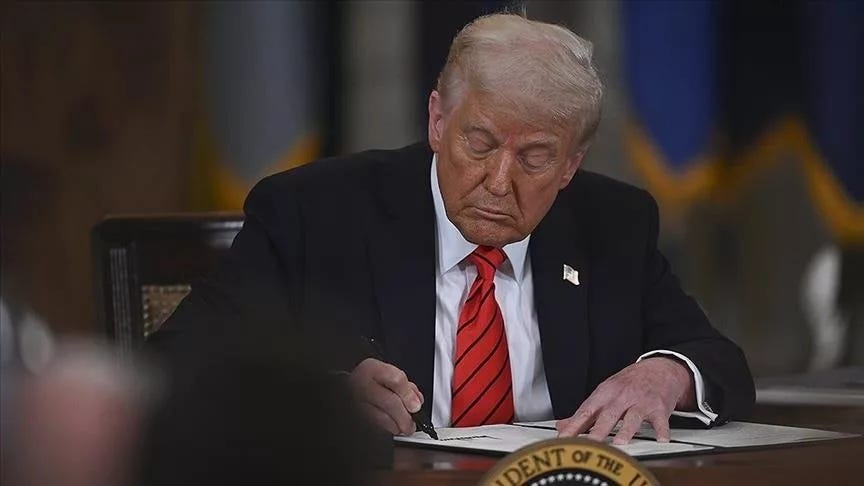
On November 25, 2025, U.S. President Donald Trump signed an executive order launching a formal process to designate certain branches of the Muslim Brotherhood in Egypt, Jordan, and Lebanon as “Foreign Terrorist Organizations” a move that paves the way for direct sanctions on the targeted entities.
This step, long avoided by successive U.S. administrations over decades, signals a fundamental shift in Washington’s approach to the Muslim Brotherhood. It also reflects a departure from the pragmatic policy that has dominated U.S. dealings with the group for more than ninety years.
Caution and Close Observation
When the Muslim Brotherhood was founded in 1928, Washington did not view it as a major player in the Middle East or Arab world. Instead, it was regarded as a religious and social movement aimed at spreading Islam through preaching, charity, and widespread youth and student engagement.
However, as British influence expanded in Egypt and the Brotherhood’s opposition to imperial rule grew, the U.S. began searching for a new foothold in the region one that could secure its interests without being tied to Britain’s colonial image. In this context, Washington’s interest gradually shifted toward monitoring the Brotherhood as a rising force opposed to British dominance.
Recognizing the group’s potential and growing role, the United States began reshaping its regional alliances to include local actors who could serve in the evolving balance of power. Among these were the Muslim Brotherhood, which Washington sought either to engage or at least understand its function in the Arab political and social landscape.
The First Official Contact
In the late 1940s, the first points of contact emerged between the Muslim Brotherhood and the U.S., when the group sent protest letters to the American embassy in Cairo denouncing Washington’s support for the Zionist project in Palestine and opposing France’s policies toward Algerians especially the granting of French citizenship, which the Brotherhood saw as undermining Algeria’s quest for independence.
These letters caught Washington’s attention, portraying the Brotherhood as a group with strong positions against Zionism and Israel’s presence.
By the early 1950s, however, U.S. calculations had shifted amid the rise of Soviet influence. Washington’s concerns over the Brotherhood’s anti-Israel rhetoric diminished, replaced by an interest in their strong anti-communist stance. This positioned the group as a potential ally in the broader U.S. strategy to curb Soviet expansion in the region.
This shift accelerated after Egypt’s 1952 revolution and the Free Officers’ alignment with the Eastern Bloc, prompting American policymakers to reclassify the Brotherhood more as a religious-social movement than as a militant organization.
Indirect Channels Through Regional Intermediaries
With the end of the Nasser era and Anwar Sadat’s rise to power in 1970, political Islam reemerged as a significant force in Egypt. Sadat saw Islamist currents foremost among them the Muslim Brotherhood as useful counterweights to leftists and Nasserists with socialist leanings.
This realignment facilitated the reintegration of Islamists into public life after years of suppression.
At the same time, U.S.-Egypt relations were warming, prompting Washington to reassess the Brotherhood’s place in Egypt’s political equation. Aware of the group’s wide-reaching influence, the U.S. began cautiously seeking indirect communication channels, careful to avoid domestic or regional backlash.
These channels were largely facilitated by regional intermediaries, chiefly Saudi Arabia, which had received many Brotherhood leaders fleeing Nasser’s repression in the 1960s. Through this Saudi connection, the U.S. began to quietly approach the Brotherhood, leveraging the network of relationships formed there to establish discreet lines of communication that served American interests without political noise.
The Afghan War Against the Soviets
The Brotherhood’s support for the Afghan jihad against the Soviet Union from 1979 to 1989 garnered interest and even admiration in Washington. Ideological and organizational figures aligned with the group played key roles in rallying Islamic support for the Afghan resistance, a priority for U.S. foreign policy at the time.
Driven by pure pragmatism, Washington saw the Brotherhood’s engagement as an opportunity to deepen indirect ties with a rising social and political force that could indirectly serve U.S. goals particularly given the group’s deep ties with Saudi Arabia, which remained a central U.S. ally.
In the 1990s, following the Soviet Union’s collapse, U.S. think tanks like the Carnegie Endowment and Brookings Institution began focusing on the Brotherhood, framing them as “non-jihadist political Islamist movements.” These studies increasingly portrayed the Brotherhood as a group that could be engaged rather than as a direct security threat.
The 9/11 Attacks
The September 11, 2001 attacks marked a turning point in America’s view of Islamist movements, including the Muslim Brotherhood. After years of indirect engagement and cautious containment, Washington adopted a more confrontational posture, treating political Islam in general as a direct threat to U.S. national security and domestic stability.
This shift prompted sweeping measures against Islamic movements: increased surveillance within the U.S., severe restrictions on their entry into the country, and sanctions targeting entities even loosely linked to extremist rhetoric.
Yet even then, some U.S. policymakers continued to distinguish between the Brotherhood and jihadist organizations, arguing that political inclusion through democratic processes might help stabilize the region and prevent radicalization.
The Arab Spring
The 2011 Arab Spring uprisings ushered in a new phase of engagement between the U.S. and the Muslim Brotherhood. As the group rose to power in Egypt and Tunisia and expanded its political activity elsewhere in the Arab world, Washington revised its stance once again.
The Obama administration officially opened channels with the Brotherhood, holding direct meetings with group leaders in Cairo and Washington. The U.S. treated the Brotherhood as a legitimate political authority with real influence in the region.
This engagement was not traditional support but rather a pragmatic effort to deal with a political reality acknowledging the Brotherhood’s organizational strength and regional presence.
The Military Coup
Following the Brotherhood’s ouster on July 3, 2013, the U.S. adopted a strictly pragmatic approach. With the group out of power, American discourse split into two opposing camps.
The first pushed to label the Brotherhood a terrorist organization, a proposal that reached Congress but failed to pass. The State Department maintained that the available evidence was insufficient for such a designation. Meanwhile, the second, more pragmatic camp warned that such a move could jeopardize U.S. interests in the region and provoke domestic backlash.
Consequently, Washington opted for a cautious middle ground: suspending all formal political contact with the Brotherhood while maintaining limited, informal research and observation channels.
Trump and the Far Right
President Trump’s administration, influenced by far-right ideologies, seized the opportunity to advance a long-debated goal: designating the Muslim Brotherhood a terrorist organization. During his first term (2017–2020), the administration pursued serious steps in that direction, though the effort was thwarted by strong resistance from U.S. national security institutions, citing insufficient legal grounds and the complexity of the Brotherhood’s global network.
Under President Joe Biden (2021–2024), the tone returned to caution. His administration prioritized study and assessment over escalation or direct engagement. U.S. think tanks resumed analyzing the Brotherhood as a sociopolitical phenomenon, without any official political contact.
However, with Trump’s return to power for a second term, the conditions were more favorable. He capitalized on shifting regional geopolitics and the Brotherhood’s declining influence to advance the long-awaited designation.
Why Now?
Trump’s administration accused Brotherhood branches in Egypt, Jordan, and Lebanon of supporting or inciting attacks against “Israel” and U.S. regional partners, and of financially aiding Hamas, according to reports by Reuters.
Designating the group as a Foreign Terrorist Organization allows the U.S. to impose a series of punitive measures, including freezing assets in American jurisdictions, banning members from entry, and imposing additional financial and security restrictions.
Observers also noted the political calculus behind the move: a bid to shore up support from Trump’s key allies in the Middle East—especially certain Gulf states that he has often described as “reservoirs of wealth” to be tapped for political and economic gain.