

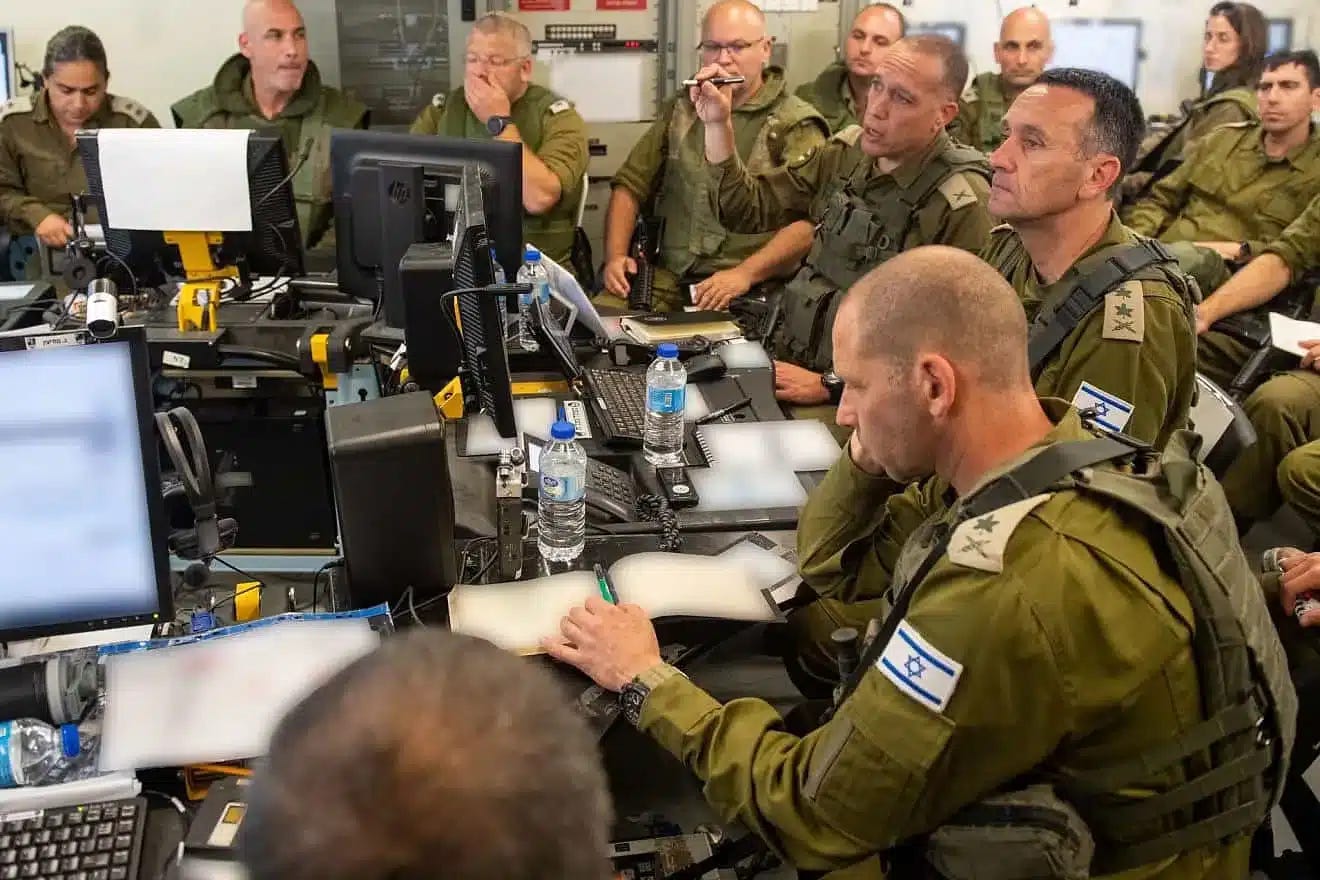
In mid-March 2026, Google finalized a massive $32 billion deal to acquire the Israeli cloud security company Wiz, whose founders were connected to Israel’s military intelligence Unit 8200.
The deal marked the latest link in a continuing chain through which Israeli intelligence expertise flows into the global digital economy. Skills, networks, and capital move from the barracks of Unit 8200 to startups building the infrastructure of the internet, before ultimately reaching Silicon Valley through acquisitions or partnerships with American firms.
The question, therefore, is not simply whether Unit 8200 produces talented programmers. It is whether Israel has built, through the unit, a kind of cloud pipeline one that transfers expertise in surveillance, hacking, and data collection from the military sphere into companies, venture capital, and the U.S. technology market.
What Is Unit 8200?
Unit 8200 is the largest cyber intelligence division in the Israeli military and is often described as Israel’s equivalent of the U.S. National Security Agency.
It emerged from early cryptography units established in 1948 and uses wiretapping, data mining, and cyber intrusions to gather intelligence. Reports have linked it to operations such as the Stuxnet virus that disrupted Iran’s nuclear program.
The unit does not rely on chance when selecting its recruits. Instead, it runs a highly structured talent pipeline beginning in high schools through programs such as Magshimim, which teaches teenagers programming and hacking in order to identify technical elites at an early age.
The unit recruits 18-year-olds from elite academic tracks and is given priority in selecting the most promising candidates. Alumni often describe the work culture as resembling a startup: small teams operating with considerable freedom to solve unprecedented problems.
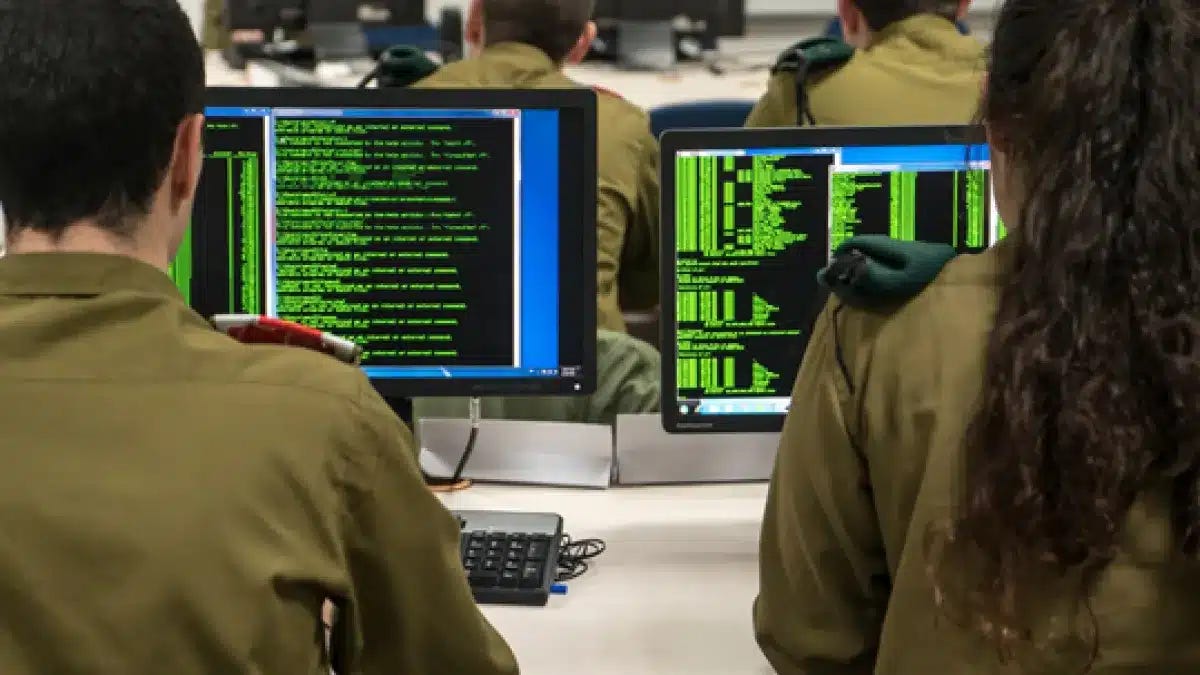
This environment produces a mindset of “do everything yourself” and “we can achieve the impossible,” according to alumnus Avi Shua, founder of Orca Security, an Israeli-American cloud security company with global reach.
Inside the unit, young recruits are immersed in a high-pressure environment that mirrors startup culture, where they are required to develop rapid software solutions for intelligence missions.
This environment also benefits from the absence of legal and ethical constraints when technologies are applied to millions of Palestinians living under occupation—who effectively become a vast, open testing ground.
Early exposure to large-scale data processing tools gives recruits exceptional technical experience, transforming compulsory military service into an intensive training camp that produces generations of engineers steeped in the mindset of penetrating and controlling systems before shedding their military uniforms and moving into civilian markets.
How Does It Open Doors to Funding and Influence?
After completing their military service, Unit 8200 alumni do not simply disappear into civilian life. Instead, they enter an organized network that invests in their skills and relationships.
The 8200 Alumni Association, for example, runs programs such as 8200 EISP, which gives participants access to a network of roughly 14,000 alumni worldwide including entrepreneurs and facilitates connections with international clients and investors.
Israeli business outlets such as Calcalist report that the EISP and Impact acceleration programs have supported more than 300 companies, more than half of which remain active. Together they have produced nine exits valued at over $4.5 billion.
During international delegations, 70 percent of participating companies secure their first contracts within six months figures that illustrate how Unit 8200 functions not merely as a military training ground but as a communications and funding ecosystem that accompanies alumni throughout their careers.
This transition from military unit to marketplace is often facilitated by venture capital intermediaries and startup accelerators run by veteran alumni.
The ecosystem does not operate in a vacuum. It is supported by vast financial resources from venture funds established by former unit leaders, creating a relatively closed and highly exclusive financing environment.
Among the most prominent is the venture capital firm Cyberstarts, founded by investor Gili Raanan, which frequently becomes the first partner for alumni startups and has generated remarkable financial returns.
Alongside it stands the venture studio Team8, founded by former Unit 8200 commander Nadav Zafrir. Rather than merely funding companies, Team8 operates using a “factory” model.
Under this approach, major cybersecurity gaps and technological challenges are identified in advance through close collaboration with executives at global corporations. Elite teams of Unit 8200 alumni are then assembled to build companies designed specifically to address those vulnerabilities.
Raanan—an investor at Cyberstarts and a partner at Sequoia Capital—says that even when he does not intentionally seek founders with military backgrounds, between 90 and 95 percent of the teams he encounters consist of Unit 8200 alumni.
He attributes this reality to the unit’s meritocratic culture and the independence it grants young recruits qualities he believes prepare them to run companies. Some alumni also establish mentorship programs, launch venture funds, and create hiring pipelines that favor fellow graduates.
In this way, military service becomes a closed trust network that facilitates funding and employment opportunities, giving alumni a significant advantage over other entrepreneurs in the technology sector.
How Does It Reach Silicon Valley?
The path typically runs through startup formation, followed by American venture investment and major acquisitions. Several prominent examples illustrate this trajectory:
Wiz: An Israeli-American cloud security company with major operations in New York and Tel Aviv. Its founding team previously built Adallom and sold it to Microsoft for $320 million before launching Wiz, which Google agreed to acquire on March 11, 2026 for $32 billion.
CyberArk: An Israeli-founded identity security company with a strong operational presence in the United States. It became part of Palo Alto Networks following a completed acquisition on February 11, 2026.
Check Point: A global Israeli cybersecurity company headquartered in Tel Aviv with a U.S. base in Redwood City the heart of Silicon Valley. A pioneer in firewalls and network security, it protects more than 100,000 organizations worldwide. Its ecosystem later produced founders behind companies such as Palo Alto Networks, Imperva, and the Israeli firm Cato Networks.
Axonius: An Israeli-American cybersecurity and asset management company headquartered in New York with a presence in Tel Aviv. Its platform helps organizations identify devices, identities, and applications connected to their networks. It is already used by more than 70 U.S. federal agencies and has been selected to modernize the Pentagon’s continuous monitoring program.
Cyera: An Israeli-American cloud data security company with major offices in New York and Tel Aviv. Its valuation surged to $9 billion in January 2026 after a new funding round.
How Do These Companies Enter Our Lives?
Companies founded by Unit 8200 alumni operate at largely invisible layers of our digital lives.
Wiz products protect the data of major corporations such as Morgan Stanley, BMW, and LVMH through cloud services provided by Amazon, Microsoft, and Google. After Google’s acquisition, Wiz technology will become part of the Google Cloud infrastructure meaning millions of users may rely on it without realizing it.
Security solutions from Check Point, Palo Alto, Imperva, and Cato filter internet traffic and protect applications in banks, hospitals, and retail systems effectively controlling the flow of information between devices and servers.
Axonius helps organizations identify devices connected to their networks and enforce access policies that can affect every employee or user interacting with those systems.
Meanwhile, the company Onyx focuses on securing AI agents capable of carrying out financial or administrative actions on behalf of users touching on the future of human interaction with artificial intelligence systems.

According to critics, such capabilities are not used solely against external adversaries, as Israeli official discourse suggests, but also in monitoring Palestinians under occupation a reality highlighted by the public protest of 43 Israeli reserve soldiers in 2014.
In an open letter at the time, they refused to participate in intelligence activities targeting Palestinians, arguing that the surveillance system “enables comprehensive monitoring and interferes in most aspects of life.” Their protest revealed aspects of the deep monitoring practices carried out by the unit in the occupied territories.
In 2025, investigative reports also revealed that the unit had stored millions of Palestinian phone calls on servers hosted by Microsoft Azure. Incidents like these illustrate how surveillance tools can migrate into American technology companies and ultimately become embedded in global infrastructure.
Taken together, Unit 8200 is not merely an isolated “talent factory” for engineers. Rather, it functions as the beating heart of a broader system that transforms militarization and surveillance into dominant digital products and massive technology investments.