

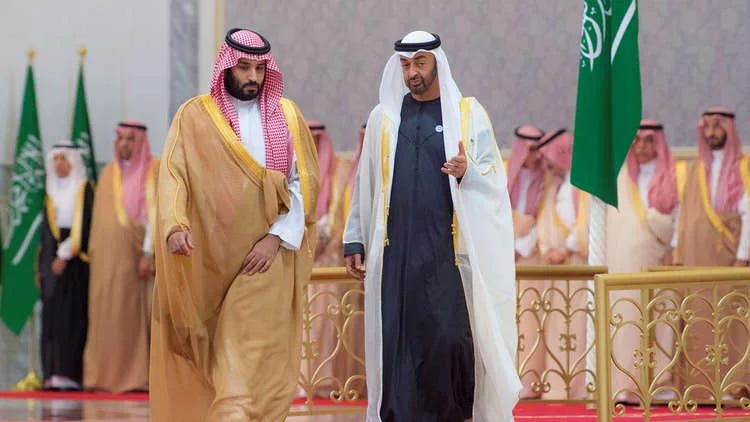
The business and financial sectors across the Gulf are closely watching the escalating tensions between Saudi Arabia and the United Arab Emirates, amid growing concerns that recent political rifts particularly over Yemen and diverging interests in countries like Sudan and Somalia, may spill over into trade and investment.
These anxieties have intensified following an unusually public display of disagreements between the two nations at the end of 2025, raising questions about the future of their deep economic partnership. The strain comes at a time when both Riyadh and Abu Dhabi are vying to assert themselves as regional hubs for commerce and finance.
A Deep Economic Partnership
Saudi Arabia and the UAE share close economic ties and a tightly woven trade relationship that has made Abu Dhabi Riyadh’s largest Arab trade partner and its sixth-largest globally.
Bilateral trade has witnessed steady growth in recent years, rising from approximately $21 billion in 2020 to nearly $30 billion by the end of 2023, according to Saudi data—a surge of about 42% over three years.
This momentum reflects a high level of economic integration between two of the region’s fastest-growing and most diversified economies. Their partnership can be broken down into several key areas:
1. Merchandise Trade
The exchange of goods spans a wide range of products, with refined petroleum and precious metals topping the list.
The UAE exports around $3.5 billion worth of refined oil to Saudi Arabia annually, along with over $2.5 billion in gold, in addition to jewelry, electronics, and a variety of re-exported goods.
Conversely, the UAE imports Saudi products including petrochemicals, foodstuffs, construction materials, and more.
A significant portion of these goods enters Saudi Arabia through UAE ports; for instance, much of the Kingdom’s imports pass through Jebel Ali Port in Dubai, a major regional re-export hub.
2. Investment and Joint Ventures
By the end of 2023, Emirati investments in Saudi Arabia had reached nearly SAR 111 billion (around $30 billion), spanning sectors from energy to technology.
Saudi investments in the UAE totaled around $6.5 billion (cumulatively through 2022), making the Kingdom the fourth-largest foreign investor in the Emirates.
Thousands of companies operate across both markets, with over 4,000 Saudi trademarks and dozens of Saudi commercial agencies registered in the UAE. Joint ventures in logistics, retail, and hospitality also serve both markets simultaneously.
These interconnections are further bolstered by strong banking and financial ties between Dubai and Riyadh, as well as cross-border capital flows driven by sovereign wealth funds that are increasingly global in reach.
3. Infrastructure and Market Integration
Both Saudi Arabia and the UAE aim to entrench their status as logistics and financial hubs, and their roles are often complementary rather than directly competitive.
Saudi Arabia benefits from the UAE’s advanced infrastructure in ports and aviation to facilitate the flow of goods and tourists into the Kingdom, while the UAE leverages the size and depth of the Saudi market.
Travel and tourism are standout examples of this synergy. Prior to the recent tensions, around 629 weekly flights connected the two countries, transporting both cargo and passengers. In 2023, more than 1.7 million Saudi tourists visited the UAE, boosting mutual tourism spending.
Additionally, consumer markets are deeply intertwined. Emirati retail chains such as the well-known LuLu group operate in both countries, offering staple Saudi products like Almarai milk, Jumara dates, and Al-Youm chicken as part of their daily offerings.
Such economic entanglement means any disruption in bilateral relations could have significant repercussions for businesses and consumers alike.
Economic Shock in Case of a Break
The business community has increasingly warned of the potentially severe economic shock should trade relations between Saudi Arabia and the UAE be severed.
Bloomberg reported, citing informed sources, that some regional and international firms operating in both countries have begun drafting contingency plans to ensure business continuity in the event of a worsening dispute that results in cross-border trade restrictions.
While no official measures have been enacted, these preemptive moves signal heightened caution among businesses bracing for the worst. Should the situation deteriorate into a full economic rupture, the fallout could include:
1. Supply Chain Disruptions
Any closure of land borders or airspace would immediately disrupt the flow of goods and services. Many observers recall the 2017 Qatar blockade, when diplomatic ties were abruptly cut, causing major regional supply chain disruptions.
While Qatar’s economy is smaller and less entangled than those of Saudi Arabia and the UAE, the blockade’s impact on trade and transportation remains vivid in the minds of investors.
A Saudi blockade of the UAE—or vice versa—could entail closure of the Al-Batha land crossing and force rerouting of shipments via longer maritime and air routes. This would delay delivery of key goods and trigger logistical bottlenecks, potentially raising shipping costs and causing short-term shortages.
Concerns are mounting due to Saudi reliance on UAE ports like Jebel Ali for a significant portion of its imports any disruption could severely affect distribution channels.
2. Decline in Investor Confidence
Perhaps the steepest cost of a break would be the loss of investor confidence both regional and international in the Gulf’s business environment. Roughly $22 billion in annual trade could be directly jeopardized by any suspension of commercial ties.
In addition to lost revenue, investment plans may be delayed or scrapped altogether. Multinational firms that maintain regional headquarters in both Dubai and Riyadh would likely reassess their strategies, while some investors might pause or abandon planned deals.
Financial institutions and sovereign wealth funds, with their deeply interwoven cross-border holdings, would also be vulnerable. Any escalation such as tariffs or restrictions on capital transfers could undermine both nations’ reputations as stable financial centers, casting doubt among multinational firms operating in the region.
3. Corporate Contingency Measures
Some entities have already started taking precautionary steps. Bloomberg reported that Emirati firms have recently faced difficulties in securing work visas for employees in Saudi Arabia, possibly indicating unofficial tightening by the Saudi side.
UAE suppliers are also considering stockpiling reserves to meet Saudi market demand in case supply routes are disrupted.
Meanwhile, several investment funds and companies have begun exploring plans to relocate or open offices in Riyadh to safeguard access to the Saudi market in the event of future restrictions on cross-border activity.
These moves reflect the sensitivity of the situation. Since 2021, Saudi Arabia has been pressuring international firms to relocate their regional headquarters to the Kingdom in order to qualify for major government contracts.
Amid current tensions, Riyadh may see an opportunity to accelerate the migration of remaining corporate HQs from Dubai to its own territory, as part of the broader economic rivalry between the two states.
4. Impact on Oil Markets
Though the rift has yet to manifest publicly within OPEC+ negotiations, a prolonged strain in relations could eventually affect oil policy coordination. Saudi Arabia and the UAE are pillars of the OPEC+ alliance, and any internal rift could derail consensus on production targets.
In 2021, for instance, the UAE pushed for a unilateral production quota increase, prompting a temporary dispute that was ultimately resolved within the organization.
But in the context of heightened political tensions, maintaining unity within OPEC could prove more difficult jeopardizing oil market stability either through uncoordinated output increases or delays in raising production.
Any cracks in the OPEC+ alliance could cause price volatility and hurt both countries’ fiscal plans at a time when they heavily rely on oil revenues to finance ambitious economic transformation programs.
Is a Complete Break Likely?
Despite the recent escalation in rhetoric, analysts speaking to Reuters believe a full economic rupture between Saudi Arabia and the UAE remains unlikely, largely due to the high cost and mutual losses such a move would incur.
Unlike the 2017 Qatar blockade, which targeted a smaller economy, far more strategic interests are now at stake between Riyadh and Abu Dhabi. Most observers believe the Gulf boycott playbook will not be repeated simply because the potential political gains do not outweigh the guaranteed economic damage.
Gulf states generally have little appetite for new crises that could destabilize the region economically. Both Saudi and Emirati leaders increasingly view foreign policy as a tool to support economic growth and attract investment not hinder it.
This pragmatic approach has kept backchannel communication open, even amid public spats.
Both sides understand that a full break would be hugely costly and would undermine their signature development agendas Saudi Vision 2030 and the UAE’s Centennial 2071 plan.
Analysts warn that a trade rupture would negatively impact both countries’ long-term development goals by shaking investor confidence and alienating international partners.
Alice Gower, a Gulf affairs expert, stated that while strategic competition between Riyadh and Abu Dhabi is natural, a mutual economic boycott would undercut diversification efforts and weaken both countries’ momentum in attracting foreign capital.
A Saudi political analyst echoed that while a complete “economic divorce” remains highly unlikely, retaliatory moves short of full disengagement should Riyadh feel its interests are directly threatened cannot be ruled out.
These comments reflect a Saudi effort to send a firm message without crossing a point of no return. Meanwhile, the UAE appears to favor a quieter approach in hopes of reaching a diplomatic resolution that preserves economic ties.
In recent days, signs of cautious de-escalation have emerged. On January 25, 2026, Saudi Foreign Minister Prince Faisal bin Farhan stated that the UAE’s withdrawal from Yemen “if that is indeed the case” could serve as a starting point to mend ties. This suggests a conditional but positive overture from Riyadh tied to Abu Dhabi’s regional posture.
Reports also indicate that behind-the-scenes diplomatic efforts have intensified to contain the fallout before it spirals out of control. Ultimately, both nations understand that their economic alliance has long been a pillar of Gulf stability and prosperity and that preserving it, even through compromise, is likely the most prudent path forward.